
Paul Gerhardt
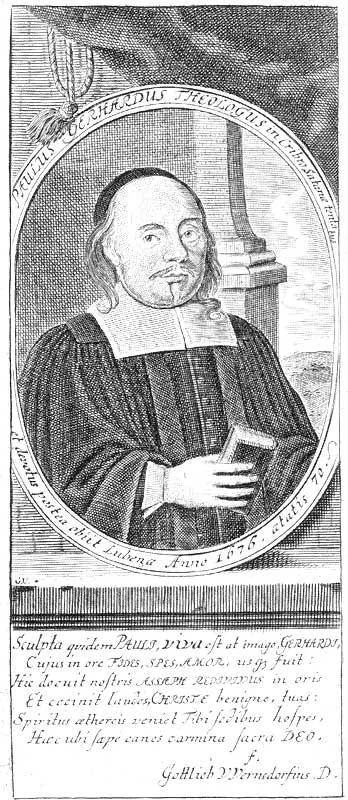
Image from Wikipedia
Image from Wikipedia
Paul Gerhardt – The Great Poet of Protestant Church Music
A Life Between War, Faith, and Poetic Grandeur
Paul Gerhardt is one of the defining voices in the history of German-speaking religion and music. Born in 1607 in Gräfenhainichen, this theologian, Lutheran pastor, and hymn writer became one of the most influential figures of spiritual songs; his texts combine existential need, comforting certainty of faith, and linguistic clarity into a form of musical piety that continues to resonate today. His songs are rooted in the Reformation tradition while marking the transition from dogmatic instructional poetry to a more personal and internally condensed spirituality. ([en.wikipedia.org](https://en.wikipedia.org/wiki/Paul_Gerhardt))
Gerhardt's life was closely intertwined with the upheavals of the Thirty Years' War. The destruction of his homeland, economic hardship, emotional turmoil, and job insecurity provided the backdrop for a music career that was not defined by modern stages but had immense cultural reach. It is precisely this historical hardship that shapes the emotional authority of his poetry: comfort, trust, and hope in Gerhardt's works never feel abstract but instead serve as responses to lived experiences. ([paul-gerhardt-verein.de](https://paul-gerhardt-verein.de/the-life-of-paul-gerhardt/))
Early Years, Studies, and Intellectual Influence
Gerhardt enrolled at the University of Wittenberg in 1628, a center of Lutheran theology and humanistic education. Here, he was influenced not only by the theological debates of his time but also by the linguistic sensitivity of his teachers, who encouraged his poetic endeavors. After his studies, he initially remained in Wittenberg and earned a living as a private tutor, a phase during which his writing gradually took shape and the connection between education, piety, and poetic form became evident. ([paul-gerhardt-verein.de](https://paul-gerhardt-verein.de/the-life-of-paul-gerhardt/))
Even early on, it was clear that Gerhardt was not merely writing religious texts but developing a distinctive lyrical style. His language employs clear imagery, musical internal logic, and a pronounced singability that continues to render his songs attractive for church music, choirs, and hymn adaptations. From a musicological perspective, this balance between theology and sensitivity to sound explains why his texts have remained so relevant over time. ([encyclopedia.com](https://www.encyclopedia.com/people/philosophy-and-religion/protestant-christianity-biographies/paul-gerhardt))
Berlin: Collaboration with Johann Crüger and the Breakthrough as a Songwriter
The decisive artistic breakthrough came in Berlin. There, Gerhardt worked as a private tutor and wrote numerous song lyrics that Johann Crüger, the cantor at Nikolaikirche, set to music or published in spiritual collections. In particular, the Praxis pietatis melica became the central publication venue for this collaboration, making Gerhardt's texts accessible to a wide Protestant audience. By 1647, this collection included 18 of Gerhardt's songs; later, this number would grow further. ([paul-gerhardt-verein.de](https://paul-gerhardt-verein.de/the-life-of-paul-gerhardt/))
The connection between Gerhardt's texts and Crüger's melodies became stylistically defining. What emerged was not just a literary supplement to church music but a cohesive work composed of poetry, melody, and congregational use. This close interlinkage explains why Gerhardt was not only read but sung in church practice. His texts were written for liturgical contexts and gained their full power there. ([paul-gerhardt-verein.de](https://paul-gerhardt-verein.de/the-life-of-paul-gerhardt/))
Conflicts, Loss of Office, and Depth of Experience
Gerhardt's biography also reflects the harshness of confessional conflicts in the 17th century. In Berlin, he became embroiled in disputes over religious tolerance and theological conscience issues, refusing to sign a corresponding decree and consequently losing his position. This episode shapes his profile as an unyielding spirit: Gerhardt appears not as a pleasing court poet but as a theologian who stands up for his beliefs and bears the professional consequences. ([paul-gerhardt-verein.de](https://paul-gerhardt-verein.de/the-life-of-paul-gerhardt/))
Privately, this period was also marked by loss. Three of his children died, and later he also lost his wife Anna Maria. Such upheavals lend an extraordinary credibility to the poetic tone of his songs. When Gerhardt speaks of comfort, protection, or divine confidence, it is not a cheap optimism but a language that has grown through suffering. ([paul-gerhardt-verein.de](https://paul-gerhardt-verein.de/the-life-of-paul-gerhardt/))
Lübben and the Later Phase: Withdrawal and Lasting Impact
In 1668, a new call brought him to Lübben, where he eventually served as archdeacon at the main church. He stayed there until his death in 1676. Although this later phase of life appears outwardly quieter, it remains important for its reception: Gerhardt was now firmly rooted in church practice, and his texts had long circulated in hymnals, church services, and private devotions. His impact thus completely detached from his person and became a cultural common good of Protestantism. ([paul-gerhardt-verein.de](https://paul-gerhardt-verein.de/the-life-of-paul-gerhardt/))
Particularly noteworthy is the long-term impact of his poetry on music history. Several of his hymns have been included in modern hymnals, and Johann Sebastian Bach incorporated Gerhardt's verses into cantatas, motets, the passions, and the Christmas Oratorio. Thus, Gerhardt's influence extends far beyond the 17th century and directly connects the Lutheran song tradition with the canon of European art music. ([en.wikipedia.org](https://en.wikipedia.org/wiki/Paul_Gerhardt))
Discography of Church Music: Key Texts and Their Distribution
In the case of Paul Gerhardt, one does not speak of a discography in the pop music sense, but rather of a tradition of songs and texts that found expression in church collections. Key milestones include early publications in Praxis pietatis melica, later compilations in Brandenburg, and the first complete collection Geistliche Andachten from 1666/67. Research indicates that no hymns are known to have been created later than 1667, marking both the end of his productive phase and providing a clear historical outline. ([en.wikipedia.org](https://en.wikipedia.org/wiki/Praxis_pietatis_melica))
Some of his best-known songs include texts like O Haupt voll Blut und Wunden, O wie soll ich dich empfangen, Nun ruhen alle Wälder, and Befiehl du deine Wege. These works exert their influence through melody, rhythmic language, and theological density. The fact that they have been sung in church practice for centuries illustrates their extraordinary robustness as a musical form and as an expression of a collective culture of faith. ([en.wikipedia.org](https://en.wikipedia.org/wiki/Praxis_pietatis_melica))
Style, Language, and Musical Development
Gerhardt's style combines poetic intimacy with liturgical function. His texts are easy to sing, rich in imagery, and theologically precise. In the development of Protestant church music, they mark a transition from the more objective teaching hymn tradition to a more personal, emotionally charged piety that places the individual at its center. ([encyclopedia.com](https://www.encyclopedia.com/people/philosophy-and-religion/protestant-christianity-biographies/paul-gerhardt))
Musically, his songs acted as a resonance chamber for composers and congregations. Crüger's melodies provided a structured form for the texts, while later composers, notably Bach, transformed the hymns into more complex compositions. This produced an extraordinary historical chain of text, melody, harmonization, and performance practice that establishes Gerhardt as a key figure in church music. ([en.wikipedia.org](https://en.wikipedia.org/wiki/Praxis_pietatis_melica))
Cultural Influence and Critical Reception
The cultural-historical significance of Paul Gerhardt is hard to overstate. Academic sources describe him as one of the most important, if not the most significant German-speaking hymn writers; his hymns are regarded as outstanding works within the Lutheran tradition. At the same time, it is often emphasized that his poetry bridges dogmatic orthodoxy and personal inner experience. ([encyclopedia.com](https://www.encyclopedia.com/people/philosophy-and-religion/protestant-christianity-biographies/paul-gerhardt))
The culture of remembrance keeps Gerhardt alive. In Wittenberg, a plaque marks his lodging near the university, and in Protestant congregations, hymnals, and memorial events, his name remains present. For music history, he is thus not only an author of historical church hymns but also an active reference point for spiritual song culture, liturgical practice, and the question of how language can provide comfort through song. ([en.wikipedia.org](https://en.wikipedia.org/wiki/Paul_Gerhardt))
Current Projects and Contemporary Relevance
As a historical figure, Paul Gerhardt has no current studio albums, tours, or social media projects. His relevance today is rather manifested in performances, hymnals, scholarly editions, and church memorial formats. This form of ongoing presence makes him exceptional: his artistic development does not end in a catalog of completed works but continues in liturgical practice and musical memory. ([en.wikipedia.org](https://en.wikipedia.org/wiki/Paul_Gerhardt))
Conclusion: A Poet Who Still Sings Today
Paul Gerhardt fascinates through the rare unity of theological depth, linguistic elegance, and lasting musical impact. His songs arose from crisis experiences, yet they never linger in pain; they transform suffering into hope, personal challenges into collective song, and historical necessity into cultural greatness. Anyone wishing to understand the history of German-speaking church music cannot overlook Gerhardt. Those who sing or hear his texts encounter a voice that has not lost any of its intensity over the centuries. ([encyclopedia.com](https://www.encyclopedia.com/people/philosophy-and-religion/protestant-christianity-biographies/paul-gerhardt))
Gerhardt is compelling because his works are not only devout poetry but also resonant cultural history. This is where his lasting strength lies: the texts carry, comfort, and connect generations. His work deserves to be rediscovered in concert, in church services, and in any serious engagement with European music and intellectual history. ([en.wikipedia.org](https://en.wikipedia.org/wiki/Praxis_pietatis_melica))
Official Channels of Paul Gerhardt:
- Instagram: No official profile found
- Facebook: No official profile found
- YouTube: No official profile found
- Spotify: No official profile found
- TikTok: No official profile found
Sources:
Upcoming Events
Erlangen University Music: Paul Gerhardt Concert
Paul Gerhardt Concert
Paul Gerhardt: The Songwriter of God
Paul Gerhardt: The Songmaker of God