
Klaus Wittmann (General)
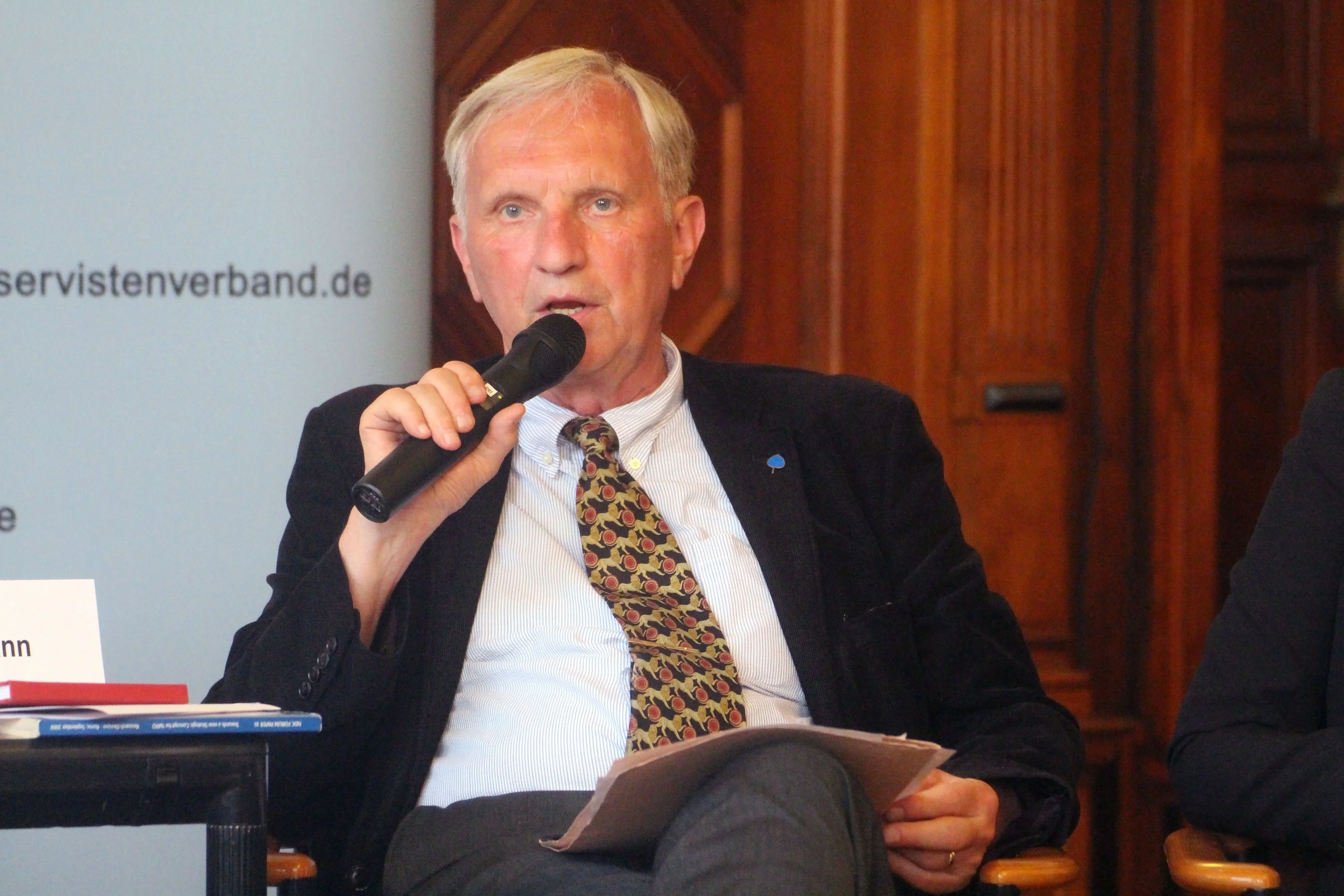
Image from Wikipedia
Image from Wikipedia
Klaus Wittmann: Historian, Publicist, and Security Policy Voice with Analytical Precision
A Life Between History, Bundeswehr, and Public Debate
Klaus Wittmann, born on October 26, 1946, in Lübeck, is one of the most prominent German historians and security policy publicists of his generation. The retired brigadier general of the Bundeswehr combines military experience, academic training, and publicist presence into an unusually rich body of work. His biography represents institutional responsibility, historical analysis, and a clear voice on questions of European and transatlantic security. ([de.wikipedia.org](https://de.wikipedia.org/wiki/Klaus_Wittmann_%28General%29))
Early Influences and Entry into the Bundeswehr
After graduating from high school in 1966 in Ulm, Wittmann entered the Bundeswehr as an officer candidate and became a career officer in 1968. This marked the beginning of a career where military practice and academic reflection merged early on. This dual perspective continues to shape the tone of his publications: sober, strategic, and historically informed. ([de.wikipedia.org](https://de.wikipedia.org/wiki/Klaus_Wittmann_%28General%29))
His career illustrates how closely operational experience and intellectual work are connected in his case. Military training was not the endpoint but the starting point for a later career as a historian, lecturer, and commentator on security policy developments. It is precisely this connection that makes him equally interesting to specialized audiences and the political public. ([de.wikipedia.org](https://de.wikipedia.org/wiki/Klaus_Wittmann_%28General%29))
Academic Training and Scientific Profiling
From 1971 to 1976, Wittmann studied history, political science, and sociology at the University of Hamburg. In 1976, he earned his doctorate there with a dissertation on "Sweden’s Economic Relations with the Third Reich, 1933–1945," inspired by Rainer Wohlfeil and Hans-Erich Volkmann. A research stay at the International Institute for Strategic Studies in London enriched this academic phase with international perspectives. ([de.wikipedia.org](https://de.wikipedia.org/wiki/Klaus_Wittmann_%28General%29))
Even in this early phase, his methodological approach is evident: Wittmann does not think of history as a mere chronicle but as an analysis of interests, structures, and political decisions. This makes his works relevant for both historical research and security policy debates. His academic foundation lends authority to his later comments, based on practical study and institutional experience. ([de.wikipedia.org](https://de.wikipedia.org/wiki/Klaus_Wittmann_%28General%29))
Career in the Bundeswehr, NATO, and Political-Military Structures
Between 1978 and 1980, Wittmann completed general staff training at the Bundeswehr Command Academy in Hamburg. Afterward, he took on leadership responsibilities, including as battalion commander of the 112th Rocket Artillery Battalion in Delmenhorst and later as brigade commander of the 14th Armored Brigade "Hessischer Löwe" in Neustadt (Hesse). His career thus leads directly from academic thinking to concrete command structures. ([de.wikipedia.org](https://de.wikipedia.org/wiki/Klaus_Wittmann_%28General%29))
Additionally, he held positions at the Federal Ministry of Defense and at NATO Headquarters in Brussels, where he worked as a planning staff officer and head of department in the International Military Staff. From 1996 to 2000, he served as the head of military policy at the German NATO ambassador in Brussels, followed by a role as Director of Education at the Bundeswehr Command Academy and ultimately as Director of Academic Planning and Policy at the NATO Defense College in Rome. These stations mark a career at the controls of Europe’s security architecture. ([de.wikipedia.org](https://de.wikipedia.org/wiki/Klaus_Wittmann_%28General%29))
In October 2008, Wittmann retired after 42 years of service. The experience from this long service period continues to shape his later publicist work, as it provides him with a rare perspective on military organization, political governance, and international alliance politics. His path is therefore less a straightforward officer biography and more a portrait of a strategist between theory and practice. ([de.wikipedia.org](https://de.wikipedia.org/wiki/Klaus_Wittmann_%28General%29))
Publicist Work and Thematic Focus
After active service, Wittmann remained publicly active. He published in the Journal for Foreign and Security Policy, in WeltTrends, in the Yearbook of Internal Leadership, and in major daily and weekly media such as Die Welt, Frankfurter Allgemeine Zeitung, Tagesspiegel, and Berliner Zeitung. This broad publicist range shows an author who does not remain in an academic ivory tower but brings security policy issues into public debate. ([de.wikipedia.org](https://de.wikipedia.org/wiki/Klaus_Wittmann_%28General%29))
His topics range from NATO strategy to military transformation to German security and alliance policy. On the website of the European Leadership Network, he is listed as a former Bundeswehr brigadier general and senior fellow at the Aspen Institute Germany, where contributions also appear discussing new strategic tasks for NATO or relations with Russia. Wittmann thus works at the interface of historical science, political analysis, and strategic communication. ([europeanleadershipnetwork.org](https://europeanleadershipnetwork.org/person/klaus-wittmann/))
Publications, Scientific Authority, and Professional Reach
Among his well-known publications is the monograph "Sweden's Economic Relations with the Third Reich, 1933–1945" from 1978. Furthermore, he wrote contributions to anthologies on defense issues within the alliance, NATO's Strategic Concept, professional armies or conscription, and security policy in the Baltic region. These topics demonstrate a clear substantive line: Wittmann always conceptualizes security historically, institutionally, and Europeanly. ([de.wikipedia.org](https://de.wikipedia.org/wiki/Klaus_Wittmann_%28General%29))
Potsdam University lists him as a lecturer at the Historical Institute; it also indicates his membership in several professional and political networks, including the German Council on Foreign Relations, the Clausewitz Society, the IISS, and the European Leadership Network. These affiliations underscore his authority as an expert who not only publishes but is also firmly anchored in academic and security policy circles. ([uni-potsdam.de](https://www.uni-potsdam.de/de/hi-militaergeschichte/klaus-wittmann/person))
Cultural Influence and Public Role
Wittmann's cultural influence lies less in classic media prominence and more in his role as a mediator between the military, academia, and the public. His texts and lectures help to contextualize security policy issues historically and make them comprehensible in broader contexts. Especially in times of geopolitical tensions, this form of expert voice is of particular value. ([de.wikipedia.org](https://de.wikipedia.org/wiki/Klaus_Wittmann_%28General%29))
His stance on political responsibility in public space is also noteworthy. In August 2019, Wittmann published an open letter expressing his dismay over the engagement of retired General Joachim Wundrak with the AfD. This demonstrates a publicist who not only analyzes debates but also takes a normative stance. ([de.wikipedia.org](https://de.wikipedia.org/wiki/Klaus_Wittmann_%28General%29))
Current Activities and Ongoing Presence
Potsdam University continues to register Wittmann as a lecturer; the European Leadership Network and Aspen Institute context material attest to his ongoing presence in security policy discussions. Even in retirement, he remains academically and publicly active, commenting on issues of NATO, Russia policy, and the European security order. His relevance thus derives not from a completed body of work but from continuous engagement in current debates. ([europeanleadershipnetwork.org](https://europeanleadershipnetwork.org/person/klaus-wittmann/))
This consistency makes Klaus Wittmann compelling: he represents a rare combination of military leadership responsibility, historical research, and public reflection. Those who read his texts encounter not a loudspeaker, but a precise analyst with endurance and a clear intellectual line. For anyone wanting to understand security policy issues beyond buzzwords, he remains a prominent voice. ([de.wikipedia.org](https://de.wikipedia.org/wiki/Klaus_Wittmann_%28General%29))
Conclusion
Klaus Wittmann fascinates through the connection of military career, historical expertise, and journalistic clarity. His biography shows how service, research, and public thinking create an extraordinarily credible profile. Anyone interested in German contemporary history, NATO policy, and strategic debates will find in him an author of substance and principle. ([de.wikipedia.org](https://de.wikipedia.org/wiki/Klaus_Wittmann_%28General%29))
While there may not be a live experience in the musical sense, his lectures, panels, and public contributions exhibit a similar presence: analytical, pointed, and engaged. For this reason, it is worthwhile to follow Klaus Wittmann closely in debates, interviews, and academic formats. ([europeanleadershipnetwork.org](https://europeanleadershipnetwork.org/person/klaus-wittmann/))
Official Channels of Klaus Wittmann:
- Instagram: no official profile found
- Facebook: no official profile found
- YouTube: no official profile found
- Spotify: no official profile found
- TikTok: no official profile found
Sources:
- Wikipedia - Klaus Wittmann (General)
- University of Potsdam - About: Dr. Klaus Wittmann
- European Leadership Network - Klaus Wittmann
- Wikipedia: Image and text source
Upcoming Events
Reading from King Ludwig II. dines in Berg