
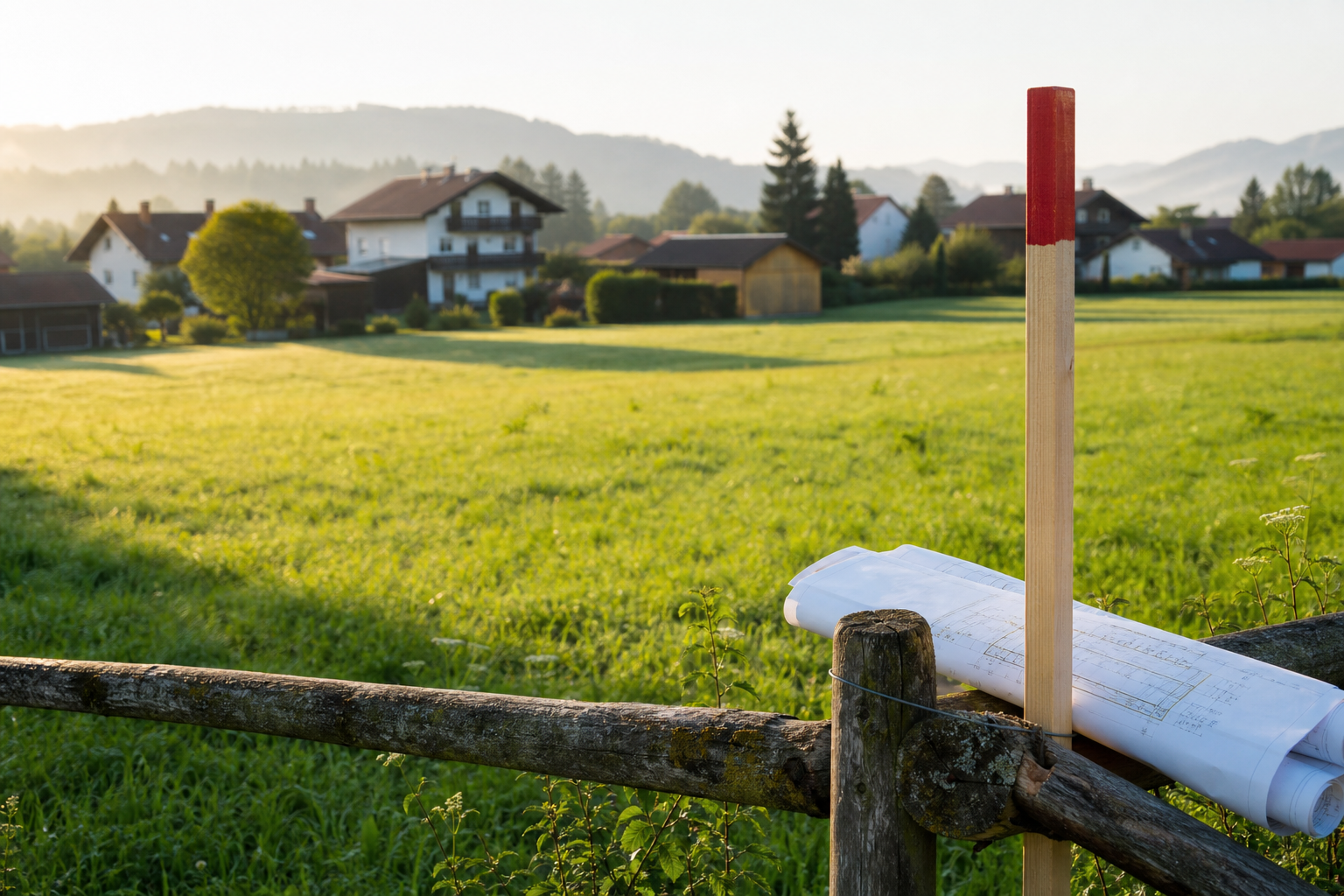
Symbolbild mithilfe von KI erstellt
Local Development and Housing Construction in Dispute
Building Boom in Widdersberg: Why the FDP Warns Against Building "on Greenfield Sites"
In Herrsching, a fundamental dispute has erupted over the so-called "building turbo" about how the municipality should grow – and where. The trigger is a project in the Widdersberg district, which the building committee has approved by majority. FDP councilor Alexander Keim criticizes the decision as a signal to the outer area and calls for clear, pre-agreed criteria for when the municipality should even use accelerated procedures.
Six Apartments – and a Political Precedent
Specifically, it is about an apartment building with six units. The building committee approved the initiation of the procedure by 6 to 3 votes. The decision is tied to conditions: An urban development contract is planned, which should bind at least 30 percent of the living space to Herrsching residents at reduced rates for 30 years. In addition, the building should not be more than 100 meters from existing development. An adjacent agricultural business must not be restricted in its development opportunities.
Outer Area or Inner Development: Keim's Countermodel
Keim not only addresses the scale of the project but also its starting point: From his perspective, it is politically risky to open an instrument like § 246e BauGB already in response to a "mere informal inquiry" from a potential investor. He sees this as the core of his criticism: If the municipality considers the "building turbo" at the first inquiry, it could become a blueprint for further projects in the outer area.
Widdersberg is described in the debate as an outer district. Keim argues that an accelerated procedure must remain the narrowly justified exception – not the start of a new practice. He also fundamentally questions the justification of "housing shortage" for Herrsching. According to Keim, the problem is less about quantity and more about affordability. Those particularly affected are those who sustain public life: young families, caregivers, craftsmen, educators.
His conclusion is a prioritization that serves as a guiding principle in many municipalities, but is being re-evaluated in Herrsching due to the Widdersberg project: inner development before outer development. Keim demands that affordable housing should primarily be created in the town – in existing buildings, through densification, in vacant lots, or by adding stories. New construction "on greenfield sites," especially away from infrastructure, he considers urbanistically wrong and ultimately expensive: Building in the outer area, in his view, creates additional travel, more car traffic, and follow-up costs for the municipality.
Majority Focuses on Housing – With Social Commitment
The majority in the building committee has clearly taken a different path: They want to enable additional housing and tie the initiation of the procedure to social policy requirements (30 percent at reduced rates, 30 years of commitment). This is more than a technical condition: Such commitments are an attempt to secure at least part of the new construction for local residents in a high-priced market – and to shift the debate from the question of "if" to "under what conditions."
At the same time, the discussion shows that there is no unified line in the committee. Criticism was also voiced by Green council members and from the Citizens' Community (BG) during the meeting. They particularly criticized the fundamental direction and pointed out that the political debate must continue in the municipal council.
What the "Building Turbo" Can Do – and What It Doesn't Promise
The "building turbo" (§ 246e BauGB) is a temporary instrument until 2030 that is intended to accelerate housing construction. According to the FAQ of the Bavarian State Ministry for Housing, Building and Transport, its application remains subject to the municipality's approval and still requires consideration of public interests – such as environment, spatial planning, and neighborhood protection. The instrument is therefore not a blank check to build on the outer area across the board. Precisely this gray area – facilitation yes, but no "full release" – intensifies the question in Herrsching of how narrowly or broadly the municipality wants to interpret the instrument.
Keim fears that a temporary exception could become a creeping change in strategy. His warning is less about the individual house and more about the signal effect: If an apartment building becomes realistic in the outer area, the pressure on further land increases – and thus the conflict between creating housing and protecting land.
Herrsching's Reality: Building Is Already Underway – But at What Price and in Which Location?
The dispute comes at a time when Herrsching is already pushing its own projects to relieve the housing market. According to publicly available information, the municipality is building 26 affordable apartments in three buildings, with completion planned for the end of 2027. The project volume is around 13.2 million euros; rents of about 13 euros per square meter are being considered. Part of the apartments is intended especially for people in essential professions.
This is exactly where Keim's argument comes in: If the municipality is already creating affordable housing with great financial effort, it must justify particularly carefully why additional, accelerated new construction projects are being launched specifically in the outer area – instead of consistently prioritizing inner development and transparently defining the instruments for it.
The Open Point: Criteria, Transparency, Guardrails
In essence, the dispute in Herrsching boils down to three questions: When is the need for housing so urgent that an accelerated procedure is justified? Which locations are eligible for this – and where does the municipality draw a hard line? And: What social commitments or compensatory measures are necessary so that "building more" actually means "living more affordably"?
Keim demands pre-agreed, comprehensible criteria for this. Without such guardrails, he argues, "speed" threatens to become a substitute for careful consideration. Or, to put it pointedly: The building turbo would then not help in a targeted way, but push local development in a direction that Herrsching could hardly reverse later.
Frequently Asked Questions
Sources
- https://herrsching.online/2026/06/08/nicht-nach-gutsherrenart-im-bauausschuss-beschliessen/, 08.06.2026
- https://herrsching.online/2026/05/25/sonst-siehts-aus-wie-kraut-und-rueben/
- https://www.stmb.bayern.de/assets/stmi/buw/baurechtundtechnik/25_bauturbo_faq_.pdf
- https://www.kreisbote.de/lokales/starnberg/bezahlbarer-wohnraum-spatenstich-fuer-26-wohnungen-fuer-herrsching-93742452.html