
Grafrath
Jesenwanger Str. 11, 82284 Grafrath, Deutschland
Forest Experience Center Grafrath | Opening Hours & Program
The Forest Experience Center Grafrath is not a classic event venue with a stage, red chairs, and a program booklet in the usual sense, but rather a special learning and experience space in the middle of a historic forestry trial garden. This is precisely where its charm lies: Those who come here not only experience the forest but also science, history, and forest education in a place where exotic tree species have been growing for over a century. The garden was established in 1881, now covers 34 hectares, and showcases around 200 foreign tree species from America, Europe, Asia, and Africa. At the same time, the area is now a modern educational institution with a new main building predominantly made of wood, which was opened in 2023 and can accommodate up to 100 people in the event room. For families, school classes, adults, groups, and nature enthusiasts, Grafrath is therefore a destination that is quiet, spacious, and surprisingly versatile. Thanks to its location directly in Grafrath, good access to the S-Bahn, and available parking spaces, the visit can be planned both spontaneously and purposefully. ([vg-grafrath.de](https://www.vg-grafrath.de/gemeinde-grafrath/kultur-und-naherholung/walderlebniszentrum/))
Opening Hours and Visiting Times at the Forest Experience Center Grafrath
The most important inquiries revolve around the opening hours, and this is where a closer look is worthwhile: The regular visiting period of the forestry trial garden runs from March 1 to October 31. During this time, the area is open daily, including on Sundays and public holidays, from 8:00 AM to 6:00 PM. Additionally, the official site points out that the garden is closed to visitors from November 1 and will reopen the following year on March 1. For planning, this is a clear rule of thumb: Spring, summer, and autumn are the main times for a free walk, while the winter months primarily serve for rest and preparation. At the same time, the seasonal closure does not automatically mean that nothing takes place in late autumn or early winter, as the official event program explicitly mentions offerings in November and December. Therefore, those looking for a special event, a guided tour, or an educational event should not only check the calendar but also always verify the current program. ([aelf-ff.bayern.de](https://www.aelf-ff.bayern.de/cms10/aelf-ff/forstwirtschaft/321786/index.php))
For the visit itself, the mix of openness and structure is important: The area can be explored independently, and the experience paths are generally accessible at any time and free of charge according to LWF. At the same time, the event program recommends registering in advance, especially for special dates, usually at least two days before the appointment, unless otherwise noted. This makes sense because individual formats may depend on the weather or take place with a limited number of participants. It is also practical to note the need for weather-appropriate clothing and mosquito protection during the warm months. This is particularly helpful for families with children, as it makes the visit more relaxed and better prepares one for longer paths, natural ground, and variable forest weather. Those traveling with strollers, backpacks, or cameras should therefore consider not only the time but also the season and the specific event. The Forest Experience Center is not a place for a quick stop but for a decelerated stay where time is part of the experience. ([lwf.bayern.de](https://www.lwf.bayern.de/wissenstransfer/forstcastnet/239533/index.php))
Program, Tours, and Events in the Forestry Trial Garden
When it comes to the keyword program, Grafrath does not refer to a rigid evening program but to a semi-annual offering aimed at people with very different interests. The official description explicitly mentions nature and forest enthusiasts, families, school classes, adults, and groups. This is complemented by cooperation partners such as mindfulness trainers, herbal educators, a beekeeper, as well as musical and artistic offerings. This mix makes the program so attractive: It combines nature knowledge with practice, movement with learning, and quiet forest observation with creative or culinary elements. For groups from forestry and forest ownership, there are also specialized tours focusing on the tree species of the trial garden, particularly the so-called climate tree species. Kindergartens, schools, and teachers are also specifically addressed, for example, through tours tailored to curricula or training for multipliers. The Forest Experience Center is thus not just a recreational spot but an educational address with a broad content spectrum. ([aelf-ff.bayern.de](https://www.aelf-ff.bayern.de/cms10/aelf-ff/forstwirtschaft/321634/index.php))
Those looking for the current program will find not only descriptions of the formats on the event page but also concrete examples: There are offerings such as Easter Bunny activities, nesting box construction, spring walks, night hikes, herbal walks, edible wild plants, bird calls, wood sculpting, as well as myths, legends, and fairy tales. This clearly shows how broad the offerings at the Forest Experience Center Grafrath are. It encompasses nature observation, crafting, animals, herbs, wood, and stories alike. Notably, there is also a clear target group address: Some dates are aimed at children between four and seven years old, others at older children, teenagers, adults, or families. Additionally, there are thematic cooperation formats with adult education centers or external experts. Therefore, those planning a specific date should not only pay attention to the date but also to age recommendations, costs, and registration methods. Many offerings are free, while others have a small fee. This keeps the program accessible yet varied. ([aelf-ff.bayern.de](https://www.aelf-ff.bayern.de/cms10/aelf-ff/forstwirtschaft/327361/index.php))
Access, Grafrath Train Station, and Parking on Site
The access is one of the most practical search terms because the Forest Experience Center Grafrath is easily accessible for visitors from Munich as well as for those from the Fürstenfeldbruck region. The official directions mention two convenient options: by car via the B471 or by S-Bahn to Grafrath train station. Those arriving by car leave the B471 in Grafrath towards the train station, follow the signage, and turn right at the Protestant church. From there, the signage leads to the main entrance, where parking is available. Those who prefer public transport can reach the area directly on foot from Grafrath train station. The official S-Bahn line S4 is mentioned for this, and the walking route runs along Bahnhofstraße. This is particularly pleasant for families, school classes, or small groups who want to arrive without additional parking stress. For visitors from Munich, the combination of S-Bahn and a walk is a particularly easy solution. ([aelf-ff.bayern.de](https://www.aelf-ff.bayern.de/cms10/aelf-ff/forstwirtschaft/321786/index.php))
The location just outside Munich is thus a real advantage, as it combines nature experience and accessibility. Unlike some remote forest destinations, there is no complicated navigation through side roads here, but one can find their way relatively easily via the train station and local signage. This is also important for events, as multiple generations often come together for tours, themed evenings, or family offerings. Those traveling with children or elderly relatives can organize the visit more easily this way. Additionally, it is advisable to plan some buffer time, as the area does not function like a compact event hall but as an expansive forest area with paths, groups of trees, and several experience stations. Therefore, those planning the access should keep not only the destination but also the desired meeting point in mind. According to the event page, the meeting point for program items is often in front of the Forest Experience Center building. This clear orientation helps with group visits and makes the start on-site uncomplicated. ([aelf-ff.bayern.de](https://www.aelf-ff.bayern.de/cms10/aelf-ff/forstwirtschaft/321786/index.php))
History of the Forestry Trial Garden since 1881
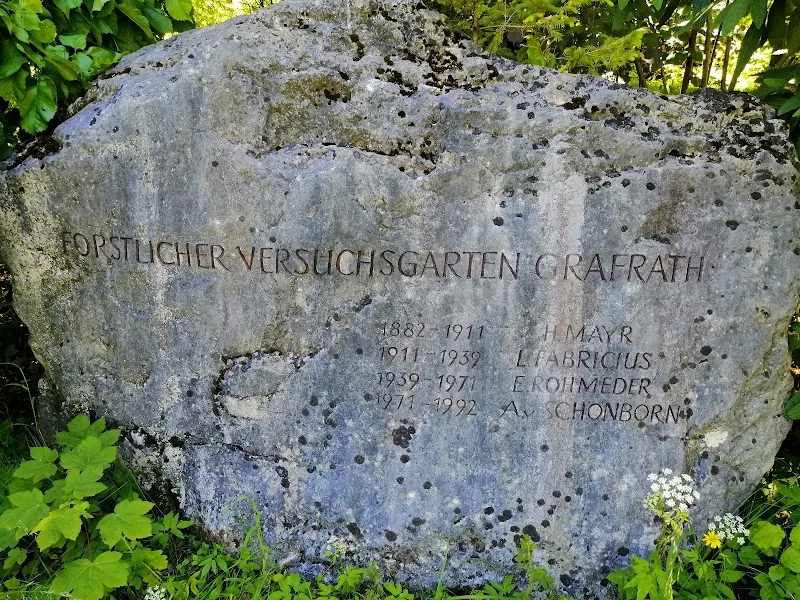
The history of the Forest Experience Center Grafrath is closely linked to the Forestry Trial Garden and dates back a long way. At the end of the 19th century, the area was established to assess the suitability of foreign tree species for domestic forestry. The official history states that 1881 is the founding year when Prof. Dr. Robert Hartig was entrusted with the management of the exotic cultivation trials in Bavaria. At that time, he had access to an area of 8 hectares that was already stocked with foreign tree species, including Douglas fir, larch, Japanese larch, and red oak. After his trip to North America, Heinrich Mayr developed a reforestation plan for cultivation trials in Grafrath in 1887, which took into account the microclimatic and silvicultural conditions of the tree species. In 1895, Mayr officially took over the management of the cultivation trials, and in 1897 the area was expanded to 10 hectares. By 1892, 42 tree species were documented, and five years later there were 57, including 20 deciduous tree species. This development shows how early Grafrath gained significance as a site for forestry research. ([aelf-ff.bayern.de](https://www.aelf-ff.bayern.de/cms10/aelf-ff/forstwirtschaft/321632/index.php))
Between 1911 and 1930, the area was finally expanded to its current size of 34 hectares. Later, the focus shifted from a pure trial facility increasingly towards tasks of forest plant breeding, emissions research, and ultimately forest education. Official pages emphasize that since the year 2000, environmental education and forest pedagogy have been at the forefront and that families, school classes, and other visitors can now embark on a journey of discovery across several continents. This development is remarkable because the site thus possesses a rare dual character: it is, on the one hand, a historic forestry area with a scientific past, and on the other hand, a modern educational center for contemporary topics such as climate change, tree species selection, and nature experience. This interplay of research and communication makes Grafrath so special. Therefore, when visiting the area, one does not simply stroll through a park but walks through a living piece of forestry history that has evolved over more than 140 years. ([aelf-ff.bayern.de](https://www.aelf-ff.bayern.de/cms10/aelf-ff/forstwirtschaft/321632/index.php))
Tree Species, Giant Sequoia, and Overview of the Arboretum
A central search interest regarding Grafrath concerns the tree species and the famous giant sequoia. The official description mentions around 200 foreign tree species from America, Europe, and Asia, while another page even mentions North and South America, Asia, Africa, and Europe. This corresponds to the character of an arboretum: a collection of woody plants that do not grow in containers but are permanently maintained in the open air. The LWF explains that there are about one hundred arboreta in Germany and that Grafrath is one of them. Such places today serve scientific teaching, research, recreation, and environmental education at the same time. For visitors, this means an enormous variety of forms, crowns, bark, and leaf patterns that are often not experienced in such density in ordinary forests. Particularly impressive is the long time axis: some of the trees were planted in the 19th century and are thus historical witnesses themselves. The oldest giant sequoia in the garden was planted in 1893 and symbolizes the connection between botanical exoticism and forestry history. ([vg-grafrath.de](https://www.vg-grafrath.de/gemeinde-grafrath/kultur-und-naherholung/walderlebniszentrum/))
The dimensions of individual specimens also make Grafrath interesting. The LWF describes the largest giant sequoia in the Forestry Trial Garden as being almost 130 years old, with a diameter of 1.50 meters and a height of 31.5 meters. Such figures are not only exciting for tree enthusiasts but also for anyone wanting to understand the topic of forests in relation to climate, growth, and site issues. The giant sequoias particularly illustrate how impressive tree growth can be over long periods. At the same time, the collection is not merely aesthetic but scientifically motivated: even the historical plantings were intended to show which foreign tree species are suitable for domestic forestry. That today it has become a learning place for visitors adds to its appeal. Therefore, those searching for keywords such as giant sequoia, tree species, or arboretum will find not only a beautiful place in Grafrath but also a piece of living forestry research with long continuity and visible results. ([lwf.bayern.de](https://www.lwf.bayern.de/wissenstransfer/oeffentlichkeitsarbeit/009288/index.php?utm_source=openai))
Wood Construction, Forest Pedagogy, and Offers for Families and Groups
The modern Forest Experience Center Grafrath is also an architectural statement. The new building was ceremoniously inaugurated at the end of March 2023 and is predominantly constructed of wood. The official description mentions around 400 square meters of usable space and about 200 cubic meters of wood used, which roughly binds around 200 tons of CO2 in the building. The house is modeled after a fork in a branch and connects foyer, event room, offices, storage, technology, and toilets in a form that harmoniously integrates into the forest. Particularly noteworthy is that the event room can accommodate up to 100 people. Additionally, there are glass fronts, clay plaster, and a construction on supports that preserves the forest floor. From every part of the house, one can directly access the forest, so that the house and nature do not stand separately but spatially intertwine. For visitors, this is not only functional but also atmospherically convincing, as architecture here becomes a topic of forest pedagogy itself. ([aelf-ff.bayern.de](https://www.aelf-ff.bayern.de/cms10/aelf-ff/forstwirtschaft/321634/index.php))
The educational aspect is as important as the building itself. The Forest Experience Center explicitly sees itself as a learning and experience place for children, teenagers, and adults. The official page addresses primary school children as well as secondary school students, kindergartens, teachers, educators, forest owner associations, and forestry cooperatives. Additionally, there are special formats, such as training for multipliers or guided tours focusing on climate tree species. The fact that the newest Forest Experience Center of the Bavarian Forestry Administration was only opened in 2023 further emphasizes how current this educational offering is. For families, this means: the visit is not just a walk in the green but can be combined with age-appropriate offerings, nature knowledge, crafting, discovering, and conversations about forests, climate, and biodiversity. For groups, Grafrath is a place where theory and practice come together. This combination of new wooden construction, historical facility, and modern forest pedagogy makes the location so strong. Those looking for a place that combines nature experience, learning, and a special ambiance will find a convincing address here. ([aelf-ff.bayern.de](https://www.aelf-ff.bayern.de/cms10/aelf-ff/forstwirtschaft/321634/index.php))
Grafrath is therefore more than just a tip for an outing. It is a place where the history of forestry science connects with contemporary environmental education, impressive tree diversity, and good accessibility. The official pages clearly show that the garden can be experienced both independently and as part of tours and programs. Those looking for the combination of opening hours, program, access, parking, and special nature experiences will find a page that answers many practical questions even before the visit. At the same time, there is enough room for discovery: from the giant sequoia to the forked architecture, from the S-Bahn arrival to the family program tour. This is precisely why it is worthwhile to see the visit not just as a short detour but as a consciously planned outing where one brings time for paths, trees, details, and tranquility. ([aelf-ff.bayern.de](https://www.aelf-ff.bayern.de/cms10/aelf-ff/forstwirtschaft/321786/index.php))
Sources:
- Forest Experience Center Grafrath – official information page ([aelf-ff.bayern.de](https://www.aelf-ff.bayern.de/forstwirtschaft/wald/322440/index.php))
- Events at the Forest Experience Center Grafrath ([aelf-ff.bayern.de](https://www.aelf-ff.bayern.de/cms10/aelf-ff/forstwirtschaft/327361/index.php))
- Access and Contact for the Forest Experience Center Grafrath ([aelf-ff.bayern.de](https://www.aelf-ff.bayern.de/cms10/aelf-ff/forstwirtschaft/321786/index.php))
- History of the Forest Experience Center Grafrath ([aelf-ff.bayern.de](https://www.aelf-ff.bayern.de/cms10/aelf-ff/forstwirtschaft/321632/index.php))
- LWF: Forest Experience Centers in Bavaria and Arboretum Background ([lwf.bayern.de](https://www.lwf.bayern.de/wissenstransfer/forstcastnet/239533/index.php))
Show moreShow less
Forest Experience Center Grafrath | Opening Hours & Program
The Forest Experience Center Grafrath is not a classic event venue with a stage, red chairs, and a program booklet in the usual sense, but rather a special learning and experience space in the middle of a historic forestry trial garden. This is precisely where its charm lies: Those who come here not only experience the forest but also science, history, and forest education in a place where exotic tree species have been growing for over a century. The garden was established in 1881, now covers 34 hectares, and showcases around 200 foreign tree species from America, Europe, Asia, and Africa. At the same time, the area is now a modern educational institution with a new main building predominantly made of wood, which was opened in 2023 and can accommodate up to 100 people in the event room. For families, school classes, adults, groups, and nature enthusiasts, Grafrath is therefore a destination that is quiet, spacious, and surprisingly versatile. Thanks to its location directly in Grafrath, good access to the S-Bahn, and available parking spaces, the visit can be planned both spontaneously and purposefully. ([vg-grafrath.de](https://www.vg-grafrath.de/gemeinde-grafrath/kultur-und-naherholung/walderlebniszentrum/))
Opening Hours and Visiting Times at the Forest Experience Center Grafrath
The most important inquiries revolve around the opening hours, and this is where a closer look is worthwhile: The regular visiting period of the forestry trial garden runs from March 1 to October 31. During this time, the area is open daily, including on Sundays and public holidays, from 8:00 AM to 6:00 PM. Additionally, the official site points out that the garden is closed to visitors from November 1 and will reopen the following year on March 1. For planning, this is a clear rule of thumb: Spring, summer, and autumn are the main times for a free walk, while the winter months primarily serve for rest and preparation. At the same time, the seasonal closure does not automatically mean that nothing takes place in late autumn or early winter, as the official event program explicitly mentions offerings in November and December. Therefore, those looking for a special event, a guided tour, or an educational event should not only check the calendar but also always verify the current program. ([aelf-ff.bayern.de](https://www.aelf-ff.bayern.de/cms10/aelf-ff/forstwirtschaft/321786/index.php))
For the visit itself, the mix of openness and structure is important: The area can be explored independently, and the experience paths are generally accessible at any time and free of charge according to LWF. At the same time, the event program recommends registering in advance, especially for special dates, usually at least two days before the appointment, unless otherwise noted. This makes sense because individual formats may depend on the weather or take place with a limited number of participants. It is also practical to note the need for weather-appropriate clothing and mosquito protection during the warm months. This is particularly helpful for families with children, as it makes the visit more relaxed and better prepares one for longer paths, natural ground, and variable forest weather. Those traveling with strollers, backpacks, or cameras should therefore consider not only the time but also the season and the specific event. The Forest Experience Center is not a place for a quick stop but for a decelerated stay where time is part of the experience. ([lwf.bayern.de](https://www.lwf.bayern.de/wissenstransfer/forstcastnet/239533/index.php))
Program, Tours, and Events in the Forestry Trial Garden
When it comes to the keyword program, Grafrath does not refer to a rigid evening program but to a semi-annual offering aimed at people with very different interests. The official description explicitly mentions nature and forest enthusiasts, families, school classes, adults, and groups. This is complemented by cooperation partners such as mindfulness trainers, herbal educators, a beekeeper, as well as musical and artistic offerings. This mix makes the program so attractive: It combines nature knowledge with practice, movement with learning, and quiet forest observation with creative or culinary elements. For groups from forestry and forest ownership, there are also specialized tours focusing on the tree species of the trial garden, particularly the so-called climate tree species. Kindergartens, schools, and teachers are also specifically addressed, for example, through tours tailored to curricula or training for multipliers. The Forest Experience Center is thus not just a recreational spot but an educational address with a broad content spectrum. ([aelf-ff.bayern.de](https://www.aelf-ff.bayern.de/cms10/aelf-ff/forstwirtschaft/321634/index.php))
Those looking for the current program will find not only descriptions of the formats on the event page but also concrete examples: There are offerings such as Easter Bunny activities, nesting box construction, spring walks, night hikes, herbal walks, edible wild plants, bird calls, wood sculpting, as well as myths, legends, and fairy tales. This clearly shows how broad the offerings at the Forest Experience Center Grafrath are. It encompasses nature observation, crafting, animals, herbs, wood, and stories alike. Notably, there is also a clear target group address: Some dates are aimed at children between four and seven years old, others at older children, teenagers, adults, or families. Additionally, there are thematic cooperation formats with adult education centers or external experts. Therefore, those planning a specific date should not only pay attention to the date but also to age recommendations, costs, and registration methods. Many offerings are free, while others have a small fee. This keeps the program accessible yet varied. ([aelf-ff.bayern.de](https://www.aelf-ff.bayern.de/cms10/aelf-ff/forstwirtschaft/327361/index.php))
Access, Grafrath Train Station, and Parking on Site
The access is one of the most practical search terms because the Forest Experience Center Grafrath is easily accessible for visitors from Munich as well as for those from the Fürstenfeldbruck region. The official directions mention two convenient options: by car via the B471 or by S-Bahn to Grafrath train station. Those arriving by car leave the B471 in Grafrath towards the train station, follow the signage, and turn right at the Protestant church. From there, the signage leads to the main entrance, where parking is available. Those who prefer public transport can reach the area directly on foot from Grafrath train station. The official S-Bahn line S4 is mentioned for this, and the walking route runs along Bahnhofstraße. This is particularly pleasant for families, school classes, or small groups who want to arrive without additional parking stress. For visitors from Munich, the combination of S-Bahn and a walk is a particularly easy solution. ([aelf-ff.bayern.de](https://www.aelf-ff.bayern.de/cms10/aelf-ff/forstwirtschaft/321786/index.php))
The location just outside Munich is thus a real advantage, as it combines nature experience and accessibility. Unlike some remote forest destinations, there is no complicated navigation through side roads here, but one can find their way relatively easily via the train station and local signage. This is also important for events, as multiple generations often come together for tours, themed evenings, or family offerings. Those traveling with children or elderly relatives can organize the visit more easily this way. Additionally, it is advisable to plan some buffer time, as the area does not function like a compact event hall but as an expansive forest area with paths, groups of trees, and several experience stations. Therefore, those planning the access should keep not only the destination but also the desired meeting point in mind. According to the event page, the meeting point for program items is often in front of the Forest Experience Center building. This clear orientation helps with group visits and makes the start on-site uncomplicated. ([aelf-ff.bayern.de](https://www.aelf-ff.bayern.de/cms10/aelf-ff/forstwirtschaft/321786/index.php))
History of the Forestry Trial Garden since 1881
The history of the Forest Experience Center Grafrath is closely linked to the Forestry Trial Garden and dates back a long way. At the end of the 19th century, the area was established to assess the suitability of foreign tree species for domestic forestry. The official history states that 1881 is the founding year when Prof. Dr. Robert Hartig was entrusted with the management of the exotic cultivation trials in Bavaria. At that time, he had access to an area of 8 hectares that was already stocked with foreign tree species, including Douglas fir, larch, Japanese larch, and red oak. After his trip to North America, Heinrich Mayr developed a reforestation plan for cultivation trials in Grafrath in 1887, which took into account the microclimatic and silvicultural conditions of the tree species. In 1895, Mayr officially took over the management of the cultivation trials, and in 1897 the area was expanded to 10 hectares. By 1892, 42 tree species were documented, and five years later there were 57, including 20 deciduous tree species. This development shows how early Grafrath gained significance as a site for forestry research. ([aelf-ff.bayern.de](https://www.aelf-ff.bayern.de/cms10/aelf-ff/forstwirtschaft/321632/index.php))
Between 1911 and 1930, the area was finally expanded to its current size of 34 hectares. Later, the focus shifted from a pure trial facility increasingly towards tasks of forest plant breeding, emissions research, and ultimately forest education. Official pages emphasize that since the year 2000, environmental education and forest pedagogy have been at the forefront and that families, school classes, and other visitors can now embark on a journey of discovery across several continents. This development is remarkable because the site thus possesses a rare dual character: it is, on the one hand, a historic forestry area with a scientific past, and on the other hand, a modern educational center for contemporary topics such as climate change, tree species selection, and nature experience. This interplay of research and communication makes Grafrath so special. Therefore, when visiting the area, one does not simply stroll through a park but walks through a living piece of forestry history that has evolved over more than 140 years. ([aelf-ff.bayern.de](https://www.aelf-ff.bayern.de/cms10/aelf-ff/forstwirtschaft/321632/index.php))
Tree Species, Giant Sequoia, and Overview of the Arboretum
A central search interest regarding Grafrath concerns the tree species and the famous giant sequoia. The official description mentions around 200 foreign tree species from America, Europe, and Asia, while another page even mentions North and South America, Asia, Africa, and Europe. This corresponds to the character of an arboretum: a collection of woody plants that do not grow in containers but are permanently maintained in the open air. The LWF explains that there are about one hundred arboreta in Germany and that Grafrath is one of them. Such places today serve scientific teaching, research, recreation, and environmental education at the same time. For visitors, this means an enormous variety of forms, crowns, bark, and leaf patterns that are often not experienced in such density in ordinary forests. Particularly impressive is the long time axis: some of the trees were planted in the 19th century and are thus historical witnesses themselves. The oldest giant sequoia in the garden was planted in 1893 and symbolizes the connection between botanical exoticism and forestry history. ([vg-grafrath.de](https://www.vg-grafrath.de/gemeinde-grafrath/kultur-und-naherholung/walderlebniszentrum/))
The dimensions of individual specimens also make Grafrath interesting. The LWF describes the largest giant sequoia in the Forestry Trial Garden as being almost 130 years old, with a diameter of 1.50 meters and a height of 31.5 meters. Such figures are not only exciting for tree enthusiasts but also for anyone wanting to understand the topic of forests in relation to climate, growth, and site issues. The giant sequoias particularly illustrate how impressive tree growth can be over long periods. At the same time, the collection is not merely aesthetic but scientifically motivated: even the historical plantings were intended to show which foreign tree species are suitable for domestic forestry. That today it has become a learning place for visitors adds to its appeal. Therefore, those searching for keywords such as giant sequoia, tree species, or arboretum will find not only a beautiful place in Grafrath but also a piece of living forestry research with long continuity and visible results. ([lwf.bayern.de](https://www.lwf.bayern.de/wissenstransfer/oeffentlichkeitsarbeit/009288/index.php?utm_source=openai))
Wood Construction, Forest Pedagogy, and Offers for Families and Groups
The modern Forest Experience Center Grafrath is also an architectural statement. The new building was ceremoniously inaugurated at the end of March 2023 and is predominantly constructed of wood. The official description mentions around 400 square meters of usable space and about 200 cubic meters of wood used, which roughly binds around 200 tons of CO2 in the building. The house is modeled after a fork in a branch and connects foyer, event room, offices, storage, technology, and toilets in a form that harmoniously integrates into the forest. Particularly noteworthy is that the event room can accommodate up to 100 people. Additionally, there are glass fronts, clay plaster, and a construction on supports that preserves the forest floor. From every part of the house, one can directly access the forest, so that the house and nature do not stand separately but spatially intertwine. For visitors, this is not only functional but also atmospherically convincing, as architecture here becomes a topic of forest pedagogy itself. ([aelf-ff.bayern.de](https://www.aelf-ff.bayern.de/cms10/aelf-ff/forstwirtschaft/321634/index.php))
The educational aspect is as important as the building itself. The Forest Experience Center explicitly sees itself as a learning and experience place for children, teenagers, and adults. The official page addresses primary school children as well as secondary school students, kindergartens, teachers, educators, forest owner associations, and forestry cooperatives. Additionally, there are special formats, such as training for multipliers or guided tours focusing on climate tree species. The fact that the newest Forest Experience Center of the Bavarian Forestry Administration was only opened in 2023 further emphasizes how current this educational offering is. For families, this means: the visit is not just a walk in the green but can be combined with age-appropriate offerings, nature knowledge, crafting, discovering, and conversations about forests, climate, and biodiversity. For groups, Grafrath is a place where theory and practice come together. This combination of new wooden construction, historical facility, and modern forest pedagogy makes the location so strong. Those looking for a place that combines nature experience, learning, and a special ambiance will find a convincing address here. ([aelf-ff.bayern.de](https://www.aelf-ff.bayern.de/cms10/aelf-ff/forstwirtschaft/321634/index.php))
Grafrath is therefore more than just a tip for an outing. It is a place where the history of forestry science connects with contemporary environmental education, impressive tree diversity, and good accessibility. The official pages clearly show that the garden can be experienced both independently and as part of tours and programs. Those looking for the combination of opening hours, program, access, parking, and special nature experiences will find a page that answers many practical questions even before the visit. At the same time, there is enough room for discovery: from the giant sequoia to the forked architecture, from the S-Bahn arrival to the family program tour. This is precisely why it is worthwhile to see the visit not just as a short detour but as a consciously planned outing where one brings time for paths, trees, details, and tranquility. ([aelf-ff.bayern.de](https://www.aelf-ff.bayern.de/cms10/aelf-ff/forstwirtschaft/321786/index.php))
Sources:
- Forest Experience Center Grafrath – official information page ([aelf-ff.bayern.de](https://www.aelf-ff.bayern.de/forstwirtschaft/wald/322440/index.php))
- Events at the Forest Experience Center Grafrath ([aelf-ff.bayern.de](https://www.aelf-ff.bayern.de/cms10/aelf-ff/forstwirtschaft/327361/index.php))
- Access and Contact for the Forest Experience Center Grafrath ([aelf-ff.bayern.de](https://www.aelf-ff.bayern.de/cms10/aelf-ff/forstwirtschaft/321786/index.php))
- History of the Forest Experience Center Grafrath ([aelf-ff.bayern.de](https://www.aelf-ff.bayern.de/cms10/aelf-ff/forstwirtschaft/321632/index.php))
- LWF: Forest Experience Centers in Bavaria and Arboretum Background ([lwf.bayern.de](https://www.lwf.bayern.de/wissenstransfer/forstcastnet/239533/index.php))
Forest Experience Center Grafrath | Opening Hours & Program
The Forest Experience Center Grafrath is not a classic event venue with a stage, red chairs, and a program booklet in the usual sense, but rather a special learning and experience space in the middle of a historic forestry trial garden. This is precisely where its charm lies: Those who come here not only experience the forest but also science, history, and forest education in a place where exotic tree species have been growing for over a century. The garden was established in 1881, now covers 34 hectares, and showcases around 200 foreign tree species from America, Europe, Asia, and Africa. At the same time, the area is now a modern educational institution with a new main building predominantly made of wood, which was opened in 2023 and can accommodate up to 100 people in the event room. For families, school classes, adults, groups, and nature enthusiasts, Grafrath is therefore a destination that is quiet, spacious, and surprisingly versatile. Thanks to its location directly in Grafrath, good access to the S-Bahn, and available parking spaces, the visit can be planned both spontaneously and purposefully. ([vg-grafrath.de](https://www.vg-grafrath.de/gemeinde-grafrath/kultur-und-naherholung/walderlebniszentrum/))
Opening Hours and Visiting Times at the Forest Experience Center Grafrath
The most important inquiries revolve around the opening hours, and this is where a closer look is worthwhile: The regular visiting period of the forestry trial garden runs from March 1 to October 31. During this time, the area is open daily, including on Sundays and public holidays, from 8:00 AM to 6:00 PM. Additionally, the official site points out that the garden is closed to visitors from November 1 and will reopen the following year on March 1. For planning, this is a clear rule of thumb: Spring, summer, and autumn are the main times for a free walk, while the winter months primarily serve for rest and preparation. At the same time, the seasonal closure does not automatically mean that nothing takes place in late autumn or early winter, as the official event program explicitly mentions offerings in November and December. Therefore, those looking for a special event, a guided tour, or an educational event should not only check the calendar but also always verify the current program. ([aelf-ff.bayern.de](https://www.aelf-ff.bayern.de/cms10/aelf-ff/forstwirtschaft/321786/index.php))
For the visit itself, the mix of openness and structure is important: The area can be explored independently, and the experience paths are generally accessible at any time and free of charge according to LWF. At the same time, the event program recommends registering in advance, especially for special dates, usually at least two days before the appointment, unless otherwise noted. This makes sense because individual formats may depend on the weather or take place with a limited number of participants. It is also practical to note the need for weather-appropriate clothing and mosquito protection during the warm months. This is particularly helpful for families with children, as it makes the visit more relaxed and better prepares one for longer paths, natural ground, and variable forest weather. Those traveling with strollers, backpacks, or cameras should therefore consider not only the time but also the season and the specific event. The Forest Experience Center is not a place for a quick stop but for a decelerated stay where time is part of the experience. ([lwf.bayern.de](https://www.lwf.bayern.de/wissenstransfer/forstcastnet/239533/index.php))
Program, Tours, and Events in the Forestry Trial Garden
When it comes to the keyword program, Grafrath does not refer to a rigid evening program but to a semi-annual offering aimed at people with very different interests. The official description explicitly mentions nature and forest enthusiasts, families, school classes, adults, and groups. This is complemented by cooperation partners such as mindfulness trainers, herbal educators, a beekeeper, as well as musical and artistic offerings. This mix makes the program so attractive: It combines nature knowledge with practice, movement with learning, and quiet forest observation with creative or culinary elements. For groups from forestry and forest ownership, there are also specialized tours focusing on the tree species of the trial garden, particularly the so-called climate tree species. Kindergartens, schools, and teachers are also specifically addressed, for example, through tours tailored to curricula or training for multipliers. The Forest Experience Center is thus not just a recreational spot but an educational address with a broad content spectrum. ([aelf-ff.bayern.de](https://www.aelf-ff.bayern.de/cms10/aelf-ff/forstwirtschaft/321634/index.php))
Those looking for the current program will find not only descriptions of the formats on the event page but also concrete examples: There are offerings such as Easter Bunny activities, nesting box construction, spring walks, night hikes, herbal walks, edible wild plants, bird calls, wood sculpting, as well as myths, legends, and fairy tales. This clearly shows how broad the offerings at the Forest Experience Center Grafrath are. It encompasses nature observation, crafting, animals, herbs, wood, and stories alike. Notably, there is also a clear target group address: Some dates are aimed at children between four and seven years old, others at older children, teenagers, adults, or families. Additionally, there are thematic cooperation formats with adult education centers or external experts. Therefore, those planning a specific date should not only pay attention to the date but also to age recommendations, costs, and registration methods. Many offerings are free, while others have a small fee. This keeps the program accessible yet varied. ([aelf-ff.bayern.de](https://www.aelf-ff.bayern.de/cms10/aelf-ff/forstwirtschaft/327361/index.php))
Access, Grafrath Train Station, and Parking on Site
The access is one of the most practical search terms because the Forest Experience Center Grafrath is easily accessible for visitors from Munich as well as for those from the Fürstenfeldbruck region. The official directions mention two convenient options: by car via the B471 or by S-Bahn to Grafrath train station. Those arriving by car leave the B471 in Grafrath towards the train station, follow the signage, and turn right at the Protestant church. From there, the signage leads to the main entrance, where parking is available. Those who prefer public transport can reach the area directly on foot from Grafrath train station. The official S-Bahn line S4 is mentioned for this, and the walking route runs along Bahnhofstraße. This is particularly pleasant for families, school classes, or small groups who want to arrive without additional parking stress. For visitors from Munich, the combination of S-Bahn and a walk is a particularly easy solution. ([aelf-ff.bayern.de](https://www.aelf-ff.bayern.de/cms10/aelf-ff/forstwirtschaft/321786/index.php))
The location just outside Munich is thus a real advantage, as it combines nature experience and accessibility. Unlike some remote forest destinations, there is no complicated navigation through side roads here, but one can find their way relatively easily via the train station and local signage. This is also important for events, as multiple generations often come together for tours, themed evenings, or family offerings. Those traveling with children or elderly relatives can organize the visit more easily this way. Additionally, it is advisable to plan some buffer time, as the area does not function like a compact event hall but as an expansive forest area with paths, groups of trees, and several experience stations. Therefore, those planning the access should keep not only the destination but also the desired meeting point in mind. According to the event page, the meeting point for program items is often in front of the Forest Experience Center building. This clear orientation helps with group visits and makes the start on-site uncomplicated. ([aelf-ff.bayern.de](https://www.aelf-ff.bayern.de/cms10/aelf-ff/forstwirtschaft/321786/index.php))
History of the Forestry Trial Garden since 1881
The history of the Forest Experience Center Grafrath is closely linked to the Forestry Trial Garden and dates back a long way. At the end of the 19th century, the area was established to assess the suitability of foreign tree species for domestic forestry. The official history states that 1881 is the founding year when Prof. Dr. Robert Hartig was entrusted with the management of the exotic cultivation trials in Bavaria. At that time, he had access to an area of 8 hectares that was already stocked with foreign tree species, including Douglas fir, larch, Japanese larch, and red oak. After his trip to North America, Heinrich Mayr developed a reforestation plan for cultivation trials in Grafrath in 1887, which took into account the microclimatic and silvicultural conditions of the tree species. In 1895, Mayr officially took over the management of the cultivation trials, and in 1897 the area was expanded to 10 hectares. By 1892, 42 tree species were documented, and five years later there were 57, including 20 deciduous tree species. This development shows how early Grafrath gained significance as a site for forestry research. ([aelf-ff.bayern.de](https://www.aelf-ff.bayern.de/cms10/aelf-ff/forstwirtschaft/321632/index.php))
Between 1911 and 1930, the area was finally expanded to its current size of 34 hectares. Later, the focus shifted from a pure trial facility increasingly towards tasks of forest plant breeding, emissions research, and ultimately forest education. Official pages emphasize that since the year 2000, environmental education and forest pedagogy have been at the forefront and that families, school classes, and other visitors can now embark on a journey of discovery across several continents. This development is remarkable because the site thus possesses a rare dual character: it is, on the one hand, a historic forestry area with a scientific past, and on the other hand, a modern educational center for contemporary topics such as climate change, tree species selection, and nature experience. This interplay of research and communication makes Grafrath so special. Therefore, when visiting the area, one does not simply stroll through a park but walks through a living piece of forestry history that has evolved over more than 140 years. ([aelf-ff.bayern.de](https://www.aelf-ff.bayern.de/cms10/aelf-ff/forstwirtschaft/321632/index.php))
Tree Species, Giant Sequoia, and Overview of the Arboretum
A central search interest regarding Grafrath concerns the tree species and the famous giant sequoia. The official description mentions around 200 foreign tree species from America, Europe, and Asia, while another page even mentions North and South America, Asia, Africa, and Europe. This corresponds to the character of an arboretum: a collection of woody plants that do not grow in containers but are permanently maintained in the open air. The LWF explains that there are about one hundred arboreta in Germany and that Grafrath is one of them. Such places today serve scientific teaching, research, recreation, and environmental education at the same time. For visitors, this means an enormous variety of forms, crowns, bark, and leaf patterns that are often not experienced in such density in ordinary forests. Particularly impressive is the long time axis: some of the trees were planted in the 19th century and are thus historical witnesses themselves. The oldest giant sequoia in the garden was planted in 1893 and symbolizes the connection between botanical exoticism and forestry history. ([vg-grafrath.de](https://www.vg-grafrath.de/gemeinde-grafrath/kultur-und-naherholung/walderlebniszentrum/))
The dimensions of individual specimens also make Grafrath interesting. The LWF describes the largest giant sequoia in the Forestry Trial Garden as being almost 130 years old, with a diameter of 1.50 meters and a height of 31.5 meters. Such figures are not only exciting for tree enthusiasts but also for anyone wanting to understand the topic of forests in relation to climate, growth, and site issues. The giant sequoias particularly illustrate how impressive tree growth can be over long periods. At the same time, the collection is not merely aesthetic but scientifically motivated: even the historical plantings were intended to show which foreign tree species are suitable for domestic forestry. That today it has become a learning place for visitors adds to its appeal. Therefore, those searching for keywords such as giant sequoia, tree species, or arboretum will find not only a beautiful place in Grafrath but also a piece of living forestry research with long continuity and visible results. ([lwf.bayern.de](https://www.lwf.bayern.de/wissenstransfer/oeffentlichkeitsarbeit/009288/index.php?utm_source=openai))
Wood Construction, Forest Pedagogy, and Offers for Families and Groups
The modern Forest Experience Center Grafrath is also an architectural statement. The new building was ceremoniously inaugurated at the end of March 2023 and is predominantly constructed of wood. The official description mentions around 400 square meters of usable space and about 200 cubic meters of wood used, which roughly binds around 200 tons of CO2 in the building. The house is modeled after a fork in a branch and connects foyer, event room, offices, storage, technology, and toilets in a form that harmoniously integrates into the forest. Particularly noteworthy is that the event room can accommodate up to 100 people. Additionally, there are glass fronts, clay plaster, and a construction on supports that preserves the forest floor. From every part of the house, one can directly access the forest, so that the house and nature do not stand separately but spatially intertwine. For visitors, this is not only functional but also atmospherically convincing, as architecture here becomes a topic of forest pedagogy itself. ([aelf-ff.bayern.de](https://www.aelf-ff.bayern.de/cms10/aelf-ff/forstwirtschaft/321634/index.php))
The educational aspect is as important as the building itself. The Forest Experience Center explicitly sees itself as a learning and experience place for children, teenagers, and adults. The official page addresses primary school children as well as secondary school students, kindergartens, teachers, educators, forest owner associations, and forestry cooperatives. Additionally, there are special formats, such as training for multipliers or guided tours focusing on climate tree species. The fact that the newest Forest Experience Center of the Bavarian Forestry Administration was only opened in 2023 further emphasizes how current this educational offering is. For families, this means: the visit is not just a walk in the green but can be combined with age-appropriate offerings, nature knowledge, crafting, discovering, and conversations about forests, climate, and biodiversity. For groups, Grafrath is a place where theory and practice come together. This combination of new wooden construction, historical facility, and modern forest pedagogy makes the location so strong. Those looking for a place that combines nature experience, learning, and a special ambiance will find a convincing address here. ([aelf-ff.bayern.de](https://www.aelf-ff.bayern.de/cms10/aelf-ff/forstwirtschaft/321634/index.php))
Grafrath is therefore more than just a tip for an outing. It is a place where the history of forestry science connects with contemporary environmental education, impressive tree diversity, and good accessibility. The official pages clearly show that the garden can be experienced both independently and as part of tours and programs. Those looking for the combination of opening hours, program, access, parking, and special nature experiences will find a page that answers many practical questions even before the visit. At the same time, there is enough room for discovery: from the giant sequoia to the forked architecture, from the S-Bahn arrival to the family program tour. This is precisely why it is worthwhile to see the visit not just as a short detour but as a consciously planned outing where one brings time for paths, trees, details, and tranquility. ([aelf-ff.bayern.de](https://www.aelf-ff.bayern.de/cms10/aelf-ff/forstwirtschaft/321786/index.php))
Sources:
- Forest Experience Center Grafrath – official information page ([aelf-ff.bayern.de](https://www.aelf-ff.bayern.de/forstwirtschaft/wald/322440/index.php))
- Events at the Forest Experience Center Grafrath ([aelf-ff.bayern.de](https://www.aelf-ff.bayern.de/cms10/aelf-ff/forstwirtschaft/327361/index.php))
- Access and Contact for the Forest Experience Center Grafrath ([aelf-ff.bayern.de](https://www.aelf-ff.bayern.de/cms10/aelf-ff/forstwirtschaft/321786/index.php))
- History of the Forest Experience Center Grafrath ([aelf-ff.bayern.de](https://www.aelf-ff.bayern.de/cms10/aelf-ff/forstwirtschaft/321632/index.php))
- LWF: Forest Experience Centers in Bavaria and Arboretum Background ([lwf.bayern.de](https://www.lwf.bayern.de/wissenstransfer/forstcastnet/239533/index.php))
Upcoming Events
No events found
Frequently Asked Questions
Reviews
Jens G. Jungfleisch
12. October 2018
Unexpected! Indian summer in the middle of Bavaria! Wide range of different trees, domestic and international! Worth a visit! The short walk only takes you 35 mins.
wayne lager
5. September 2021
Amazing walk
Chris Adkins
3. December 2019
Great place for a day trip with the family.
David Ločárek
21. December 2023
Ok
Angie
19. October 2025
We love it! Such a beautiful forest with paths, great trees, and cute wooden sculptures ❣️ We were there again today and are always thrilled. Entrance is free & there are even restrooms in the large building at the main entrance. Also easily accessible by S-Bahn (Grafrath station) and a side entrance.