
Seefeld
Marienpl. 1, 82229 Seefeld, Deutschland
St. Peter and Paul | Church & Services
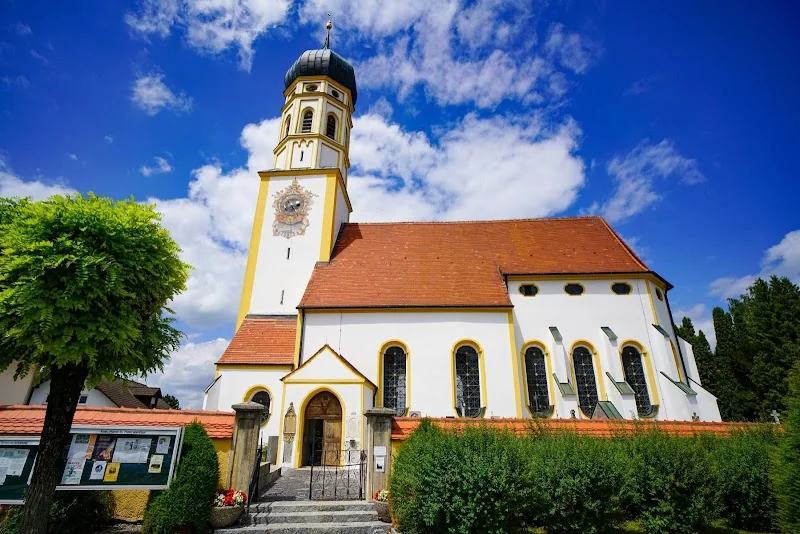
St. Peter and Paul in Oberalting is more than just a church name on the map of Seefeld. The parish church at Marienplatz 1 belongs to the Catholic parish community of Seefeld/Wörthsee and is thus a vibrant place of faith, not just a historical monument. The community's homepage explicitly designates Oberalting as a place of worship, and it simultaneously documents an active community life with regular masses, festive services, and devotions. This is important for visitors: Those searching for St. Peter and Paul are not just looking for a sight, but also for a place where the church remains present in the daily life of the community. The central location in the village center, near Marienplatz and the parish office located at Marienplatz 4, fits this description. The overlap of faith, village history, and everyday life adds to the special charm of this address. The church is thus relevant for search queries such as church, services, history, and photos, as well as for people specifically looking for a place to attend a mass or to get a first impression of Oberalting. ([pg-seefeld-woerthsee.de](https://www.pg-seefeld-woerthsee.de/))
Services at St. Peter and Paul Oberalting
Those searching for St. Peter and Paul in Seefeld often mean not just the building itself, but also the question of when services are held there. This is where one of the greatest practical advantages of this church lies: It is integrated into the parish community of Seefeld/Wörthsee and is continuously listed as a place of worship on the official homepage. Current dates for Oberalting can be found there, including Holy Masses, parish services, May devotions, and festive days in the church year. Special occasions such as Ascension Day, Corpus Christi, or Pentecost also appear in the schedule, showing that St. Peter and Paul is used as a regular liturgical center and not just as an occasionally opened chapel. The parish community itself describes itself as a community of about 4,500 Catholic Christians in four parishes, supported by many volunteers. This environment explains why Oberalting remains so present in church matters: The church stands at the center of a larger network of pastoral care, community life, and regional festivals. For visitors, this means that St. Peter and Paul is a reliable anchor point for the Catholic calendar in Seefeld and at the same time remains the classic village church with a vibrant inner life. ([pg-seefeld-woerthsee.de](https://www.pg-seefeld-woerthsee.de/))
The SEO logic behind terms like services, church, and parish office is unusually clear for this location. The church is not an abstract name but a concrete place where liturgy takes place weekly or seasonally, where parish newsletters are published, and where the community is organized. The public website of the parish community also lists contact methods for Pastor Roland Böckler, the parish office, and the administrative area. This is crucial for many seekers: Those who want not only to read the history but also to attend a service or ask for a contact person will find current and directly usable information here. For St. Peter and Paul in Oberalting, this means an important dual character. On one hand, the church has historical significance and is of art-historical interest; on the other hand, it is a functioning place of the present. This connection of tradition and current community life is one of the reasons why search queries related to church, services, parish office, and Oberalting are particularly closely associated with this building. ([pg-seefeld-woerthsee.de](https://www.pg-seefeld-woerthsee.de/))
History of the Parish Church at Marienplatz
The historical depth of St. Peter and Paul can be gleaned from just a few numbers. The monument path of the community of Seefeld describes the church as an impressive parish church, whose choir and tower base date back to 1489. The nave and choir extension date to 1675. Thus, the building combines late medieval substance with a later baroque extension and forms exactly that architectural mixture that makes many Bavarian village churches so distinctive. The fact that the church is located directly at Marienplatz further enhances its value in the local landscape. The square is not randomly chosen but visibly belongs to the historical core of Oberalting. Today, when looking at the church from Marienplatz, one sees not only a religious building but also a rooted center of the old village structure. The community of Seefeld also points out in its local history that the districts of the current community look back on a long history and were already documented between the 9th and 12th centuries. Against this background, St. Peter and Paul appears as part of a very old settlement landscape, whose religious and village center has been preserved for centuries. This historical continuity makes the church particularly attractive for those interested in history, monument preservation, and regional development. ([seefeld.de](https://www.seefeld.de/gsf-files/gsf--denkmal-radltour-seefeld-id127-217.pdf))
The monument path also provides an important local context: It leads from the surroundings via Kirchenstraße to Marienplatz and describes the church as a destination of a historical tour through Seefeld-Oberalting. This shows that St. Peter and Paul does not stand isolated but is part of an ensemble of Marienplatz, Marienbrunnen, former hospital, and other protected traces of the old village core. This is crucial for the perception of the church, as it is not only read as a sacred building but as the center of a developed hub. Such centers in Upper Bavaria are often strong precisely because they fulfilled religious, social, and economic functions simultaneously over a long period. The place Oberalting is today part of the municipality of Seefeld, which was formed in its current composition in 1978; however, its historical development goes back much further. Thus, the church of St. Peter and Paul stands at an intersection between medieval building history, early modern expansion, and today's community culture. This historical layering makes the location particularly valuable for search terms like history, monument, and church. ([seefeld.de](https://www.seefeld.de/gsf-files/gsf--denkmal-radltour-seefeld-id127-217.pdf))
Altars, Marienbrunnen, and Gravestones
The interior of St. Peter and Paul is rich in details that make a visit to the church a small journey of discovery. The monument path of the community of Seefeld first highlights the large high altar, on which the handing over of the keys to Peter is depicted. The painting of the Weilheim artist Mattias Schöffelhuber is mentioned as the image carrier. To the left is a Marian altar with a replica of the Altötting Mother of God, which Pastor Johann Faber had brought here in the 18th century. Additionally, there are busts of Saints Mary and Joseph, created by Johann Luidl around 1730. To the right, Saint Catherine is mentioned, a work that can possibly be attributed to the famous Johann Baptist Straub. Below the gallery, there are eight gravestones, among which the stones of Georg von Gundelfingen, the last owner of Schloss Seefeld before the Toerring family, and Hans von Toerring zu Seefeld and Jettenbach stand out. This interior is thus not only liturgically significant but also densely packed with art history. It consolidates image programs, donor history, and local memory in one place. For visitors searching for altars, church, or photos, these layers are a central reason why the church has such a strong visual impact. ([seefeld.de](https://www.seefeld.de/gsf-files/gsf--denkmal-radltour-seefeld-id127-217.pdf))
This impression continues even outside the church. The monument path describes the Marienbrunnen as a newer component of the square; the cast-iron Marian figure was erected in 1873. Additionally, a report from the Süddeutsche Zeitung describes the Madonna at Marienplatz as a 2.16-meter tall and 75-centimeter wide figure that was sold in 1873, cast in France, and donated to the parish of Oberalting. The depiction also refers to an early Marian column, which Pastor Johannes Georg Faber had already donated from his private assets, before the wooden column was replaced by a stone one in 1873 and the cast-iron Madonna was placed on it. The Madonna stood until 1949 on the road from Drößling and only then moved to the current square with the fountain in the background. Together with the former hospital, which Georg von Gundelfingen had built for the staff of the castle and which was renewed in 1820, a small historical ensemble emerges in front of the church that strongly shapes the external impact of St. Peter and Paul. Thus, those searching for photos, highlights, or special features find more than just a facade view here: The place offers a compact image of sacred building, square history, Marian devotion, and regional memory. ([seefeld.de](https://www.seefeld.de/gsf-files/gsf--denkmal-radltour-seefeld-id127-217.pdf))
Directions, Parking, and the Way to Oberalting
Navigating to the church is simple and typical for a developed village center. The address Marienplatz 1 leads directly to the center of Oberalting, and the monument path explicitly states that Marienplatz is located next to the church and is easily reachable via Kirchenstraße. This is important for visitors who expect a short, clear walking route and want to find not a large urban situation but a manageable village center. Those who orient themselves in advance should therefore focus less on a major traffic axis and more on the combination of Marienplatz, Kirchenstraße, and the parish house/parish office. The parish office Oberalting is located at Marienplatz 4; the official homepage lists office hours on Tuesday from 9 to 11 a.m. and Thursday from 4 to 7 p.m. This means that the church is not only spatially but also organizationally very close to its visitors. The location in the village center is a plus for all who plan a devotion, a mass, or simply a quiet visit. At the same time, it should be noted that Marienplatz is a place for local festivals. The community of Seefeld explicitly points out street closures around Marienplatz during the May festival in Oberalting. Therefore, those arriving on such days should plan for some buffer time. ([seefeld.de](https://www.seefeld.de/gsf-files/gsf--denkmal-radltour-seefeld-id127-217.pdf))
Regarding parking, the sources should be read with caution. The parish community mentions the parking lot behind the House of Peter and Paul as a drop-off point for a collection campaign. This at least proves that there is a usable parking space for parish activities in the immediate vicinity. For regular visits, it is therefore sensible to initially keep an eye on the area around the House of Peter and Paul as well as Marienplatz. Because the church location is small and central, parking in Oberalting is organized more as a local solution with short distances than through large, separate facilities. This fits the structure of the village center. Those arriving by car should therefore prepare to stop directly in the historical area rather than looking for a faraway large parking lot. This form of arrival is typical for village churches in the Starnberg district and even contributes to the character of the visit: One does not enter an anonymous parking garage but right into a small, historical environment. If a festival is taking place in the village, such as the May festival, signage and local information become particularly important. For search queries like directions and parking, the church is therefore less a logistics destination than a quiet village center with a clear but narrow access situation. ([pg-seefeld-woerthsee.de](https://www.pg-seefeld-woerthsee.de/))
Photos and Special Viewpoints Around the Church
The keyword impulse photos is very well traceable at St. Peter and Paul, as the entire area around the church is visually strongly interconnected. The church itself, Marienplatz, Marienbrunnen, the Marian figure, and the former hospital are closely located together and form a historically grown backdrop that almost invites for photos. The community of Seefeld explicitly mentions Marienplatz as a destination of the monument path, and the monument path, in turn, describes the individual components of the ensemble in such a way that it becomes clear why the village center is photographically appealing. Thus, those photographing the church not only capture a building but also a small piece of local history in the image. This is especially true for the perspective from the square when the church becomes visible together with the fountain and the old neighboring buildings. Additionally, the community of Seefeld even shows a photo caption for the Oberalting church on its information page, highlighting a sundial in the context of the church. This further shows that the place is also visually maintained and perceived in its historical appearance. For users searching for church photos, interior photos, or impressions of Marienplatz, this location is therefore particularly fruitful. ([seefeld.de](https://www.seefeld.de/gsf-files/gsf--denkmal-radltour-seefeld-id127-217.pdf))
A second photographic viewpoint is the Madonna at Marienplatz itself. The Süddeutsche Zeitung describes the figure as a special Marian statue that stands out not only because of its origin from France but also due to its dimensions. Equally remarkable is the fact that it originally stood on the road from Drößling and was only later moved to the current square. Such details make a photo not only decorative but also contentually readable: Those capturing the figure document the history of piety and village design in Oberalting. Additionally, there are artworks inside the church, although these are not always freely accessible or suitable for photography. For this reason, exterior shots are particularly important for many visitors. They can capture Marienplatz, the church, the fountain, and the adjacent former hospital as an ensemble, thus obtaining an image that very well captures the soul of the place. The combination of late medieval substance, baroque extension, and Marian devotion creates exactly that mixture that is often sought in church photos: calm, historical, detailed, and unmistakable. ([sueddeutsche.de](https://www.sueddeutsche.de/muenchen/starnberg/seefeld-die-madonna-vom-marienplatz-1.2428641))
Parish Office, Current Dates, and Practical Information
Practical information can be quickly found at St. Peter and Paul, as the church is firmly integrated into the parish community. The parish office Oberalting is located at Marienplatz 4 in Seefeld and is staffed according to the official homepage on Tuesdays from 9 to 11 a.m. and Thursdays from 4 to 7 p.m. Additionally, there are phone numbers and other contact methods through the parish community. This is particularly helpful for visitors who want to clarify a baptism, a wedding, a mass intention, or general questions about the church. The homepage also shows that the parish community not only publishes services but also provides dates for parish newsletters, activities, and community events. St. Peter and Paul is thus organizationally a hub where church space, administration, and community life meet. The central location at Marienplatz further facilitates this connection. Once on site, one quickly realizes that the paths are short and the church resonates in the daily life of the village. Especially for older or unfamiliar visitors, it is pleasant that the place is not overly complex but remains clearly structured. ([pg-seefeld-woerthsee.de](https://www.pg-seefeld-woerthsee.de/))
In the end, St. Peter and Paul can be very well described as a church with three levels: It is historical, liturgical, and shapes the local landscape. Historical because its choir and tower base date back to the 15th century and the nave was expanded in the 17th century. Liturgical because regular services are held here and the parish community of Oberalting is listed as a fixed place of church life. Shaping the local landscape because Marienbrunnen, the former hospital, and the historical square make the building a visible centerpiece of Oberalting. This triple role explains why the church appears so broadly in search queries: Some search specifically for photos, others for history, and still others for services, parking, or parish office. St. Peter and Paul fulfills all these search intentions in a small space and with a genuine connection to the place. Those wanting to understand Seefeld will therefore find a very good starting point here. The church is not on the edge but right in the midst of the historical life of the community part of Oberalting. This is what makes its charm and explains why it remains not only a monument but a lived place to this day. ([seefeld.de](https://www.seefeld.de/gsf-files/gsf--denkmal-radltour-seefeld-id127-217.pdf))
Sources:
Show moreShow less
St. Peter and Paul | Church & Services
St. Peter and Paul in Oberalting is more than just a church name on the map of Seefeld. The parish church at Marienplatz 1 belongs to the Catholic parish community of Seefeld/Wörthsee and is thus a vibrant place of faith, not just a historical monument. The community's homepage explicitly designates Oberalting as a place of worship, and it simultaneously documents an active community life with regular masses, festive services, and devotions. This is important for visitors: Those searching for St. Peter and Paul are not just looking for a sight, but also for a place where the church remains present in the daily life of the community. The central location in the village center, near Marienplatz and the parish office located at Marienplatz 4, fits this description. The overlap of faith, village history, and everyday life adds to the special charm of this address. The church is thus relevant for search queries such as church, services, history, and photos, as well as for people specifically looking for a place to attend a mass or to get a first impression of Oberalting. ([pg-seefeld-woerthsee.de](https://www.pg-seefeld-woerthsee.de/))
Services at St. Peter and Paul Oberalting
Those searching for St. Peter and Paul in Seefeld often mean not just the building itself, but also the question of when services are held there. This is where one of the greatest practical advantages of this church lies: It is integrated into the parish community of Seefeld/Wörthsee and is continuously listed as a place of worship on the official homepage. Current dates for Oberalting can be found there, including Holy Masses, parish services, May devotions, and festive days in the church year. Special occasions such as Ascension Day, Corpus Christi, or Pentecost also appear in the schedule, showing that St. Peter and Paul is used as a regular liturgical center and not just as an occasionally opened chapel. The parish community itself describes itself as a community of about 4,500 Catholic Christians in four parishes, supported by many volunteers. This environment explains why Oberalting remains so present in church matters: The church stands at the center of a larger network of pastoral care, community life, and regional festivals. For visitors, this means that St. Peter and Paul is a reliable anchor point for the Catholic calendar in Seefeld and at the same time remains the classic village church with a vibrant inner life. ([pg-seefeld-woerthsee.de](https://www.pg-seefeld-woerthsee.de/))
The SEO logic behind terms like services, church, and parish office is unusually clear for this location. The church is not an abstract name but a concrete place where liturgy takes place weekly or seasonally, where parish newsletters are published, and where the community is organized. The public website of the parish community also lists contact methods for Pastor Roland Böckler, the parish office, and the administrative area. This is crucial for many seekers: Those who want not only to read the history but also to attend a service or ask for a contact person will find current and directly usable information here. For St. Peter and Paul in Oberalting, this means an important dual character. On one hand, the church has historical significance and is of art-historical interest; on the other hand, it is a functioning place of the present. This connection of tradition and current community life is one of the reasons why search queries related to church, services, parish office, and Oberalting are particularly closely associated with this building. ([pg-seefeld-woerthsee.de](https://www.pg-seefeld-woerthsee.de/))
History of the Parish Church at Marienplatz
The historical depth of St. Peter and Paul can be gleaned from just a few numbers. The monument path of the community of Seefeld describes the church as an impressive parish church, whose choir and tower base date back to 1489. The nave and choir extension date to 1675. Thus, the building combines late medieval substance with a later baroque extension and forms exactly that architectural mixture that makes many Bavarian village churches so distinctive. The fact that the church is located directly at Marienplatz further enhances its value in the local landscape. The square is not randomly chosen but visibly belongs to the historical core of Oberalting. Today, when looking at the church from Marienplatz, one sees not only a religious building but also a rooted center of the old village structure. The community of Seefeld also points out in its local history that the districts of the current community look back on a long history and were already documented between the 9th and 12th centuries. Against this background, St. Peter and Paul appears as part of a very old settlement landscape, whose religious and village center has been preserved for centuries. This historical continuity makes the church particularly attractive for those interested in history, monument preservation, and regional development. ([seefeld.de](https://www.seefeld.de/gsf-files/gsf--denkmal-radltour-seefeld-id127-217.pdf))
The monument path also provides an important local context: It leads from the surroundings via Kirchenstraße to Marienplatz and describes the church as a destination of a historical tour through Seefeld-Oberalting. This shows that St. Peter and Paul does not stand isolated but is part of an ensemble of Marienplatz, Marienbrunnen, former hospital, and other protected traces of the old village core. This is crucial for the perception of the church, as it is not only read as a sacred building but as the center of a developed hub. Such centers in Upper Bavaria are often strong precisely because they fulfilled religious, social, and economic functions simultaneously over a long period. The place Oberalting is today part of the municipality of Seefeld, which was formed in its current composition in 1978; however, its historical development goes back much further. Thus, the church of St. Peter and Paul stands at an intersection between medieval building history, early modern expansion, and today's community culture. This historical layering makes the location particularly valuable for search terms like history, monument, and church. ([seefeld.de](https://www.seefeld.de/gsf-files/gsf--denkmal-radltour-seefeld-id127-217.pdf))
Altars, Marienbrunnen, and Gravestones
The interior of St. Peter and Paul is rich in details that make a visit to the church a small journey of discovery. The monument path of the community of Seefeld first highlights the large high altar, on which the handing over of the keys to Peter is depicted. The painting of the Weilheim artist Mattias Schöffelhuber is mentioned as the image carrier. To the left is a Marian altar with a replica of the Altötting Mother of God, which Pastor Johann Faber had brought here in the 18th century. Additionally, there are busts of Saints Mary and Joseph, created by Johann Luidl around 1730. To the right, Saint Catherine is mentioned, a work that can possibly be attributed to the famous Johann Baptist Straub. Below the gallery, there are eight gravestones, among which the stones of Georg von Gundelfingen, the last owner of Schloss Seefeld before the Toerring family, and Hans von Toerring zu Seefeld and Jettenbach stand out. This interior is thus not only liturgically significant but also densely packed with art history. It consolidates image programs, donor history, and local memory in one place. For visitors searching for altars, church, or photos, these layers are a central reason why the church has such a strong visual impact. ([seefeld.de](https://www.seefeld.de/gsf-files/gsf--denkmal-radltour-seefeld-id127-217.pdf))
This impression continues even outside the church. The monument path describes the Marienbrunnen as a newer component of the square; the cast-iron Marian figure was erected in 1873. Additionally, a report from the Süddeutsche Zeitung describes the Madonna at Marienplatz as a 2.16-meter tall and 75-centimeter wide figure that was sold in 1873, cast in France, and donated to the parish of Oberalting. The depiction also refers to an early Marian column, which Pastor Johannes Georg Faber had already donated from his private assets, before the wooden column was replaced by a stone one in 1873 and the cast-iron Madonna was placed on it. The Madonna stood until 1949 on the road from Drößling and only then moved to the current square with the fountain in the background. Together with the former hospital, which Georg von Gundelfingen had built for the staff of the castle and which was renewed in 1820, a small historical ensemble emerges in front of the church that strongly shapes the external impact of St. Peter and Paul. Thus, those searching for photos, highlights, or special features find more than just a facade view here: The place offers a compact image of sacred building, square history, Marian devotion, and regional memory. ([seefeld.de](https://www.seefeld.de/gsf-files/gsf--denkmal-radltour-seefeld-id127-217.pdf))
Directions, Parking, and the Way to Oberalting
Navigating to the church is simple and typical for a developed village center. The address Marienplatz 1 leads directly to the center of Oberalting, and the monument path explicitly states that Marienplatz is located next to the church and is easily reachable via Kirchenstraße. This is important for visitors who expect a short, clear walking route and want to find not a large urban situation but a manageable village center. Those who orient themselves in advance should therefore focus less on a major traffic axis and more on the combination of Marienplatz, Kirchenstraße, and the parish house/parish office. The parish office Oberalting is located at Marienplatz 4; the official homepage lists office hours on Tuesday from 9 to 11 a.m. and Thursday from 4 to 7 p.m. This means that the church is not only spatially but also organizationally very close to its visitors. The location in the village center is a plus for all who plan a devotion, a mass, or simply a quiet visit. At the same time, it should be noted that Marienplatz is a place for local festivals. The community of Seefeld explicitly points out street closures around Marienplatz during the May festival in Oberalting. Therefore, those arriving on such days should plan for some buffer time. ([seefeld.de](https://www.seefeld.de/gsf-files/gsf--denkmal-radltour-seefeld-id127-217.pdf))
Regarding parking, the sources should be read with caution. The parish community mentions the parking lot behind the House of Peter and Paul as a drop-off point for a collection campaign. This at least proves that there is a usable parking space for parish activities in the immediate vicinity. For regular visits, it is therefore sensible to initially keep an eye on the area around the House of Peter and Paul as well as Marienplatz. Because the church location is small and central, parking in Oberalting is organized more as a local solution with short distances than through large, separate facilities. This fits the structure of the village center. Those arriving by car should therefore prepare to stop directly in the historical area rather than looking for a faraway large parking lot. This form of arrival is typical for village churches in the Starnberg district and even contributes to the character of the visit: One does not enter an anonymous parking garage but right into a small, historical environment. If a festival is taking place in the village, such as the May festival, signage and local information become particularly important. For search queries like directions and parking, the church is therefore less a logistics destination than a quiet village center with a clear but narrow access situation. ([pg-seefeld-woerthsee.de](https://www.pg-seefeld-woerthsee.de/))
Photos and Special Viewpoints Around the Church
The keyword impulse photos is very well traceable at St. Peter and Paul, as the entire area around the church is visually strongly interconnected. The church itself, Marienplatz, Marienbrunnen, the Marian figure, and the former hospital are closely located together and form a historically grown backdrop that almost invites for photos. The community of Seefeld explicitly mentions Marienplatz as a destination of the monument path, and the monument path, in turn, describes the individual components of the ensemble in such a way that it becomes clear why the village center is photographically appealing. Thus, those photographing the church not only capture a building but also a small piece of local history in the image. This is especially true for the perspective from the square when the church becomes visible together with the fountain and the old neighboring buildings. Additionally, the community of Seefeld even shows a photo caption for the Oberalting church on its information page, highlighting a sundial in the context of the church. This further shows that the place is also visually maintained and perceived in its historical appearance. For users searching for church photos, interior photos, or impressions of Marienplatz, this location is therefore particularly fruitful. ([seefeld.de](https://www.seefeld.de/gsf-files/gsf--denkmal-radltour-seefeld-id127-217.pdf))
A second photographic viewpoint is the Madonna at Marienplatz itself. The Süddeutsche Zeitung describes the figure as a special Marian statue that stands out not only because of its origin from France but also due to its dimensions. Equally remarkable is the fact that it originally stood on the road from Drößling and was only later moved to the current square. Such details make a photo not only decorative but also contentually readable: Those capturing the figure document the history of piety and village design in Oberalting. Additionally, there are artworks inside the church, although these are not always freely accessible or suitable for photography. For this reason, exterior shots are particularly important for many visitors. They can capture Marienplatz, the church, the fountain, and the adjacent former hospital as an ensemble, thus obtaining an image that very well captures the soul of the place. The combination of late medieval substance, baroque extension, and Marian devotion creates exactly that mixture that is often sought in church photos: calm, historical, detailed, and unmistakable. ([sueddeutsche.de](https://www.sueddeutsche.de/muenchen/starnberg/seefeld-die-madonna-vom-marienplatz-1.2428641))
Parish Office, Current Dates, and Practical Information
Practical information can be quickly found at St. Peter and Paul, as the church is firmly integrated into the parish community. The parish office Oberalting is located at Marienplatz 4 in Seefeld and is staffed according to the official homepage on Tuesdays from 9 to 11 a.m. and Thursdays from 4 to 7 p.m. Additionally, there are phone numbers and other contact methods through the parish community. This is particularly helpful for visitors who want to clarify a baptism, a wedding, a mass intention, or general questions about the church. The homepage also shows that the parish community not only publishes services but also provides dates for parish newsletters, activities, and community events. St. Peter and Paul is thus organizationally a hub where church space, administration, and community life meet. The central location at Marienplatz further facilitates this connection. Once on site, one quickly realizes that the paths are short and the church resonates in the daily life of the village. Especially for older or unfamiliar visitors, it is pleasant that the place is not overly complex but remains clearly structured. ([pg-seefeld-woerthsee.de](https://www.pg-seefeld-woerthsee.de/))
In the end, St. Peter and Paul can be very well described as a church with three levels: It is historical, liturgical, and shapes the local landscape. Historical because its choir and tower base date back to the 15th century and the nave was expanded in the 17th century. Liturgical because regular services are held here and the parish community of Oberalting is listed as a fixed place of church life. Shaping the local landscape because Marienbrunnen, the former hospital, and the historical square make the building a visible centerpiece of Oberalting. This triple role explains why the church appears so broadly in search queries: Some search specifically for photos, others for history, and still others for services, parking, or parish office. St. Peter and Paul fulfills all these search intentions in a small space and with a genuine connection to the place. Those wanting to understand Seefeld will therefore find a very good starting point here. The church is not on the edge but right in the midst of the historical life of the community part of Oberalting. This is what makes its charm and explains why it remains not only a monument but a lived place to this day. ([seefeld.de](https://www.seefeld.de/gsf-files/gsf--denkmal-radltour-seefeld-id127-217.pdf))
Sources:
St. Peter and Paul | Church & Services
St. Peter and Paul in Oberalting is more than just a church name on the map of Seefeld. The parish church at Marienplatz 1 belongs to the Catholic parish community of Seefeld/Wörthsee and is thus a vibrant place of faith, not just a historical monument. The community's homepage explicitly designates Oberalting as a place of worship, and it simultaneously documents an active community life with regular masses, festive services, and devotions. This is important for visitors: Those searching for St. Peter and Paul are not just looking for a sight, but also for a place where the church remains present in the daily life of the community. The central location in the village center, near Marienplatz and the parish office located at Marienplatz 4, fits this description. The overlap of faith, village history, and everyday life adds to the special charm of this address. The church is thus relevant for search queries such as church, services, history, and photos, as well as for people specifically looking for a place to attend a mass or to get a first impression of Oberalting. ([pg-seefeld-woerthsee.de](https://www.pg-seefeld-woerthsee.de/))
Services at St. Peter and Paul Oberalting
Those searching for St. Peter and Paul in Seefeld often mean not just the building itself, but also the question of when services are held there. This is where one of the greatest practical advantages of this church lies: It is integrated into the parish community of Seefeld/Wörthsee and is continuously listed as a place of worship on the official homepage. Current dates for Oberalting can be found there, including Holy Masses, parish services, May devotions, and festive days in the church year. Special occasions such as Ascension Day, Corpus Christi, or Pentecost also appear in the schedule, showing that St. Peter and Paul is used as a regular liturgical center and not just as an occasionally opened chapel. The parish community itself describes itself as a community of about 4,500 Catholic Christians in four parishes, supported by many volunteers. This environment explains why Oberalting remains so present in church matters: The church stands at the center of a larger network of pastoral care, community life, and regional festivals. For visitors, this means that St. Peter and Paul is a reliable anchor point for the Catholic calendar in Seefeld and at the same time remains the classic village church with a vibrant inner life. ([pg-seefeld-woerthsee.de](https://www.pg-seefeld-woerthsee.de/))
The SEO logic behind terms like services, church, and parish office is unusually clear for this location. The church is not an abstract name but a concrete place where liturgy takes place weekly or seasonally, where parish newsletters are published, and where the community is organized. The public website of the parish community also lists contact methods for Pastor Roland Böckler, the parish office, and the administrative area. This is crucial for many seekers: Those who want not only to read the history but also to attend a service or ask for a contact person will find current and directly usable information here. For St. Peter and Paul in Oberalting, this means an important dual character. On one hand, the church has historical significance and is of art-historical interest; on the other hand, it is a functioning place of the present. This connection of tradition and current community life is one of the reasons why search queries related to church, services, parish office, and Oberalting are particularly closely associated with this building. ([pg-seefeld-woerthsee.de](https://www.pg-seefeld-woerthsee.de/))
History of the Parish Church at Marienplatz
The historical depth of St. Peter and Paul can be gleaned from just a few numbers. The monument path of the community of Seefeld describes the church as an impressive parish church, whose choir and tower base date back to 1489. The nave and choir extension date to 1675. Thus, the building combines late medieval substance with a later baroque extension and forms exactly that architectural mixture that makes many Bavarian village churches so distinctive. The fact that the church is located directly at Marienplatz further enhances its value in the local landscape. The square is not randomly chosen but visibly belongs to the historical core of Oberalting. Today, when looking at the church from Marienplatz, one sees not only a religious building but also a rooted center of the old village structure. The community of Seefeld also points out in its local history that the districts of the current community look back on a long history and were already documented between the 9th and 12th centuries. Against this background, St. Peter and Paul appears as part of a very old settlement landscape, whose religious and village center has been preserved for centuries. This historical continuity makes the church particularly attractive for those interested in history, monument preservation, and regional development. ([seefeld.de](https://www.seefeld.de/gsf-files/gsf--denkmal-radltour-seefeld-id127-217.pdf))
The monument path also provides an important local context: It leads from the surroundings via Kirchenstraße to Marienplatz and describes the church as a destination of a historical tour through Seefeld-Oberalting. This shows that St. Peter and Paul does not stand isolated but is part of an ensemble of Marienplatz, Marienbrunnen, former hospital, and other protected traces of the old village core. This is crucial for the perception of the church, as it is not only read as a sacred building but as the center of a developed hub. Such centers in Upper Bavaria are often strong precisely because they fulfilled religious, social, and economic functions simultaneously over a long period. The place Oberalting is today part of the municipality of Seefeld, which was formed in its current composition in 1978; however, its historical development goes back much further. Thus, the church of St. Peter and Paul stands at an intersection between medieval building history, early modern expansion, and today's community culture. This historical layering makes the location particularly valuable for search terms like history, monument, and church. ([seefeld.de](https://www.seefeld.de/gsf-files/gsf--denkmal-radltour-seefeld-id127-217.pdf))
Altars, Marienbrunnen, and Gravestones
The interior of St. Peter and Paul is rich in details that make a visit to the church a small journey of discovery. The monument path of the community of Seefeld first highlights the large high altar, on which the handing over of the keys to Peter is depicted. The painting of the Weilheim artist Mattias Schöffelhuber is mentioned as the image carrier. To the left is a Marian altar with a replica of the Altötting Mother of God, which Pastor Johann Faber had brought here in the 18th century. Additionally, there are busts of Saints Mary and Joseph, created by Johann Luidl around 1730. To the right, Saint Catherine is mentioned, a work that can possibly be attributed to the famous Johann Baptist Straub. Below the gallery, there are eight gravestones, among which the stones of Georg von Gundelfingen, the last owner of Schloss Seefeld before the Toerring family, and Hans von Toerring zu Seefeld and Jettenbach stand out. This interior is thus not only liturgically significant but also densely packed with art history. It consolidates image programs, donor history, and local memory in one place. For visitors searching for altars, church, or photos, these layers are a central reason why the church has such a strong visual impact. ([seefeld.de](https://www.seefeld.de/gsf-files/gsf--denkmal-radltour-seefeld-id127-217.pdf))
This impression continues even outside the church. The monument path describes the Marienbrunnen as a newer component of the square; the cast-iron Marian figure was erected in 1873. Additionally, a report from the Süddeutsche Zeitung describes the Madonna at Marienplatz as a 2.16-meter tall and 75-centimeter wide figure that was sold in 1873, cast in France, and donated to the parish of Oberalting. The depiction also refers to an early Marian column, which Pastor Johannes Georg Faber had already donated from his private assets, before the wooden column was replaced by a stone one in 1873 and the cast-iron Madonna was placed on it. The Madonna stood until 1949 on the road from Drößling and only then moved to the current square with the fountain in the background. Together with the former hospital, which Georg von Gundelfingen had built for the staff of the castle and which was renewed in 1820, a small historical ensemble emerges in front of the church that strongly shapes the external impact of St. Peter and Paul. Thus, those searching for photos, highlights, or special features find more than just a facade view here: The place offers a compact image of sacred building, square history, Marian devotion, and regional memory. ([seefeld.de](https://www.seefeld.de/gsf-files/gsf--denkmal-radltour-seefeld-id127-217.pdf))
Directions, Parking, and the Way to Oberalting
Navigating to the church is simple and typical for a developed village center. The address Marienplatz 1 leads directly to the center of Oberalting, and the monument path explicitly states that Marienplatz is located next to the church and is easily reachable via Kirchenstraße. This is important for visitors who expect a short, clear walking route and want to find not a large urban situation but a manageable village center. Those who orient themselves in advance should therefore focus less on a major traffic axis and more on the combination of Marienplatz, Kirchenstraße, and the parish house/parish office. The parish office Oberalting is located at Marienplatz 4; the official homepage lists office hours on Tuesday from 9 to 11 a.m. and Thursday from 4 to 7 p.m. This means that the church is not only spatially but also organizationally very close to its visitors. The location in the village center is a plus for all who plan a devotion, a mass, or simply a quiet visit. At the same time, it should be noted that Marienplatz is a place for local festivals. The community of Seefeld explicitly points out street closures around Marienplatz during the May festival in Oberalting. Therefore, those arriving on such days should plan for some buffer time. ([seefeld.de](https://www.seefeld.de/gsf-files/gsf--denkmal-radltour-seefeld-id127-217.pdf))
Regarding parking, the sources should be read with caution. The parish community mentions the parking lot behind the House of Peter and Paul as a drop-off point for a collection campaign. This at least proves that there is a usable parking space for parish activities in the immediate vicinity. For regular visits, it is therefore sensible to initially keep an eye on the area around the House of Peter and Paul as well as Marienplatz. Because the church location is small and central, parking in Oberalting is organized more as a local solution with short distances than through large, separate facilities. This fits the structure of the village center. Those arriving by car should therefore prepare to stop directly in the historical area rather than looking for a faraway large parking lot. This form of arrival is typical for village churches in the Starnberg district and even contributes to the character of the visit: One does not enter an anonymous parking garage but right into a small, historical environment. If a festival is taking place in the village, such as the May festival, signage and local information become particularly important. For search queries like directions and parking, the church is therefore less a logistics destination than a quiet village center with a clear but narrow access situation. ([pg-seefeld-woerthsee.de](https://www.pg-seefeld-woerthsee.de/))
Photos and Special Viewpoints Around the Church
The keyword impulse photos is very well traceable at St. Peter and Paul, as the entire area around the church is visually strongly interconnected. The church itself, Marienplatz, Marienbrunnen, the Marian figure, and the former hospital are closely located together and form a historically grown backdrop that almost invites for photos. The community of Seefeld explicitly mentions Marienplatz as a destination of the monument path, and the monument path, in turn, describes the individual components of the ensemble in such a way that it becomes clear why the village center is photographically appealing. Thus, those photographing the church not only capture a building but also a small piece of local history in the image. This is especially true for the perspective from the square when the church becomes visible together with the fountain and the old neighboring buildings. Additionally, the community of Seefeld even shows a photo caption for the Oberalting church on its information page, highlighting a sundial in the context of the church. This further shows that the place is also visually maintained and perceived in its historical appearance. For users searching for church photos, interior photos, or impressions of Marienplatz, this location is therefore particularly fruitful. ([seefeld.de](https://www.seefeld.de/gsf-files/gsf--denkmal-radltour-seefeld-id127-217.pdf))
A second photographic viewpoint is the Madonna at Marienplatz itself. The Süddeutsche Zeitung describes the figure as a special Marian statue that stands out not only because of its origin from France but also due to its dimensions. Equally remarkable is the fact that it originally stood on the road from Drößling and was only later moved to the current square. Such details make a photo not only decorative but also contentually readable: Those capturing the figure document the history of piety and village design in Oberalting. Additionally, there are artworks inside the church, although these are not always freely accessible or suitable for photography. For this reason, exterior shots are particularly important for many visitors. They can capture Marienplatz, the church, the fountain, and the adjacent former hospital as an ensemble, thus obtaining an image that very well captures the soul of the place. The combination of late medieval substance, baroque extension, and Marian devotion creates exactly that mixture that is often sought in church photos: calm, historical, detailed, and unmistakable. ([sueddeutsche.de](https://www.sueddeutsche.de/muenchen/starnberg/seefeld-die-madonna-vom-marienplatz-1.2428641))
Parish Office, Current Dates, and Practical Information
Practical information can be quickly found at St. Peter and Paul, as the church is firmly integrated into the parish community. The parish office Oberalting is located at Marienplatz 4 in Seefeld and is staffed according to the official homepage on Tuesdays from 9 to 11 a.m. and Thursdays from 4 to 7 p.m. Additionally, there are phone numbers and other contact methods through the parish community. This is particularly helpful for visitors who want to clarify a baptism, a wedding, a mass intention, or general questions about the church. The homepage also shows that the parish community not only publishes services but also provides dates for parish newsletters, activities, and community events. St. Peter and Paul is thus organizationally a hub where church space, administration, and community life meet. The central location at Marienplatz further facilitates this connection. Once on site, one quickly realizes that the paths are short and the church resonates in the daily life of the village. Especially for older or unfamiliar visitors, it is pleasant that the place is not overly complex but remains clearly structured. ([pg-seefeld-woerthsee.de](https://www.pg-seefeld-woerthsee.de/))
In the end, St. Peter and Paul can be very well described as a church with three levels: It is historical, liturgical, and shapes the local landscape. Historical because its choir and tower base date back to the 15th century and the nave was expanded in the 17th century. Liturgical because regular services are held here and the parish community of Oberalting is listed as a fixed place of church life. Shaping the local landscape because Marienbrunnen, the former hospital, and the historical square make the building a visible centerpiece of Oberalting. This triple role explains why the church appears so broadly in search queries: Some search specifically for photos, others for history, and still others for services, parking, or parish office. St. Peter and Paul fulfills all these search intentions in a small space and with a genuine connection to the place. Those wanting to understand Seefeld will therefore find a very good starting point here. The church is not on the edge but right in the midst of the historical life of the community part of Oberalting. This is what makes its charm and explains why it remains not only a monument but a lived place to this day. ([seefeld.de](https://www.seefeld.de/gsf-files/gsf--denkmal-radltour-seefeld-id127-217.pdf))
Sources:
Upcoming Events
No events found
Frequently Asked Questions
Reviews
Thomas Schmiedgen
22. November 2025
beautiful sacred building in the middle of the community of Seefeld
Stefan Mayr
4. October 2017
Very pretty village church. With a nicely designed Marian square.
T MW
5. April 2019
Cabaret in the parish hall. Personal service with affordable drinks.
Skulgerdat Jera
18. June 2019
With a black and white Madonna, the balance was recognized. Our world is dual.
Diana
2. July 2023
No comment