
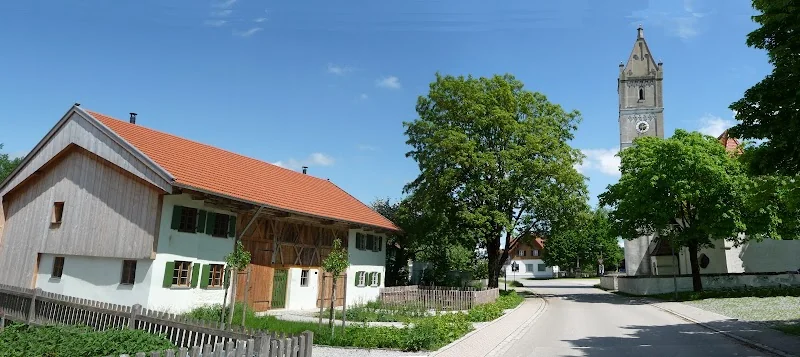
Thaining
Grasweg 20, 86943 Thaining, Deutschland
Rochlhaus Thaining | Events & Photos
The Rochlhaus in Thaining combines monument preservation, village history, and vibrant culture in a compact space. The former farmhouse is located at Grasweg 20, diagonally across from St. Wolfgang Church, is the oldest non-religious building in the village, and has been made publicly accessible again after an extensive renovation. Today, it serves as a venue for exhibitions, concerts, lectures, weddings, and gatherings, while House 81 showcases the historical collection of the local heritage association. The special effect arises from the mix of old building substance, rural location, and a program that not only preserves the past but brings it into the present. Therefore, those searching for Rochlhaus Thaining, Rochlhaus events, or Rochlhaus photos will find not just an address here, but a developed cultural and memory site. ([thaining.de](https://www.thaining.de/vereine/foerderverein-rochlhaus/?utm_source=openai))
Current Events, Concerts, and Exhibitions at Rochlhaus
The current events page shows that the Rochlhaus is not a static local museum, but a very active cultural venue with an ongoing program. For 2026, among other things, lectures, a jazz concert, a painting and sculpture exhibition, a reading, an Austropop concert, and several other exhibitions are scheduled. The rhythm of the dates makes it clear how broad the house's offerings are: music, visual arts, readings, and regional topics run alongside each other. Particularly interesting for search queries are the terms events, program, concert, and exhibition, as they very well represent the house's usage concept. Additionally, the page shows that the offerings do not only take place in summer but are staggered over several months, making the Rochlhaus attractive for different target groups. ([rochlhaus.de](https://www.rochlhaus.de/veranstaltungen-2/?utm_source=openai))
The archive page with past events confirms this profile over several years. There, one can find folk music evenings, lectures on regional history, readings with music, thematic exhibitions, and activities for the Day of Open Monuments. Thus, the Rochlhaus is not limited to a single type of event but functions as a small, versatile place for culture in the rural area. For visitors, this is practical, as they can experience very different formats depending on the date: from an intimate lecture in a historical setting to a concert with regional or national relevance. Therefore, those searching for Rochlhaus events are not just looking for a date but often for a piece of vibrant village culture and a place where cultural preservation is not abstract but directly tangible. ([rochlhaus.de](https://www.rochlhaus.de/vergangene-veranstaltungen/?utm_source=openai))
A look at the current dates also shows how strongly the house works with seasons and local themes. For example, the website announces a lecture in June 2026 about a cookbook from a family in the 17th century, shortly followed by a jazz concert and later in the year exhibitions and concerts with very different musical styles. This range is important for search intentions because users often search for live, current, or program-oriented content and not just a historical description. Thus, the Rochlhaus serves both the desire for information and the desire for experience: people want to know what is happening there and at the same time feel why this place is so well suited for events. ([rochlhaus.de](https://www.rochlhaus.de/veranstaltungen-2/?utm_source=openai))
History of the Rochlhaus and Monument Protection
The history of the Rochlhaus is closely linked to the history of Thaining after the Thirty Years' War. The current form of the house can be traced back to the second half of the 17th century; the first mention of the current Rochlhaus dates to 1651. House 80 was built by Bartholomäus Hueber from Lans in Tyrol, and House 81 was added shortly thereafter. The image panels from 1657 in the neighboring St. Wolfgang Church already show the two parts of the house. This makes the Rochlhaus a particularly well-documented example of rural building and ownership history in the Lechrain region. The building form as a double house and the partially timber-framed construction are unusual enough for the region to make the house interesting from an architectural historical perspective. ([rochlhaus.de](https://www.rochlhaus.de/geschichte/?utm_source=openai))
The building also tells several layers of history. Investigations indicate that the wood of the current roof structure and the wooden posts date from around 1795, while around 1860 the roof structure was made steeper and the earlier wooden shingle covering was replaced with roof tiles. The name Rochlhaus has been established since the late 19th century and goes back to Rochus Finsterwalder, who owned the house around 1890. After decades of decay, the municipality of Thaining acquired the listed property in 2003, and between 2014 and 2015, it was extensively renovated under professional supervision. Today, the building thus combines original substance, careful restoration, and a new cultural use. This combination is particularly strong for SEO because it brings together historical depth, architectural uniqueness, and current relevance. ([rochlhaus.de](https://www.rochlhaus.de/geschichte/?utm_source=openai))
The monument value of the house lies not only in its age but also in its readability. Anyone looking at the facade, the double structure, and the later alterations can recognize how a rural dwelling has changed from the 17th to the 20th century. The Rochlhaus is therefore more than just a pretty old building: it is a piece of tangible local history, where economy, living, remodeling, and memory overlap. Especially for readers searching for history, monument, renovation, or the oldest house in Thaining, this place provides a very clear content value. And because the official website presents the history in such detail, the house can be well understood even without prior knowledge. ([rochlhaus.de](https://www.rochlhaus.de/geschichte/?utm_source=openai))
Location in the Village, Access, and the Surroundings at St. Wolfgang Church
The location of the Rochlhaus is very clear and at the same time picturesque for visitors: Grasweg 20, 86943 Thaining, at the southern edge of the village and diagonally across from St. Wolfgang Church. The official location description emphasizes the beautiful village ensemble into which the building is embedded. Immediately next to it is the village green with trees, a playground, a well, and benches, creating an environment that makes a visit pleasant even beyond a guided tour. Those searching for Rochlhaus Grasweg Thaining or Rochlhaus access will find here mainly orientation about the local context: the house is not isolated but forms a small historical ensemble with the church, the green, and traditional buildings. This makes the place not just a pure tourist attraction but a grown part of the village. ([rochlhaus.de](https://www.rochlhaus.de/lage-im-dorf/?utm_source=openai))
Particularly important for the history of the place is the connection to St. Wolfgang Church. The church was built around 1430 in the late Gothic style and received its Baroque furnishings starting in 1650, which is referred to as Thaininger Bauernbarock. The five image panels from 1657, which also depict the Rochlhaus, create a direct bridge between sacred and secular heritage. For content searches, this is a strong signal: those interested in the Rochlhaus often seek not just a single house but a historical place with a church, village image, and art history. This very connection makes the Rochlhaus particularly valuable in the local context and explains why photos of the house are often searched together with images of St. Wolfgang and the village green. The location is thus not only geographical information but part of the content identity of the place. ([rochlhaus.de](https://www.rochlhaus.de/lage-im-dorf/?utm_source=openai))
Also, for practical orientation, the ensemble is helpful. The church is so close that a visit to the house and a walk through the immediate surroundings can be easily combined. Since the website explicitly mentions the village green, benches, and playground, it creates the image of a place that is also suitable for families, walkers, and culture enthusiasts. This is also important for search engines because search queries about access, location, surroundings, and attractions often overlap. Therefore, the Rochlhaus can be told not just as a building but as part of a small cultural whole, where architecture, history, and village life belong together. ([rochlhaus.de](https://www.rochlhaus.de/lage-im-dorf/?utm_source=openai))
House 80: Event Space with Gallery, Weddings, and Rentals
Today, House 80 is the core of the event usage. The support association organizes a newly created event space with a gallery there, where exhibitions and concerts take place. Additionally, civil weddings and private rentals are possible, making the house interesting for personal and family occasions. The sources also highlight the good acoustics that were deliberately considered for concerts. For smaller groups, there is a room with a tiled stove, thus a space that supports conversation, readings, or small meetings rather than a large stage. This makes House 80 a rare mix of historical ambiance and functional flexibility. This versatility is a strong SEO signal because users often search for event space, wedding, gallery, or rental, meaning very concrete usage options. ([rochlhaus.de](https://www.rochlhaus.de/nutzungskonzept/?utm_source=openai))
The kitchen is also part of the experience and not just an ancillary room. A historical tiled stove from the heritage association's collection has been set up there; at the same time, there is a modern kitchen area. This makes it clear that the Rochlhaus is not only preserved but also brought to life. Visitors thus experience not just reconstruction but a house that has been adapted for today's uses without losing its character. For interior searches, this is important because terms like room, tiled stove, kitchen, and tiled stove convey very concrete impressions. Additionally, a credible contrast arises between the everyday life of the past and today's usage, making the house particularly attractive for readings, small concerts, and private events. ([rochlhaus.de](https://www.rochlhaus.de/nutzungskonzept/?utm_source=openai))
The renovation documents also show that cultural use and good spatial flows were consciously considered during the redesign. From the former stable and threshing area, a space for cultural events was created; the gallery above allows a view into the former threshing floor. This is not only architecturally exciting but also intuitively understandable for visitors: the house visibly narrates its transformation. Such details help in SEO because search intentions for hall, room, gallery, or event space always also inquire about atmosphere. Therefore, those searching for the Rochlhaus often seek a place where history does not appear museum-like but continues to live on in a modern event usage. ([rochlhaus.de](https://www.rochlhaus.de/wp-content/uploads/sites/11/2017/03/Programm-Kulturfahrt-nach-Thaining.pdf?utm_source=openai))
House 81: Historical Gallery, Collection, and Open Sundays
House 81 complements the event level with the historical depth of the place. Here, the local heritage association displays its historically significant exhibits and aims to explore the history of the place and preserve local culture. In the attics of both house parts, further parts of the collection are shown in walk-in display cases. The texts on the website describe these rooms as an opportunity to trace the simple and austere life of farmers in earlier times. Thus, House 81 becomes a kind of cultural memory of the house, shifting the focus from the event to the origin. Those searching for Rochlhaus museum, heritage association, or historical gallery will find the appropriate content answer here. ([rochlhaus.de](https://www.rochlhaus.de/nutzungskonzept/?utm_source=openai))
Particularly helpful for visitors are the open Sundays. House 81 can be visited from May to October on every second Sunday of the month from 2 to 4 PM, alternatively by telephone appointment. During these times, St. Wolfgang Church across the street is also open, making a combined visit very appealing. Those searching for Rochlhaus photos will also find a dedicated gallery on the website with exterior views, detail photos, interior views, and renovation views. This is an important service for users because it allows them to see the character of the house in advance and better contextualize their visit. Especially the image views support the expectation of what the Rochlhaus is: not an artificially staged event space but a carefully restored monument with a comprehensible history. ([rochlhaus.de](https://www.rochlhaus.de/nutzungskonzept/?utm_source=openai))
The connection of collection and public accessibility makes House 81 particularly valuable for local memory culture. It is not just about exhibiting but about preserving and explaining. A visitor can experience cultural events in one part of the house and in the other part understand how rural life, house history, and local development are interconnected. For search terms like photos, museum, open Sundays, or heritage association, this is exactly the content intersection that should carry a good search result. The opening hours are intentionally low-threshold: one afternoon per month is enough to get to know the space while also incorporating the church environment. ([rochlhaus.de](https://www.rochlhaus.de/nutzungskonzept/?utm_source=openai))
Support Association Rochlhaus, Photos, and Visitor Experience
The Support Association Rochlhaus is the driving force behind many of these developments. Together with the municipality and heritage association, funding has been raised for the house; as part of the Heritage Museums 2020 program, nearly 20,000 euros were invested in better exhibition lighting, power supply, an outdoor depot, and a cabinet for old passion and theater costumes. The funding page also mentions further supports, including the purchase of a projector and the award of the monument protection medal. This information shows that the Rochlhaus does not only live from its past but is secured through continuous voluntary and municipal engagement. For search queries about the Support Association Rochlhaus, this is particularly relevant because here not only a name appears but a clear contribution to the cultural infrastructure of the place becomes visible. ([rochlhaus.de](https://www.rochlhaus.de/foerderung/?utm_source=openai))
Precisely for this reason, the Rochlhaus functions so well as an SEO and visitor topic: it unites history, photos, events, exhibitions, concerts, local heritage, and the support association in a single address. The gallery of the website not only shows beautiful views but also the renovation and character of the house as a monument. For those interested, looking at the current program is worthwhile, as well as the image series, because both together provide a complete picture. Therefore, when visiting the Rochlhaus in Thaining, one sees not just an old building but a carefully maintained cultural house that credibly connects village history and the present. In this mix lies the actual charm: the house is small enough for intimacy and large enough for different formats, historically rich enough for depth and lively enough for a current program. ([rochlhaus.de](https://www.rochlhaus.de/galerie/?utm_source=openai))
For user searches, these combination terms are important. Many searchers start with photos or events and then discover the historical dimension; others come through history, monument protection, or St. Wolfgang Church and eventually land at the current program. The Rochlhaus offers a very stable content bridge for this because the website provides both image material and well-founded texts on the origin, renovation, and usage. Thus, the house is a good example of how a local cultural site can become visible online: not through grand superlatives but through authentic details, clear information, and a versatile offer. ([thaining.de](https://www.thaining.de/vereine/foerderverein-rochlhaus/?utm_source=openai))
Sources:
Mehr anzeigenWeniger anzeigen
Rochlhaus Thaining | Events & Photos
The Rochlhaus in Thaining combines monument preservation, village history, and vibrant culture in a compact space. The former farmhouse is located at Grasweg 20, diagonally across from St. Wolfgang Church, is the oldest non-religious building in the village, and has been made publicly accessible again after an extensive renovation. Today, it serves as a venue for exhibitions, concerts, lectures, weddings, and gatherings, while House 81 showcases the historical collection of the local heritage association. The special effect arises from the mix of old building substance, rural location, and a program that not only preserves the past but brings it into the present. Therefore, those searching for Rochlhaus Thaining, Rochlhaus events, or Rochlhaus photos will find not just an address here, but a developed cultural and memory site. ([thaining.de](https://www.thaining.de/vereine/foerderverein-rochlhaus/?utm_source=openai))
Current Events, Concerts, and Exhibitions at Rochlhaus
The current events page shows that the Rochlhaus is not a static local museum, but a very active cultural venue with an ongoing program. For 2026, among other things, lectures, a jazz concert, a painting and sculpture exhibition, a reading, an Austropop concert, and several other exhibitions are scheduled. The rhythm of the dates makes it clear how broad the house's offerings are: music, visual arts, readings, and regional topics run alongside each other. Particularly interesting for search queries are the terms events, program, concert, and exhibition, as they very well represent the house's usage concept. Additionally, the page shows that the offerings do not only take place in summer but are staggered over several months, making the Rochlhaus attractive for different target groups. ([rochlhaus.de](https://www.rochlhaus.de/veranstaltungen-2/?utm_source=openai))
The archive page with past events confirms this profile over several years. There, one can find folk music evenings, lectures on regional history, readings with music, thematic exhibitions, and activities for the Day of Open Monuments. Thus, the Rochlhaus is not limited to a single type of event but functions as a small, versatile place for culture in the rural area. For visitors, this is practical, as they can experience very different formats depending on the date: from an intimate lecture in a historical setting to a concert with regional or national relevance. Therefore, those searching for Rochlhaus events are not just looking for a date but often for a piece of vibrant village culture and a place where cultural preservation is not abstract but directly tangible. ([rochlhaus.de](https://www.rochlhaus.de/vergangene-veranstaltungen/?utm_source=openai))
A look at the current dates also shows how strongly the house works with seasons and local themes. For example, the website announces a lecture in June 2026 about a cookbook from a family in the 17th century, shortly followed by a jazz concert and later in the year exhibitions and concerts with very different musical styles. This range is important for search intentions because users often search for live, current, or program-oriented content and not just a historical description. Thus, the Rochlhaus serves both the desire for information and the desire for experience: people want to know what is happening there and at the same time feel why this place is so well suited for events. ([rochlhaus.de](https://www.rochlhaus.de/veranstaltungen-2/?utm_source=openai))
History of the Rochlhaus and Monument Protection
The history of the Rochlhaus is closely linked to the history of Thaining after the Thirty Years' War. The current form of the house can be traced back to the second half of the 17th century; the first mention of the current Rochlhaus dates to 1651. House 80 was built by Bartholomäus Hueber from Lans in Tyrol, and House 81 was added shortly thereafter. The image panels from 1657 in the neighboring St. Wolfgang Church already show the two parts of the house. This makes the Rochlhaus a particularly well-documented example of rural building and ownership history in the Lechrain region. The building form as a double house and the partially timber-framed construction are unusual enough for the region to make the house interesting from an architectural historical perspective. ([rochlhaus.de](https://www.rochlhaus.de/geschichte/?utm_source=openai))
The building also tells several layers of history. Investigations indicate that the wood of the current roof structure and the wooden posts date from around 1795, while around 1860 the roof structure was made steeper and the earlier wooden shingle covering was replaced with roof tiles. The name Rochlhaus has been established since the late 19th century and goes back to Rochus Finsterwalder, who owned the house around 1890. After decades of decay, the municipality of Thaining acquired the listed property in 2003, and between 2014 and 2015, it was extensively renovated under professional supervision. Today, the building thus combines original substance, careful restoration, and a new cultural use. This combination is particularly strong for SEO because it brings together historical depth, architectural uniqueness, and current relevance. ([rochlhaus.de](https://www.rochlhaus.de/geschichte/?utm_source=openai))
The monument value of the house lies not only in its age but also in its readability. Anyone looking at the facade, the double structure, and the later alterations can recognize how a rural dwelling has changed from the 17th to the 20th century. The Rochlhaus is therefore more than just a pretty old building: it is a piece of tangible local history, where economy, living, remodeling, and memory overlap. Especially for readers searching for history, monument, renovation, or the oldest house in Thaining, this place provides a very clear content value. And because the official website presents the history in such detail, the house can be well understood even without prior knowledge. ([rochlhaus.de](https://www.rochlhaus.de/geschichte/?utm_source=openai))
Location in the Village, Access, and the Surroundings at St. Wolfgang Church
The location of the Rochlhaus is very clear and at the same time picturesque for visitors: Grasweg 20, 86943 Thaining, at the southern edge of the village and diagonally across from St. Wolfgang Church. The official location description emphasizes the beautiful village ensemble into which the building is embedded. Immediately next to it is the village green with trees, a playground, a well, and benches, creating an environment that makes a visit pleasant even beyond a guided tour. Those searching for Rochlhaus Grasweg Thaining or Rochlhaus access will find here mainly orientation about the local context: the house is not isolated but forms a small historical ensemble with the church, the green, and traditional buildings. This makes the place not just a pure tourist attraction but a grown part of the village. ([rochlhaus.de](https://www.rochlhaus.de/lage-im-dorf/?utm_source=openai))
Particularly important for the history of the place is the connection to St. Wolfgang Church. The church was built around 1430 in the late Gothic style and received its Baroque furnishings starting in 1650, which is referred to as Thaininger Bauernbarock. The five image panels from 1657, which also depict the Rochlhaus, create a direct bridge between sacred and secular heritage. For content searches, this is a strong signal: those interested in the Rochlhaus often seek not just a single house but a historical place with a church, village image, and art history. This very connection makes the Rochlhaus particularly valuable in the local context and explains why photos of the house are often searched together with images of St. Wolfgang and the village green. The location is thus not only geographical information but part of the content identity of the place. ([rochlhaus.de](https://www.rochlhaus.de/lage-im-dorf/?utm_source=openai))
Also, for practical orientation, the ensemble is helpful. The church is so close that a visit to the house and a walk through the immediate surroundings can be easily combined. Since the website explicitly mentions the village green, benches, and playground, it creates the image of a place that is also suitable for families, walkers, and culture enthusiasts. This is also important for search engines because search queries about access, location, surroundings, and attractions often overlap. Therefore, the Rochlhaus can be told not just as a building but as part of a small cultural whole, where architecture, history, and village life belong together. ([rochlhaus.de](https://www.rochlhaus.de/lage-im-dorf/?utm_source=openai))
House 80: Event Space with Gallery, Weddings, and Rentals
Today, House 80 is the core of the event usage. The support association organizes a newly created event space with a gallery there, where exhibitions and concerts take place. Additionally, civil weddings and private rentals are possible, making the house interesting for personal and family occasions. The sources also highlight the good acoustics that were deliberately considered for concerts. For smaller groups, there is a room with a tiled stove, thus a space that supports conversation, readings, or small meetings rather than a large stage. This makes House 80 a rare mix of historical ambiance and functional flexibility. This versatility is a strong SEO signal because users often search for event space, wedding, gallery, or rental, meaning very concrete usage options. ([rochlhaus.de](https://www.rochlhaus.de/nutzungskonzept/?utm_source=openai))
The kitchen is also part of the experience and not just an ancillary room. A historical tiled stove from the heritage association's collection has been set up there; at the same time, there is a modern kitchen area. This makes it clear that the Rochlhaus is not only preserved but also brought to life. Visitors thus experience not just reconstruction but a house that has been adapted for today's uses without losing its character. For interior searches, this is important because terms like room, tiled stove, kitchen, and tiled stove convey very concrete impressions. Additionally, a credible contrast arises between the everyday life of the past and today's usage, making the house particularly attractive for readings, small concerts, and private events. ([rochlhaus.de](https://www.rochlhaus.de/nutzungskonzept/?utm_source=openai))
The renovation documents also show that cultural use and good spatial flows were consciously considered during the redesign. From the former stable and threshing area, a space for cultural events was created; the gallery above allows a view into the former threshing floor. This is not only architecturally exciting but also intuitively understandable for visitors: the house visibly narrates its transformation. Such details help in SEO because search intentions for hall, room, gallery, or event space always also inquire about atmosphere. Therefore, those searching for the Rochlhaus often seek a place where history does not appear museum-like but continues to live on in a modern event usage. ([rochlhaus.de](https://www.rochlhaus.de/wp-content/uploads/sites/11/2017/03/Programm-Kulturfahrt-nach-Thaining.pdf?utm_source=openai))
House 81: Historical Gallery, Collection, and Open Sundays
House 81 complements the event level with the historical depth of the place. Here, the local heritage association displays its historically significant exhibits and aims to explore the history of the place and preserve local culture. In the attics of both house parts, further parts of the collection are shown in walk-in display cases. The texts on the website describe these rooms as an opportunity to trace the simple and austere life of farmers in earlier times. Thus, House 81 becomes a kind of cultural memory of the house, shifting the focus from the event to the origin. Those searching for Rochlhaus museum, heritage association, or historical gallery will find the appropriate content answer here. ([rochlhaus.de](https://www.rochlhaus.de/nutzungskonzept/?utm_source=openai))
Particularly helpful for visitors are the open Sundays. House 81 can be visited from May to October on every second Sunday of the month from 2 to 4 PM, alternatively by telephone appointment. During these times, St. Wolfgang Church across the street is also open, making a combined visit very appealing. Those searching for Rochlhaus photos will also find a dedicated gallery on the website with exterior views, detail photos, interior views, and renovation views. This is an important service for users because it allows them to see the character of the house in advance and better contextualize their visit. Especially the image views support the expectation of what the Rochlhaus is: not an artificially staged event space but a carefully restored monument with a comprehensible history. ([rochlhaus.de](https://www.rochlhaus.de/nutzungskonzept/?utm_source=openai))
The connection of collection and public accessibility makes House 81 particularly valuable for local memory culture. It is not just about exhibiting but about preserving and explaining. A visitor can experience cultural events in one part of the house and in the other part understand how rural life, house history, and local development are interconnected. For search terms like photos, museum, open Sundays, or heritage association, this is exactly the content intersection that should carry a good search result. The opening hours are intentionally low-threshold: one afternoon per month is enough to get to know the space while also incorporating the church environment. ([rochlhaus.de](https://www.rochlhaus.de/nutzungskonzept/?utm_source=openai))
Support Association Rochlhaus, Photos, and Visitor Experience
The Support Association Rochlhaus is the driving force behind many of these developments. Together with the municipality and heritage association, funding has been raised for the house; as part of the Heritage Museums 2020 program, nearly 20,000 euros were invested in better exhibition lighting, power supply, an outdoor depot, and a cabinet for old passion and theater costumes. The funding page also mentions further supports, including the purchase of a projector and the award of the monument protection medal. This information shows that the Rochlhaus does not only live from its past but is secured through continuous voluntary and municipal engagement. For search queries about the Support Association Rochlhaus, this is particularly relevant because here not only a name appears but a clear contribution to the cultural infrastructure of the place becomes visible. ([rochlhaus.de](https://www.rochlhaus.de/foerderung/?utm_source=openai))
Precisely for this reason, the Rochlhaus functions so well as an SEO and visitor topic: it unites history, photos, events, exhibitions, concerts, local heritage, and the support association in a single address. The gallery of the website not only shows beautiful views but also the renovation and character of the house as a monument. For those interested, looking at the current program is worthwhile, as well as the image series, because both together provide a complete picture. Therefore, when visiting the Rochlhaus in Thaining, one sees not just an old building but a carefully maintained cultural house that credibly connects village history and the present. In this mix lies the actual charm: the house is small enough for intimacy and large enough for different formats, historically rich enough for depth and lively enough for a current program. ([rochlhaus.de](https://www.rochlhaus.de/galerie/?utm_source=openai))
For user searches, these combination terms are important. Many searchers start with photos or events and then discover the historical dimension; others come through history, monument protection, or St. Wolfgang Church and eventually land at the current program. The Rochlhaus offers a very stable content bridge for this because the website provides both image material and well-founded texts on the origin, renovation, and usage. Thus, the house is a good example of how a local cultural site can become visible online: not through grand superlatives but through authentic details, clear information, and a versatile offer. ([thaining.de](https://www.thaining.de/vereine/foerderverein-rochlhaus/?utm_source=openai))
Sources:
Rochlhaus Thaining | Events & Photos
The Rochlhaus in Thaining combines monument preservation, village history, and vibrant culture in a compact space. The former farmhouse is located at Grasweg 20, diagonally across from St. Wolfgang Church, is the oldest non-religious building in the village, and has been made publicly accessible again after an extensive renovation. Today, it serves as a venue for exhibitions, concerts, lectures, weddings, and gatherings, while House 81 showcases the historical collection of the local heritage association. The special effect arises from the mix of old building substance, rural location, and a program that not only preserves the past but brings it into the present. Therefore, those searching for Rochlhaus Thaining, Rochlhaus events, or Rochlhaus photos will find not just an address here, but a developed cultural and memory site. ([thaining.de](https://www.thaining.de/vereine/foerderverein-rochlhaus/?utm_source=openai))
Current Events, Concerts, and Exhibitions at Rochlhaus
The current events page shows that the Rochlhaus is not a static local museum, but a very active cultural venue with an ongoing program. For 2026, among other things, lectures, a jazz concert, a painting and sculpture exhibition, a reading, an Austropop concert, and several other exhibitions are scheduled. The rhythm of the dates makes it clear how broad the house's offerings are: music, visual arts, readings, and regional topics run alongside each other. Particularly interesting for search queries are the terms events, program, concert, and exhibition, as they very well represent the house's usage concept. Additionally, the page shows that the offerings do not only take place in summer but are staggered over several months, making the Rochlhaus attractive for different target groups. ([rochlhaus.de](https://www.rochlhaus.de/veranstaltungen-2/?utm_source=openai))
The archive page with past events confirms this profile over several years. There, one can find folk music evenings, lectures on regional history, readings with music, thematic exhibitions, and activities for the Day of Open Monuments. Thus, the Rochlhaus is not limited to a single type of event but functions as a small, versatile place for culture in the rural area. For visitors, this is practical, as they can experience very different formats depending on the date: from an intimate lecture in a historical setting to a concert with regional or national relevance. Therefore, those searching for Rochlhaus events are not just looking for a date but often for a piece of vibrant village culture and a place where cultural preservation is not abstract but directly tangible. ([rochlhaus.de](https://www.rochlhaus.de/vergangene-veranstaltungen/?utm_source=openai))
A look at the current dates also shows how strongly the house works with seasons and local themes. For example, the website announces a lecture in June 2026 about a cookbook from a family in the 17th century, shortly followed by a jazz concert and later in the year exhibitions and concerts with very different musical styles. This range is important for search intentions because users often search for live, current, or program-oriented content and not just a historical description. Thus, the Rochlhaus serves both the desire for information and the desire for experience: people want to know what is happening there and at the same time feel why this place is so well suited for events. ([rochlhaus.de](https://www.rochlhaus.de/veranstaltungen-2/?utm_source=openai))
History of the Rochlhaus and Monument Protection
The history of the Rochlhaus is closely linked to the history of Thaining after the Thirty Years' War. The current form of the house can be traced back to the second half of the 17th century; the first mention of the current Rochlhaus dates to 1651. House 80 was built by Bartholomäus Hueber from Lans in Tyrol, and House 81 was added shortly thereafter. The image panels from 1657 in the neighboring St. Wolfgang Church already show the two parts of the house. This makes the Rochlhaus a particularly well-documented example of rural building and ownership history in the Lechrain region. The building form as a double house and the partially timber-framed construction are unusual enough for the region to make the house interesting from an architectural historical perspective. ([rochlhaus.de](https://www.rochlhaus.de/geschichte/?utm_source=openai))
The building also tells several layers of history. Investigations indicate that the wood of the current roof structure and the wooden posts date from around 1795, while around 1860 the roof structure was made steeper and the earlier wooden shingle covering was replaced with roof tiles. The name Rochlhaus has been established since the late 19th century and goes back to Rochus Finsterwalder, who owned the house around 1890. After decades of decay, the municipality of Thaining acquired the listed property in 2003, and between 2014 and 2015, it was extensively renovated under professional supervision. Today, the building thus combines original substance, careful restoration, and a new cultural use. This combination is particularly strong for SEO because it brings together historical depth, architectural uniqueness, and current relevance. ([rochlhaus.de](https://www.rochlhaus.de/geschichte/?utm_source=openai))
The monument value of the house lies not only in its age but also in its readability. Anyone looking at the facade, the double structure, and the later alterations can recognize how a rural dwelling has changed from the 17th to the 20th century. The Rochlhaus is therefore more than just a pretty old building: it is a piece of tangible local history, where economy, living, remodeling, and memory overlap. Especially for readers searching for history, monument, renovation, or the oldest house in Thaining, this place provides a very clear content value. And because the official website presents the history in such detail, the house can be well understood even without prior knowledge. ([rochlhaus.de](https://www.rochlhaus.de/geschichte/?utm_source=openai))
Location in the Village, Access, and the Surroundings at St. Wolfgang Church
The location of the Rochlhaus is very clear and at the same time picturesque for visitors: Grasweg 20, 86943 Thaining, at the southern edge of the village and diagonally across from St. Wolfgang Church. The official location description emphasizes the beautiful village ensemble into which the building is embedded. Immediately next to it is the village green with trees, a playground, a well, and benches, creating an environment that makes a visit pleasant even beyond a guided tour. Those searching for Rochlhaus Grasweg Thaining or Rochlhaus access will find here mainly orientation about the local context: the house is not isolated but forms a small historical ensemble with the church, the green, and traditional buildings. This makes the place not just a pure tourist attraction but a grown part of the village. ([rochlhaus.de](https://www.rochlhaus.de/lage-im-dorf/?utm_source=openai))
Particularly important for the history of the place is the connection to St. Wolfgang Church. The church was built around 1430 in the late Gothic style and received its Baroque furnishings starting in 1650, which is referred to as Thaininger Bauernbarock. The five image panels from 1657, which also depict the Rochlhaus, create a direct bridge between sacred and secular heritage. For content searches, this is a strong signal: those interested in the Rochlhaus often seek not just a single house but a historical place with a church, village image, and art history. This very connection makes the Rochlhaus particularly valuable in the local context and explains why photos of the house are often searched together with images of St. Wolfgang and the village green. The location is thus not only geographical information but part of the content identity of the place. ([rochlhaus.de](https://www.rochlhaus.de/lage-im-dorf/?utm_source=openai))
Also, for practical orientation, the ensemble is helpful. The church is so close that a visit to the house and a walk through the immediate surroundings can be easily combined. Since the website explicitly mentions the village green, benches, and playground, it creates the image of a place that is also suitable for families, walkers, and culture enthusiasts. This is also important for search engines because search queries about access, location, surroundings, and attractions often overlap. Therefore, the Rochlhaus can be told not just as a building but as part of a small cultural whole, where architecture, history, and village life belong together. ([rochlhaus.de](https://www.rochlhaus.de/lage-im-dorf/?utm_source=openai))
House 80: Event Space with Gallery, Weddings, and Rentals
Today, House 80 is the core of the event usage. The support association organizes a newly created event space with a gallery there, where exhibitions and concerts take place. Additionally, civil weddings and private rentals are possible, making the house interesting for personal and family occasions. The sources also highlight the good acoustics that were deliberately considered for concerts. For smaller groups, there is a room with a tiled stove, thus a space that supports conversation, readings, or small meetings rather than a large stage. This makes House 80 a rare mix of historical ambiance and functional flexibility. This versatility is a strong SEO signal because users often search for event space, wedding, gallery, or rental, meaning very concrete usage options. ([rochlhaus.de](https://www.rochlhaus.de/nutzungskonzept/?utm_source=openai))
The kitchen is also part of the experience and not just an ancillary room. A historical tiled stove from the heritage association's collection has been set up there; at the same time, there is a modern kitchen area. This makes it clear that the Rochlhaus is not only preserved but also brought to life. Visitors thus experience not just reconstruction but a house that has been adapted for today's uses without losing its character. For interior searches, this is important because terms like room, tiled stove, kitchen, and tiled stove convey very concrete impressions. Additionally, a credible contrast arises between the everyday life of the past and today's usage, making the house particularly attractive for readings, small concerts, and private events. ([rochlhaus.de](https://www.rochlhaus.de/nutzungskonzept/?utm_source=openai))
The renovation documents also show that cultural use and good spatial flows were consciously considered during the redesign. From the former stable and threshing area, a space for cultural events was created; the gallery above allows a view into the former threshing floor. This is not only architecturally exciting but also intuitively understandable for visitors: the house visibly narrates its transformation. Such details help in SEO because search intentions for hall, room, gallery, or event space always also inquire about atmosphere. Therefore, those searching for the Rochlhaus often seek a place where history does not appear museum-like but continues to live on in a modern event usage. ([rochlhaus.de](https://www.rochlhaus.de/wp-content/uploads/sites/11/2017/03/Programm-Kulturfahrt-nach-Thaining.pdf?utm_source=openai))
House 81: Historical Gallery, Collection, and Open Sundays
House 81 complements the event level with the historical depth of the place. Here, the local heritage association displays its historically significant exhibits and aims to explore the history of the place and preserve local culture. In the attics of both house parts, further parts of the collection are shown in walk-in display cases. The texts on the website describe these rooms as an opportunity to trace the simple and austere life of farmers in earlier times. Thus, House 81 becomes a kind of cultural memory of the house, shifting the focus from the event to the origin. Those searching for Rochlhaus museum, heritage association, or historical gallery will find the appropriate content answer here. ([rochlhaus.de](https://www.rochlhaus.de/nutzungskonzept/?utm_source=openai))
Particularly helpful for visitors are the open Sundays. House 81 can be visited from May to October on every second Sunday of the month from 2 to 4 PM, alternatively by telephone appointment. During these times, St. Wolfgang Church across the street is also open, making a combined visit very appealing. Those searching for Rochlhaus photos will also find a dedicated gallery on the website with exterior views, detail photos, interior views, and renovation views. This is an important service for users because it allows them to see the character of the house in advance and better contextualize their visit. Especially the image views support the expectation of what the Rochlhaus is: not an artificially staged event space but a carefully restored monument with a comprehensible history. ([rochlhaus.de](https://www.rochlhaus.de/nutzungskonzept/?utm_source=openai))
The connection of collection and public accessibility makes House 81 particularly valuable for local memory culture. It is not just about exhibiting but about preserving and explaining. A visitor can experience cultural events in one part of the house and in the other part understand how rural life, house history, and local development are interconnected. For search terms like photos, museum, open Sundays, or heritage association, this is exactly the content intersection that should carry a good search result. The opening hours are intentionally low-threshold: one afternoon per month is enough to get to know the space while also incorporating the church environment. ([rochlhaus.de](https://www.rochlhaus.de/nutzungskonzept/?utm_source=openai))
Support Association Rochlhaus, Photos, and Visitor Experience
The Support Association Rochlhaus is the driving force behind many of these developments. Together with the municipality and heritage association, funding has been raised for the house; as part of the Heritage Museums 2020 program, nearly 20,000 euros were invested in better exhibition lighting, power supply, an outdoor depot, and a cabinet for old passion and theater costumes. The funding page also mentions further supports, including the purchase of a projector and the award of the monument protection medal. This information shows that the Rochlhaus does not only live from its past but is secured through continuous voluntary and municipal engagement. For search queries about the Support Association Rochlhaus, this is particularly relevant because here not only a name appears but a clear contribution to the cultural infrastructure of the place becomes visible. ([rochlhaus.de](https://www.rochlhaus.de/foerderung/?utm_source=openai))
Precisely for this reason, the Rochlhaus functions so well as an SEO and visitor topic: it unites history, photos, events, exhibitions, concerts, local heritage, and the support association in a single address. The gallery of the website not only shows beautiful views but also the renovation and character of the house as a monument. For those interested, looking at the current program is worthwhile, as well as the image series, because both together provide a complete picture. Therefore, when visiting the Rochlhaus in Thaining, one sees not just an old building but a carefully maintained cultural house that credibly connects village history and the present. In this mix lies the actual charm: the house is small enough for intimacy and large enough for different formats, historically rich enough for depth and lively enough for a current program. ([rochlhaus.de](https://www.rochlhaus.de/galerie/?utm_source=openai))
For user searches, these combination terms are important. Many searchers start with photos or events and then discover the historical dimension; others come through history, monument protection, or St. Wolfgang Church and eventually land at the current program. The Rochlhaus offers a very stable content bridge for this because the website provides both image material and well-founded texts on the origin, renovation, and usage. Thus, the house is a good example of how a local cultural site can become visible online: not through grand superlatives but through authentic details, clear information, and a versatile offer. ([thaining.de](https://www.thaining.de/vereine/foerderverein-rochlhaus/?utm_source=openai))
Sources:
Upcoming Events
Exhibition Dieter Lier Photography at Rochlhaus
Visit the impressive photo exhibition by Dieter Lier in Thaining and experience creative artworks in a relaxed atmosphere.
Dieter Lier – Photography at Rochlhaus Thaining
Photography in a special atmosphere: Dieter Lier at Rochlhaus Thaining connects image, space, and history. Opening on 18.09.2026. #Photography #Art
Frequently Asked Questions
Reviews
No reviews found