
Dießen am Ammersee
Klosterhof 14, 86911 Dießen am Ammersee, Deutschland
Münster Mariä Himmelfahrt | Photos & History
The Münster Mariä Himmelfahrt in Dießen am Ammersee is one of the most famous church spaces in Upper Bavaria and is much more than just a beautiful stop by the lake. Those looking for photos, reviews, or historical backgrounds quickly find themselves at a building that unites Baroque art, spiritual significance, and regional identity in rare density. The former monastery church of the Augustinian canons stands high above the town, is now a parish church, and has been referred to as Marienmünster since 1988. Even from the outside, it conveys grandeur and dignity; inside, a space unfolds that has an almost scenic effect through frescoes, stucco, altars, organ, and bells. This mixture of a cultural monument, place of prayer, and cultural magnet makes the location so extraordinary. Visitor feedback supports this: With 4.7 stars and 873 reviews, it is clear that the Münster is well received by guests not only for its history but also for its atmosphere. ([diessen.de](https://www.diessen.de/ortsplan))
History of the Marienmünster in Dießen am Ammersee
The history of the Marienmünster does not begin with the Baroque reconstruction but with a longer development of sacred architecture at this site. Initially, a Romanesque predecessor building stood on the site, followed by a Gothic reconstruction, before the current church space was created in the 18th century. In 1732, the reconstruction was commissioned by the art-loving provost Herkulan Karg and completed in 1739 under the guidance of the Munich master builder Johann Michael Fischer. Thus, the church is one of Fischer's main works and one of the most significant creations of sacred architecture of Bavarian Baroque. The building is over 70 meters long and already shows in its dimensions that this is not just a parish center but a representative church of the old monastery. The former monastery church has been the parish church of Mariä Himmelfahrt since 1804; in 1988 it was officially elevated to Marienmünster. This development is important because it marks the transition from a monastic center to a place of identity for the community. At the same time, the building itself tells of breaks: In 1827, the tower was destroyed by a lightning strike and initially replaced by a plain neo-Gothic tower. Only in 1985/86 was the so-called Fischer Tower rebuilt according to the original design of Johann Michael Fischer, restoring the historical silhouette of the ensemble. Today, standing at the Klosterhof, one sees not only a Baroque monument but also a carefully restored piece of local history that has withstood centuries of religious, political, and artistic upheaval. ([diessen.de](https://www.diessen.de/ortsplan))
The historical significance of the Marienmünster is also underscored by its close connection to the old Augustinian canon monastery. The Münster was the burial place of the House of Andechs-Meranien, and this historical depth makes the site particularly attractive for visitors interested in history, regional tradition, and spiritual heritage. The parish describes the church as a path to heaven, beginning at the portal and leading through the pictorial program to the high altar. This interpretation is not merely a later narrative but part of the Baroque overall concept in which architecture, painting, sculpture, and liturgy intertwine. This explains why the Marienmünster is not simply perceived as a church but as a cultural landmark of the town of Dießen. Especially in connection with the historical bells, the musical tradition, and the monumental furnishings, it becomes clear that here, over centuries, a place has emerged that combines faith, power, and art in a single architectural idea. Therefore, those interested in the term Marienmünster will find a church with extraordinary historical layering and a clear Baroque signature. ([katholisch-diessen.de](https://katholisch-diessen.de/unsere-kirchen/bedeutung-des-marienmuensters/))
Photos, Frescoes, and Baroque Art Inside
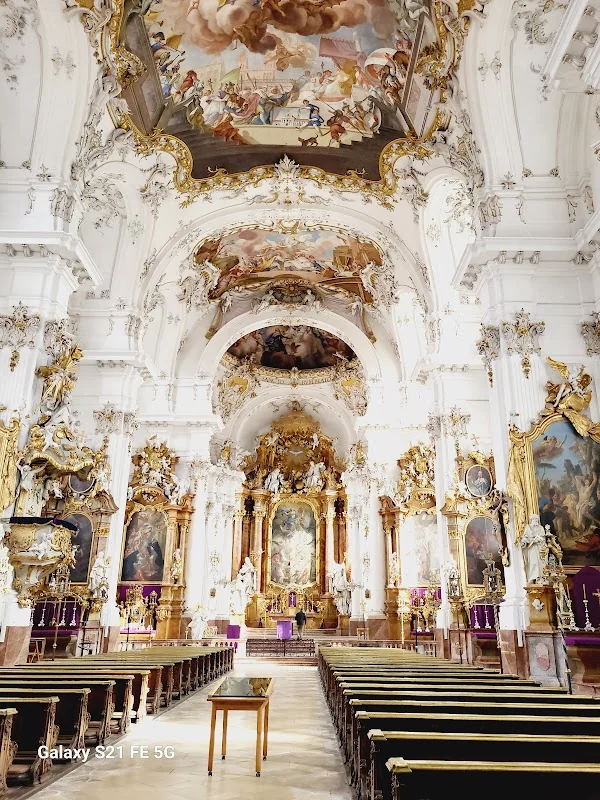
For many visitors, the Marienmünster is primarily a place for impressive photos because the interior design overwhelms at first glance. Especially striking are the ceiling frescoes by Johann Georg Bergmüller from 1736. They focus on four large picture fields and narrate the history of the place and the monastery in historical and theological condensation. In the choir dome, the so-called Dießen Heavenly Heaven appears with the saints and blessed from the lineage of the Dießen-Andechs counts. In the nave, founding stories of the monasteries St. Stephan and St. Maria are depicted in images. This local iconography makes the Münster a space where art is not merely decorative but has a narrative and identity-forming function. Additionally, there are the stuccos by Franz Xaver and Johann Michael Feichtmayr as well as Johann Georg Üblherr, which frame the pictorial program with their ornamental richness. Their early Rococo proximity ensures that the eye constantly wanders between calm surfaces, moving plant motifs, and figurative elements. The result is a church space that offers new photo opportunities in every corner: the bright nave architecture, the muted depth of the choir, the artistic ceiling zones, and the transitions between painting and stucco. ([katholisch-diessen.de](https://katholisch-diessen.de/unsere-kirchen/bedeutung-des-marienmuensters/))
The perhaps most spectacular focal point is the high altar. It is described as a massive changing altar and is constructed in the sense of a Theatrum Sacrum. This means: It is not just an altar design but a kind of liturgical stage. The altar painting depicts the Assumption of Mary; in festive use, changing backdrop scenes can open behind the image, making the salvation history visible in an almost scenic form. This idea makes the high altar a unique feature among Baroque church spaces and also explains why the Münster is so often highlighted in art historical literature. Four life-size figures of the Church Fathers flank the altar on both sides, which are considered masterpieces of Bavarian Baroque sculpture. Additionally, the side altars feature paintings by Giovanni Battista Pittoni and Giovanni Battista Tiepolo, works that impressively demonstrate the international aspirations of the former monastery. The contrast between Bavarian building and furnishing tradition and Venetian painting makes the interior so exciting. Those searching for the keyword photos will find here not only beautiful views but a whole world of images made of light, gold, color, and movement. The church is thus not only photogenic but visually highly complex. ([baroqueart.museumwnf.org](https://baroqueart.museumwnf.org/database_item.php?id=monument%3BBAR%3Bde%3BMon12%3B9%3Bde))
Other highlights include the mystery stage and the Baroque side chapels. The parish explicitly describes the mystery stage as a unique feature with great backdrops. This is rare in this form and makes the Marienmünster interesting for visitors who usually know church spaces as quiet places. In the Marienmünster, the liturgical year is made visible, not only in images but in a whole logic of staging. This is particularly impressive in combination with local piety and holiday customs. The side altars, pulpit, organ railing, and baptismal chapel complement this overall impression and show how closely sculpture, painting, and spatial effect interact. Those photographing here should not only think of individual details but of the overall atmosphere: the transition between bright expanse and concentrated depth, between Baroque abundance and spiritual calm. For this reason, the Marienmünster is often perceived as one of the most beautiful church spaces in Bavaria. The church is not a museum in the strict sense but a living space where beauty and function continue to support each other to this day. ([katholisch-diessen.de](https://katholisch-diessen.de/unsere-kirchen/bedeutung-des-marienmuensters/))
Directions and Parking at Klosterhof 14
For practical planning, the address Klosterhof 14, 86911 Dießen am Ammersee is crucial. The entry in the local map of the market Dießen lists the Catholic parish church of Mariä Himmelfahrt directly under this location and also refers to the official parish community. Those arriving by car will find several zones and designated parking spaces in the community's parking system. Particularly important for the Marienmünster is the Marienmünster parking lot, which is listed as parking lot 15 in zone 2 in the municipal parking overview. In zone 1 and zone 2, the first 30 minutes are free; after that, the normal fee regulations apply. This is practical for short visits or a quick church visit, as one does not have to plan for long parking times immediately. Additionally, the community designates the Klosterhof parking lot as a special area; on Sundays and public holidays, the fee obligation there and in front of the Marienmünster begins only at 12:00 PM. Therefore, those planning a visit on a holiday should keep this rule in mind to arrive relaxed. The community also points out digital payment options and parking ticket machines, making usage uncomplicated. ([diessen.de](https://www.diessen.de/ortsplan))
Orientation on site is overall simple because the Marienmünster is clearly named in the local map and is located in an area with other cultural points. For first-time visitors, it is advisable to pay attention to the parking regulations not just roughly but specifically, as Dießen has a well-organized but also controlled parking system. Especially during times of higher visitor traffic, such as concerts, church tours, or holidays, the official parking spaces are the safest option. It is also practical that the community has its own rules for the area around the Marienmünster and the Klosterhof, which are designed for short distances to the church building. This way, the visit can be planned with little effort: park, walk the few steps to the Münster, let the Baroque building take effect, and then drive away relaxed. Those who also pay attention to the surroundings will quickly notice that the Münster serves as a historical focal point of the town center. The interplay of central location, clearly designated parking spaces, and a well-thought-out parking order makes the visit pleasant, provided one pays attention to the signage. For SEO searches regarding directions and parking, this is therefore a particularly relevant point, as practical information and visitor interest meet directly here. ([diessen.de](https://www.diessen.de/ortsplan))
Organ, Bells, and the Diessen Münster Concerts
Another reason why the Münster Mariä Himmelfahrt is searched so frequently is its musical tradition. The organ is a central element of the spatial effect and at the same time a historical instrument of special significance. According to the parish, the Marienmünster received an organ work from Caspar König from Ingolstadt in 1739. The organ builder had to consider the lighting of the three windows on the west gallery, which is why a symmetrical three-part structure was created. The organ case was richly decorated and still fits closely into the space today. The parish describes the König organ as an important example of classical organ building principles. Later, in 1878, a romantic redesign was carried out by Max Maerz, while the prospect was preserved and the original windchests were not lost. For visitors, this means: The organ is not only a sound instrument but also a cultural monument that makes the development of music in the Münster comprehensible. Therefore, those searching for organ, concert, or church music will find here a nationally known example of the connection between architecture and sound. ([katholisch-diessen.de](https://katholisch-diessen.de/kirchenmusik/orgel/))
However, the music history of the church does not end with the organ. According to the parish, there has been church music and choral singing in Dießen since the founding time of the Augustinian monastery in the Middle Ages. In the 18th century, musical life reached a particular peak, and the tradition continued in the second half of the 20th century. Today, the Diessen Münster concerts and organ matinees are a fixed part of the cultural profile. This is important for the perception of the location because many visitors experience the Marienmünster not only as a monument but as a lively concert venue. The high acoustics, the proximity to the organ, and the interplay with the historical space explain why these events are known far beyond the region. For the search terms Münsterkonzerte Dießen and Orgel Marienmünster, these are the central facts. The current church music framework is also recorded: Since January 2025, Agata Leichtscheidel has been the church musician in Dießen. Thus, the music tradition is not a thing of the past but a present reality. This makes the visit particularly interesting for concert lovers, especially when one wants to not only look at the Baroque ambiance but also hear it. ([katholisch-diessen.de](https://katholisch-diessen.de/kirchenmusik/geschichte/))
Additionally, the ringing of the eight bells acoustically shapes the church space and the church year. The parish describes that after the reconstruction of the tower, four historical bells and four newly cast bells are present. The ensemble is tuned so that it can produce different sound images on Sundays and public holidays as well as during Lent, Easter, or the patronage feast. Particularly interesting for the term Mariä Himmelfahrt holiday is that the bells ring in a special way on August 15, the feast of the Assumption of Mary. The daily ringing motifs are also explained: in the morning, at noon, and in the evening, on Thursdays and Fridays, as well as on Saturday evenings to herald the Sunday. Thus, the Marienmünster is not only visually but also acoustically a place with a clear rhythm. The bells mark time, feast, and community belonging. Those who experience the space during a service or a tour quickly feel that sound is no trivial matter here. The organ, the bells, and the concert series together form a cultural profile that has made the place known far beyond Dießen. ([katholisch-diessen.de](https://katholisch-diessen.de/unsere-kirchen/glocken-des-marienmuensters/))
Mariä Himmelfahrt, Services, and the Special Significance of the Place
The name Mariä Himmelfahrt is not just a simple dedication at the Dießen Münster but the core of the spiritual narrative. The parish describes the building as a path to heaven, which begins at the portal and leads through the high altar, pictorial program, and mystery stage. This is more than symbolism, as the entire space is designed so that the visitor is not only looking but is spiritually taken along. Especially in a time when many travelers seek photos, reviews, and a quick impression, the Marienmünster offers a counter-model: a place where art slows down and meaning becomes visible. The official parish emphasizes that many people find inner peace and spiritual retreat here, and that church tours are meant to convey not only information but also a spiritual exploration of the house of God. This connection of knowledge, atmosphere, and devotion makes the place so special. Therefore, those visiting the location do not simply receive a sight but a multifaceted experience of history, liturgy, and art. ([katholisch-diessen.de](https://katholisch-diessen.de/unsere-kirchen/bedeutung-des-marienmuensters/))
This is particularly fitting on the feast of Mariä Himmelfahrt, that is, on August 15. The bell order explicitly mentions that on this patronage feast, the Easter Hallelujah rings out and proclaims the hope of eternal life. This is interesting for visitors who want to align their journey with religious highlights or simply want to experience the special sound of a high feast. At the same time, the Münster remains an open space with continuous significance in everyday life: services, church music, tours, and personal visits structure the year. For search queries like mariä himmelfahrt holiday münster or mariä himmelfahrt holiday near münster, it is therefore important to know that here not only the holiday name stands but that there is indeed a central liturgical reference point of the place. The high visitor rating of 4.7 stars with 873 reviews further underscores that the place is well received by guests. Those looking for a mix of tranquility, Baroque splendor, and local place of faith will find it here. The Marienmünster is thus both a monument, parish church, and symbol for Dießen am Ammersee. ([katholisch-diessen.de](https://katholisch-diessen.de/unsere-kirchen/glocken-des-marienmuensters/))
For a practical visit, it is worthwhile to pay attention not only to the church space but also to the context: The Münster is in immediate connection to the historical townscape, the paths of the Klosterhof, and the cultural offerings of the community. Those who have more time can consciously perceive the effect of the facade, the reconstructed tower, and the interaction between the outdoor and indoor spaces. Those who only stop by briefly will primarily orient themselves on the unusual height of the space, the brightness, and the Baroque abundance. The strength of the Marienmünster lies in the fact that it allows both: quiet devotion and intense wonder. For a content plan in the SEO area, this is valuable because the search intentions for photos, reviews, directions, parking, history, and organ result in a very clear mix of topics. The Marienmünster is not just a search term but a real cultural destination with a distinctive identity. Anyone visiting Dießen am Ammersee should not only have this church on their list but also plan it as one of the most important anchor points of the place. ([diessen.de](https://www.diessen.de/ortsplan))
Sources:
- Dießen am Ammersee – Marienmünster (diessen.de)
- Parish Community Dießen – Significance of the Marienmünster
- Parish Community Dießen – Organ
- Parish Community Dießen – Bells of the Marienmünster
- Market Dießen am Ammersee – Local Map and Parking
- Discover Baroque Art – Catholic Parish Church Mariä Himmelfahrt
- Dehio DE – Furnishings and Ceiling Paintings
Show moreShow less
Münster Mariä Himmelfahrt | Photos & History
The Münster Mariä Himmelfahrt in Dießen am Ammersee is one of the most famous church spaces in Upper Bavaria and is much more than just a beautiful stop by the lake. Those looking for photos, reviews, or historical backgrounds quickly find themselves at a building that unites Baroque art, spiritual significance, and regional identity in rare density. The former monastery church of the Augustinian canons stands high above the town, is now a parish church, and has been referred to as Marienmünster since 1988. Even from the outside, it conveys grandeur and dignity; inside, a space unfolds that has an almost scenic effect through frescoes, stucco, altars, organ, and bells. This mixture of a cultural monument, place of prayer, and cultural magnet makes the location so extraordinary. Visitor feedback supports this: With 4.7 stars and 873 reviews, it is clear that the Münster is well received by guests not only for its history but also for its atmosphere. ([diessen.de](https://www.diessen.de/ortsplan))
History of the Marienmünster in Dießen am Ammersee
The history of the Marienmünster does not begin with the Baroque reconstruction but with a longer development of sacred architecture at this site. Initially, a Romanesque predecessor building stood on the site, followed by a Gothic reconstruction, before the current church space was created in the 18th century. In 1732, the reconstruction was commissioned by the art-loving provost Herkulan Karg and completed in 1739 under the guidance of the Munich master builder Johann Michael Fischer. Thus, the church is one of Fischer's main works and one of the most significant creations of sacred architecture of Bavarian Baroque. The building is over 70 meters long and already shows in its dimensions that this is not just a parish center but a representative church of the old monastery. The former monastery church has been the parish church of Mariä Himmelfahrt since 1804; in 1988 it was officially elevated to Marienmünster. This development is important because it marks the transition from a monastic center to a place of identity for the community. At the same time, the building itself tells of breaks: In 1827, the tower was destroyed by a lightning strike and initially replaced by a plain neo-Gothic tower. Only in 1985/86 was the so-called Fischer Tower rebuilt according to the original design of Johann Michael Fischer, restoring the historical silhouette of the ensemble. Today, standing at the Klosterhof, one sees not only a Baroque monument but also a carefully restored piece of local history that has withstood centuries of religious, political, and artistic upheaval. ([diessen.de](https://www.diessen.de/ortsplan))
The historical significance of the Marienmünster is also underscored by its close connection to the old Augustinian canon monastery. The Münster was the burial place of the House of Andechs-Meranien, and this historical depth makes the site particularly attractive for visitors interested in history, regional tradition, and spiritual heritage. The parish describes the church as a path to heaven, beginning at the portal and leading through the pictorial program to the high altar. This interpretation is not merely a later narrative but part of the Baroque overall concept in which architecture, painting, sculpture, and liturgy intertwine. This explains why the Marienmünster is not simply perceived as a church but as a cultural landmark of the town of Dießen. Especially in connection with the historical bells, the musical tradition, and the monumental furnishings, it becomes clear that here, over centuries, a place has emerged that combines faith, power, and art in a single architectural idea. Therefore, those interested in the term Marienmünster will find a church with extraordinary historical layering and a clear Baroque signature. ([katholisch-diessen.de](https://katholisch-diessen.de/unsere-kirchen/bedeutung-des-marienmuensters/))
Photos, Frescoes, and Baroque Art Inside
For many visitors, the Marienmünster is primarily a place for impressive photos because the interior design overwhelms at first glance. Especially striking are the ceiling frescoes by Johann Georg Bergmüller from 1736. They focus on four large picture fields and narrate the history of the place and the monastery in historical and theological condensation. In the choir dome, the so-called Dießen Heavenly Heaven appears with the saints and blessed from the lineage of the Dießen-Andechs counts. In the nave, founding stories of the monasteries St. Stephan and St. Maria are depicted in images. This local iconography makes the Münster a space where art is not merely decorative but has a narrative and identity-forming function. Additionally, there are the stuccos by Franz Xaver and Johann Michael Feichtmayr as well as Johann Georg Üblherr, which frame the pictorial program with their ornamental richness. Their early Rococo proximity ensures that the eye constantly wanders between calm surfaces, moving plant motifs, and figurative elements. The result is a church space that offers new photo opportunities in every corner: the bright nave architecture, the muted depth of the choir, the artistic ceiling zones, and the transitions between painting and stucco. ([katholisch-diessen.de](https://katholisch-diessen.de/unsere-kirchen/bedeutung-des-marienmuensters/))
The perhaps most spectacular focal point is the high altar. It is described as a massive changing altar and is constructed in the sense of a Theatrum Sacrum. This means: It is not just an altar design but a kind of liturgical stage. The altar painting depicts the Assumption of Mary; in festive use, changing backdrop scenes can open behind the image, making the salvation history visible in an almost scenic form. This idea makes the high altar a unique feature among Baroque church spaces and also explains why the Münster is so often highlighted in art historical literature. Four life-size figures of the Church Fathers flank the altar on both sides, which are considered masterpieces of Bavarian Baroque sculpture. Additionally, the side altars feature paintings by Giovanni Battista Pittoni and Giovanni Battista Tiepolo, works that impressively demonstrate the international aspirations of the former monastery. The contrast between Bavarian building and furnishing tradition and Venetian painting makes the interior so exciting. Those searching for the keyword photos will find here not only beautiful views but a whole world of images made of light, gold, color, and movement. The church is thus not only photogenic but visually highly complex. ([baroqueart.museumwnf.org](https://baroqueart.museumwnf.org/database_item.php?id=monument%3BBAR%3Bde%3BMon12%3B9%3Bde))
Other highlights include the mystery stage and the Baroque side chapels. The parish explicitly describes the mystery stage as a unique feature with great backdrops. This is rare in this form and makes the Marienmünster interesting for visitors who usually know church spaces as quiet places. In the Marienmünster, the liturgical year is made visible, not only in images but in a whole logic of staging. This is particularly impressive in combination with local piety and holiday customs. The side altars, pulpit, organ railing, and baptismal chapel complement this overall impression and show how closely sculpture, painting, and spatial effect interact. Those photographing here should not only think of individual details but of the overall atmosphere: the transition between bright expanse and concentrated depth, between Baroque abundance and spiritual calm. For this reason, the Marienmünster is often perceived as one of the most beautiful church spaces in Bavaria. The church is not a museum in the strict sense but a living space where beauty and function continue to support each other to this day. ([katholisch-diessen.de](https://katholisch-diessen.de/unsere-kirchen/bedeutung-des-marienmuensters/))
Directions and Parking at Klosterhof 14
For practical planning, the address Klosterhof 14, 86911 Dießen am Ammersee is crucial. The entry in the local map of the market Dießen lists the Catholic parish church of Mariä Himmelfahrt directly under this location and also refers to the official parish community. Those arriving by car will find several zones and designated parking spaces in the community's parking system. Particularly important for the Marienmünster is the Marienmünster parking lot, which is listed as parking lot 15 in zone 2 in the municipal parking overview. In zone 1 and zone 2, the first 30 minutes are free; after that, the normal fee regulations apply. This is practical for short visits or a quick church visit, as one does not have to plan for long parking times immediately. Additionally, the community designates the Klosterhof parking lot as a special area; on Sundays and public holidays, the fee obligation there and in front of the Marienmünster begins only at 12:00 PM. Therefore, those planning a visit on a holiday should keep this rule in mind to arrive relaxed. The community also points out digital payment options and parking ticket machines, making usage uncomplicated. ([diessen.de](https://www.diessen.de/ortsplan))
Orientation on site is overall simple because the Marienmünster is clearly named in the local map and is located in an area with other cultural points. For first-time visitors, it is advisable to pay attention to the parking regulations not just roughly but specifically, as Dießen has a well-organized but also controlled parking system. Especially during times of higher visitor traffic, such as concerts, church tours, or holidays, the official parking spaces are the safest option. It is also practical that the community has its own rules for the area around the Marienmünster and the Klosterhof, which are designed for short distances to the church building. This way, the visit can be planned with little effort: park, walk the few steps to the Münster, let the Baroque building take effect, and then drive away relaxed. Those who also pay attention to the surroundings will quickly notice that the Münster serves as a historical focal point of the town center. The interplay of central location, clearly designated parking spaces, and a well-thought-out parking order makes the visit pleasant, provided one pays attention to the signage. For SEO searches regarding directions and parking, this is therefore a particularly relevant point, as practical information and visitor interest meet directly here. ([diessen.de](https://www.diessen.de/ortsplan))
Organ, Bells, and the Diessen Münster Concerts
Another reason why the Münster Mariä Himmelfahrt is searched so frequently is its musical tradition. The organ is a central element of the spatial effect and at the same time a historical instrument of special significance. According to the parish, the Marienmünster received an organ work from Caspar König from Ingolstadt in 1739. The organ builder had to consider the lighting of the three windows on the west gallery, which is why a symmetrical three-part structure was created. The organ case was richly decorated and still fits closely into the space today. The parish describes the König organ as an important example of classical organ building principles. Later, in 1878, a romantic redesign was carried out by Max Maerz, while the prospect was preserved and the original windchests were not lost. For visitors, this means: The organ is not only a sound instrument but also a cultural monument that makes the development of music in the Münster comprehensible. Therefore, those searching for organ, concert, or church music will find here a nationally known example of the connection between architecture and sound. ([katholisch-diessen.de](https://katholisch-diessen.de/kirchenmusik/orgel/))
However, the music history of the church does not end with the organ. According to the parish, there has been church music and choral singing in Dießen since the founding time of the Augustinian monastery in the Middle Ages. In the 18th century, musical life reached a particular peak, and the tradition continued in the second half of the 20th century. Today, the Diessen Münster concerts and organ matinees are a fixed part of the cultural profile. This is important for the perception of the location because many visitors experience the Marienmünster not only as a monument but as a lively concert venue. The high acoustics, the proximity to the organ, and the interplay with the historical space explain why these events are known far beyond the region. For the search terms Münsterkonzerte Dießen and Orgel Marienmünster, these are the central facts. The current church music framework is also recorded: Since January 2025, Agata Leichtscheidel has been the church musician in Dießen. Thus, the music tradition is not a thing of the past but a present reality. This makes the visit particularly interesting for concert lovers, especially when one wants to not only look at the Baroque ambiance but also hear it. ([katholisch-diessen.de](https://katholisch-diessen.de/kirchenmusik/geschichte/))
Additionally, the ringing of the eight bells acoustically shapes the church space and the church year. The parish describes that after the reconstruction of the tower, four historical bells and four newly cast bells are present. The ensemble is tuned so that it can produce different sound images on Sundays and public holidays as well as during Lent, Easter, or the patronage feast. Particularly interesting for the term Mariä Himmelfahrt holiday is that the bells ring in a special way on August 15, the feast of the Assumption of Mary. The daily ringing motifs are also explained: in the morning, at noon, and in the evening, on Thursdays and Fridays, as well as on Saturday evenings to herald the Sunday. Thus, the Marienmünster is not only visually but also acoustically a place with a clear rhythm. The bells mark time, feast, and community belonging. Those who experience the space during a service or a tour quickly feel that sound is no trivial matter here. The organ, the bells, and the concert series together form a cultural profile that has made the place known far beyond Dießen. ([katholisch-diessen.de](https://katholisch-diessen.de/unsere-kirchen/glocken-des-marienmuensters/))
Mariä Himmelfahrt, Services, and the Special Significance of the Place
The name Mariä Himmelfahrt is not just a simple dedication at the Dießen Münster but the core of the spiritual narrative. The parish describes the building as a path to heaven, which begins at the portal and leads through the high altar, pictorial program, and mystery stage. This is more than symbolism, as the entire space is designed so that the visitor is not only looking but is spiritually taken along. Especially in a time when many travelers seek photos, reviews, and a quick impression, the Marienmünster offers a counter-model: a place where art slows down and meaning becomes visible. The official parish emphasizes that many people find inner peace and spiritual retreat here, and that church tours are meant to convey not only information but also a spiritual exploration of the house of God. This connection of knowledge, atmosphere, and devotion makes the place so special. Therefore, those visiting the location do not simply receive a sight but a multifaceted experience of history, liturgy, and art. ([katholisch-diessen.de](https://katholisch-diessen.de/unsere-kirchen/bedeutung-des-marienmuensters/))
This is particularly fitting on the feast of Mariä Himmelfahrt, that is, on August 15. The bell order explicitly mentions that on this patronage feast, the Easter Hallelujah rings out and proclaims the hope of eternal life. This is interesting for visitors who want to align their journey with religious highlights or simply want to experience the special sound of a high feast. At the same time, the Münster remains an open space with continuous significance in everyday life: services, church music, tours, and personal visits structure the year. For search queries like mariä himmelfahrt holiday münster or mariä himmelfahrt holiday near münster, it is therefore important to know that here not only the holiday name stands but that there is indeed a central liturgical reference point of the place. The high visitor rating of 4.7 stars with 873 reviews further underscores that the place is well received by guests. Those looking for a mix of tranquility, Baroque splendor, and local place of faith will find it here. The Marienmünster is thus both a monument, parish church, and symbol for Dießen am Ammersee. ([katholisch-diessen.de](https://katholisch-diessen.de/unsere-kirchen/glocken-des-marienmuensters/))
For a practical visit, it is worthwhile to pay attention not only to the church space but also to the context: The Münster is in immediate connection to the historical townscape, the paths of the Klosterhof, and the cultural offerings of the community. Those who have more time can consciously perceive the effect of the facade, the reconstructed tower, and the interaction between the outdoor and indoor spaces. Those who only stop by briefly will primarily orient themselves on the unusual height of the space, the brightness, and the Baroque abundance. The strength of the Marienmünster lies in the fact that it allows both: quiet devotion and intense wonder. For a content plan in the SEO area, this is valuable because the search intentions for photos, reviews, directions, parking, history, and organ result in a very clear mix of topics. The Marienmünster is not just a search term but a real cultural destination with a distinctive identity. Anyone visiting Dießen am Ammersee should not only have this church on their list but also plan it as one of the most important anchor points of the place. ([diessen.de](https://www.diessen.de/ortsplan))
Sources:
- Dießen am Ammersee – Marienmünster (diessen.de)
- Parish Community Dießen – Significance of the Marienmünster
- Parish Community Dießen – Organ
- Parish Community Dießen – Bells of the Marienmünster
- Market Dießen am Ammersee – Local Map and Parking
- Discover Baroque Art – Catholic Parish Church Mariä Himmelfahrt
- Dehio DE – Furnishings and Ceiling Paintings
Münster Mariä Himmelfahrt | Photos & History
The Münster Mariä Himmelfahrt in Dießen am Ammersee is one of the most famous church spaces in Upper Bavaria and is much more than just a beautiful stop by the lake. Those looking for photos, reviews, or historical backgrounds quickly find themselves at a building that unites Baroque art, spiritual significance, and regional identity in rare density. The former monastery church of the Augustinian canons stands high above the town, is now a parish church, and has been referred to as Marienmünster since 1988. Even from the outside, it conveys grandeur and dignity; inside, a space unfolds that has an almost scenic effect through frescoes, stucco, altars, organ, and bells. This mixture of a cultural monument, place of prayer, and cultural magnet makes the location so extraordinary. Visitor feedback supports this: With 4.7 stars and 873 reviews, it is clear that the Münster is well received by guests not only for its history but also for its atmosphere. ([diessen.de](https://www.diessen.de/ortsplan))
History of the Marienmünster in Dießen am Ammersee
The history of the Marienmünster does not begin with the Baroque reconstruction but with a longer development of sacred architecture at this site. Initially, a Romanesque predecessor building stood on the site, followed by a Gothic reconstruction, before the current church space was created in the 18th century. In 1732, the reconstruction was commissioned by the art-loving provost Herkulan Karg and completed in 1739 under the guidance of the Munich master builder Johann Michael Fischer. Thus, the church is one of Fischer's main works and one of the most significant creations of sacred architecture of Bavarian Baroque. The building is over 70 meters long and already shows in its dimensions that this is not just a parish center but a representative church of the old monastery. The former monastery church has been the parish church of Mariä Himmelfahrt since 1804; in 1988 it was officially elevated to Marienmünster. This development is important because it marks the transition from a monastic center to a place of identity for the community. At the same time, the building itself tells of breaks: In 1827, the tower was destroyed by a lightning strike and initially replaced by a plain neo-Gothic tower. Only in 1985/86 was the so-called Fischer Tower rebuilt according to the original design of Johann Michael Fischer, restoring the historical silhouette of the ensemble. Today, standing at the Klosterhof, one sees not only a Baroque monument but also a carefully restored piece of local history that has withstood centuries of religious, political, and artistic upheaval. ([diessen.de](https://www.diessen.de/ortsplan))
The historical significance of the Marienmünster is also underscored by its close connection to the old Augustinian canon monastery. The Münster was the burial place of the House of Andechs-Meranien, and this historical depth makes the site particularly attractive for visitors interested in history, regional tradition, and spiritual heritage. The parish describes the church as a path to heaven, beginning at the portal and leading through the pictorial program to the high altar. This interpretation is not merely a later narrative but part of the Baroque overall concept in which architecture, painting, sculpture, and liturgy intertwine. This explains why the Marienmünster is not simply perceived as a church but as a cultural landmark of the town of Dießen. Especially in connection with the historical bells, the musical tradition, and the monumental furnishings, it becomes clear that here, over centuries, a place has emerged that combines faith, power, and art in a single architectural idea. Therefore, those interested in the term Marienmünster will find a church with extraordinary historical layering and a clear Baroque signature. ([katholisch-diessen.de](https://katholisch-diessen.de/unsere-kirchen/bedeutung-des-marienmuensters/))
Photos, Frescoes, and Baroque Art Inside
For many visitors, the Marienmünster is primarily a place for impressive photos because the interior design overwhelms at first glance. Especially striking are the ceiling frescoes by Johann Georg Bergmüller from 1736. They focus on four large picture fields and narrate the history of the place and the monastery in historical and theological condensation. In the choir dome, the so-called Dießen Heavenly Heaven appears with the saints and blessed from the lineage of the Dießen-Andechs counts. In the nave, founding stories of the monasteries St. Stephan and St. Maria are depicted in images. This local iconography makes the Münster a space where art is not merely decorative but has a narrative and identity-forming function. Additionally, there are the stuccos by Franz Xaver and Johann Michael Feichtmayr as well as Johann Georg Üblherr, which frame the pictorial program with their ornamental richness. Their early Rococo proximity ensures that the eye constantly wanders between calm surfaces, moving plant motifs, and figurative elements. The result is a church space that offers new photo opportunities in every corner: the bright nave architecture, the muted depth of the choir, the artistic ceiling zones, and the transitions between painting and stucco. ([katholisch-diessen.de](https://katholisch-diessen.de/unsere-kirchen/bedeutung-des-marienmuensters/))
The perhaps most spectacular focal point is the high altar. It is described as a massive changing altar and is constructed in the sense of a Theatrum Sacrum. This means: It is not just an altar design but a kind of liturgical stage. The altar painting depicts the Assumption of Mary; in festive use, changing backdrop scenes can open behind the image, making the salvation history visible in an almost scenic form. This idea makes the high altar a unique feature among Baroque church spaces and also explains why the Münster is so often highlighted in art historical literature. Four life-size figures of the Church Fathers flank the altar on both sides, which are considered masterpieces of Bavarian Baroque sculpture. Additionally, the side altars feature paintings by Giovanni Battista Pittoni and Giovanni Battista Tiepolo, works that impressively demonstrate the international aspirations of the former monastery. The contrast between Bavarian building and furnishing tradition and Venetian painting makes the interior so exciting. Those searching for the keyword photos will find here not only beautiful views but a whole world of images made of light, gold, color, and movement. The church is thus not only photogenic but visually highly complex. ([baroqueart.museumwnf.org](https://baroqueart.museumwnf.org/database_item.php?id=monument%3BBAR%3Bde%3BMon12%3B9%3Bde))
Other highlights include the mystery stage and the Baroque side chapels. The parish explicitly describes the mystery stage as a unique feature with great backdrops. This is rare in this form and makes the Marienmünster interesting for visitors who usually know church spaces as quiet places. In the Marienmünster, the liturgical year is made visible, not only in images but in a whole logic of staging. This is particularly impressive in combination with local piety and holiday customs. The side altars, pulpit, organ railing, and baptismal chapel complement this overall impression and show how closely sculpture, painting, and spatial effect interact. Those photographing here should not only think of individual details but of the overall atmosphere: the transition between bright expanse and concentrated depth, between Baroque abundance and spiritual calm. For this reason, the Marienmünster is often perceived as one of the most beautiful church spaces in Bavaria. The church is not a museum in the strict sense but a living space where beauty and function continue to support each other to this day. ([katholisch-diessen.de](https://katholisch-diessen.de/unsere-kirchen/bedeutung-des-marienmuensters/))
Directions and Parking at Klosterhof 14
For practical planning, the address Klosterhof 14, 86911 Dießen am Ammersee is crucial. The entry in the local map of the market Dießen lists the Catholic parish church of Mariä Himmelfahrt directly under this location and also refers to the official parish community. Those arriving by car will find several zones and designated parking spaces in the community's parking system. Particularly important for the Marienmünster is the Marienmünster parking lot, which is listed as parking lot 15 in zone 2 in the municipal parking overview. In zone 1 and zone 2, the first 30 minutes are free; after that, the normal fee regulations apply. This is practical for short visits or a quick church visit, as one does not have to plan for long parking times immediately. Additionally, the community designates the Klosterhof parking lot as a special area; on Sundays and public holidays, the fee obligation there and in front of the Marienmünster begins only at 12:00 PM. Therefore, those planning a visit on a holiday should keep this rule in mind to arrive relaxed. The community also points out digital payment options and parking ticket machines, making usage uncomplicated. ([diessen.de](https://www.diessen.de/ortsplan))
Orientation on site is overall simple because the Marienmünster is clearly named in the local map and is located in an area with other cultural points. For first-time visitors, it is advisable to pay attention to the parking regulations not just roughly but specifically, as Dießen has a well-organized but also controlled parking system. Especially during times of higher visitor traffic, such as concerts, church tours, or holidays, the official parking spaces are the safest option. It is also practical that the community has its own rules for the area around the Marienmünster and the Klosterhof, which are designed for short distances to the church building. This way, the visit can be planned with little effort: park, walk the few steps to the Münster, let the Baroque building take effect, and then drive away relaxed. Those who also pay attention to the surroundings will quickly notice that the Münster serves as a historical focal point of the town center. The interplay of central location, clearly designated parking spaces, and a well-thought-out parking order makes the visit pleasant, provided one pays attention to the signage. For SEO searches regarding directions and parking, this is therefore a particularly relevant point, as practical information and visitor interest meet directly here. ([diessen.de](https://www.diessen.de/ortsplan))
Organ, Bells, and the Diessen Münster Concerts
Another reason why the Münster Mariä Himmelfahrt is searched so frequently is its musical tradition. The organ is a central element of the spatial effect and at the same time a historical instrument of special significance. According to the parish, the Marienmünster received an organ work from Caspar König from Ingolstadt in 1739. The organ builder had to consider the lighting of the three windows on the west gallery, which is why a symmetrical three-part structure was created. The organ case was richly decorated and still fits closely into the space today. The parish describes the König organ as an important example of classical organ building principles. Later, in 1878, a romantic redesign was carried out by Max Maerz, while the prospect was preserved and the original windchests were not lost. For visitors, this means: The organ is not only a sound instrument but also a cultural monument that makes the development of music in the Münster comprehensible. Therefore, those searching for organ, concert, or church music will find here a nationally known example of the connection between architecture and sound. ([katholisch-diessen.de](https://katholisch-diessen.de/kirchenmusik/orgel/))
However, the music history of the church does not end with the organ. According to the parish, there has been church music and choral singing in Dießen since the founding time of the Augustinian monastery in the Middle Ages. In the 18th century, musical life reached a particular peak, and the tradition continued in the second half of the 20th century. Today, the Diessen Münster concerts and organ matinees are a fixed part of the cultural profile. This is important for the perception of the location because many visitors experience the Marienmünster not only as a monument but as a lively concert venue. The high acoustics, the proximity to the organ, and the interplay with the historical space explain why these events are known far beyond the region. For the search terms Münsterkonzerte Dießen and Orgel Marienmünster, these are the central facts. The current church music framework is also recorded: Since January 2025, Agata Leichtscheidel has been the church musician in Dießen. Thus, the music tradition is not a thing of the past but a present reality. This makes the visit particularly interesting for concert lovers, especially when one wants to not only look at the Baroque ambiance but also hear it. ([katholisch-diessen.de](https://katholisch-diessen.de/kirchenmusik/geschichte/))
Additionally, the ringing of the eight bells acoustically shapes the church space and the church year. The parish describes that after the reconstruction of the tower, four historical bells and four newly cast bells are present. The ensemble is tuned so that it can produce different sound images on Sundays and public holidays as well as during Lent, Easter, or the patronage feast. Particularly interesting for the term Mariä Himmelfahrt holiday is that the bells ring in a special way on August 15, the feast of the Assumption of Mary. The daily ringing motifs are also explained: in the morning, at noon, and in the evening, on Thursdays and Fridays, as well as on Saturday evenings to herald the Sunday. Thus, the Marienmünster is not only visually but also acoustically a place with a clear rhythm. The bells mark time, feast, and community belonging. Those who experience the space during a service or a tour quickly feel that sound is no trivial matter here. The organ, the bells, and the concert series together form a cultural profile that has made the place known far beyond Dießen. ([katholisch-diessen.de](https://katholisch-diessen.de/unsere-kirchen/glocken-des-marienmuensters/))
Mariä Himmelfahrt, Services, and the Special Significance of the Place
The name Mariä Himmelfahrt is not just a simple dedication at the Dießen Münster but the core of the spiritual narrative. The parish describes the building as a path to heaven, which begins at the portal and leads through the high altar, pictorial program, and mystery stage. This is more than symbolism, as the entire space is designed so that the visitor is not only looking but is spiritually taken along. Especially in a time when many travelers seek photos, reviews, and a quick impression, the Marienmünster offers a counter-model: a place where art slows down and meaning becomes visible. The official parish emphasizes that many people find inner peace and spiritual retreat here, and that church tours are meant to convey not only information but also a spiritual exploration of the house of God. This connection of knowledge, atmosphere, and devotion makes the place so special. Therefore, those visiting the location do not simply receive a sight but a multifaceted experience of history, liturgy, and art. ([katholisch-diessen.de](https://katholisch-diessen.de/unsere-kirchen/bedeutung-des-marienmuensters/))
This is particularly fitting on the feast of Mariä Himmelfahrt, that is, on August 15. The bell order explicitly mentions that on this patronage feast, the Easter Hallelujah rings out and proclaims the hope of eternal life. This is interesting for visitors who want to align their journey with religious highlights or simply want to experience the special sound of a high feast. At the same time, the Münster remains an open space with continuous significance in everyday life: services, church music, tours, and personal visits structure the year. For search queries like mariä himmelfahrt holiday münster or mariä himmelfahrt holiday near münster, it is therefore important to know that here not only the holiday name stands but that there is indeed a central liturgical reference point of the place. The high visitor rating of 4.7 stars with 873 reviews further underscores that the place is well received by guests. Those looking for a mix of tranquility, Baroque splendor, and local place of faith will find it here. The Marienmünster is thus both a monument, parish church, and symbol for Dießen am Ammersee. ([katholisch-diessen.de](https://katholisch-diessen.de/unsere-kirchen/glocken-des-marienmuensters/))
For a practical visit, it is worthwhile to pay attention not only to the church space but also to the context: The Münster is in immediate connection to the historical townscape, the paths of the Klosterhof, and the cultural offerings of the community. Those who have more time can consciously perceive the effect of the facade, the reconstructed tower, and the interaction between the outdoor and indoor spaces. Those who only stop by briefly will primarily orient themselves on the unusual height of the space, the brightness, and the Baroque abundance. The strength of the Marienmünster lies in the fact that it allows both: quiet devotion and intense wonder. For a content plan in the SEO area, this is valuable because the search intentions for photos, reviews, directions, parking, history, and organ result in a very clear mix of topics. The Marienmünster is not just a search term but a real cultural destination with a distinctive identity. Anyone visiting Dießen am Ammersee should not only have this church on their list but also plan it as one of the most important anchor points of the place. ([diessen.de](https://www.diessen.de/ortsplan))
Sources:
- Dießen am Ammersee – Marienmünster (diessen.de)
- Parish Community Dießen – Significance of the Marienmünster
- Parish Community Dießen – Organ
- Parish Community Dießen – Bells of the Marienmünster
- Market Dießen am Ammersee – Local Map and Parking
- Discover Baroque Art – Catholic Parish Church Mariä Himmelfahrt
- Dehio DE – Furnishings and Ceiling Paintings

Frequently Asked Questions
Reviews
david antoun
3. October 2023
A baroque-renaissance architecture defines the magnificent monastery, impressive altars and shrines with a majestic exterior surrounded by greenery. You can even spot the church from the lake. What I did was take the short sea trip between Herrsching and Dießen, and then I walked about 15 minutes to the monastery.
Axel
6. May 2024
Marienmünster Dießen is a historic Benedictine monastery in Dießen am Ammersee, Bavaria. Dating back to the 8th century, it offers visitors a serene escape with its Romanesque architecture and peaceful gardens, making it a must-visit destination for history enthusiasts and spiritual seekers alike.
Jens G. Jungfleisch
3. May 2025
Returning visitor. Always a good place for a bit of contemplation. The pilgrim inside me likes the place a lot!
Frank Bollmann
12. October 2018
Beautiful Münster which is perfectly renovated.
Robert Taylor
7. June 2025
Fantastic lovely peaceful and beautiful church so peaceful. Cafe there as well.