
Starnberg
82319 Starnberg, Deutschland
Leutstettener Moos | Circular Trail & Hike
The Leutstettener Moos near Starnberg is not a classic excursion destination with a stage, hall, or grandstand, but a quiet natural area with remarkable depth. Here, low moor landscape, the slowly flowing Würm, small residual lakes, wet meadows, and historical traces come together. The city of Starnberg describes the area as a natural space and refers to a path that was partially newly created in connection with the Federal Garden Show 2005. The State Association for Bird Protection classifies the area as a regionally significant low moor and as part of the FFH area in the Natura 2000 network. This very mixture makes the Leutstettener Moos so exciting for hikers, cyclists, nature lovers, and anyone looking for a quiet round near Starnberg. With a rating of 4.4 from 253 reviews, the place no longer feels like a hidden gem but rather like a well-established destination for a nature-related outing. Those seeking the Leutstettener Moos will not find a loud spectacle but a landscape that convinces with quiet details: reeds, water, moorland, birdlife, and cultural history lie unusually close together. ([starnberg.de](https://www.starnberg.de/kultur-freizeit/erholungsflaechen/naturraum-leutstettener-moos/))
Circular Trail around the Leutstettener Moos: Length, Stages, and Pace
The circular trail around the Leutstettener Moos is one of the most attractive paths in the Starnberg area because it combines nature experience and good orientation. The StarnbergAmmersee region describes the official tour as approximately 9.8 kilometers long, with 69 meters of elevation gain and a very easy difficulty level. The city of Starnberg, on the other hand, mentions a cycling and hiking path of about 12 kilometers in the Moos circular trail material. This is not a contradiction but shows that different lengths can arise depending on the starting point and variant. In practice, this means: Those who are leisurely will plan for about two and a half to three and a half hours, while those who want to photograph, observe, or take a break should allow a bit more time. According to the official regional description, the tour starts at the district office in Starnberg, leads to Percha, and continues to the nature reserve Leutstettener Moos. At the edge of the moor area, one follows the signage, reaches the Villa Rustica, continues to Leutstetten with the castle tavern, and returns via Petersbrunn and the residential area Starnberger Wiese to the Nord train station and the starting point. This clear loop makes the path very pleasant for beginners, families, and relaxed day visitors. ([starnbergammersee.de](https://www.starnbergammersee.de/detail/id%3D6075b83ad8fb501ac55de380))
It is particularly interesting that the Leutstettener Moos functions not only as a footpath but is explicitly described as a cycling and hiking path. In the municipal documents, the route is presented as one that can also be walked by bicycle; it is also mentioned that guided tours on foot or by bicycle are offered. This makes the search interest for leutstettener moos bicycle absolutely justified. The tour is not a sporting battle against steep ascents but a quiet round through a protected landscape. Those who pay attention while cycling or walking experience the transition from the open lake landscape through Percha into the moorland, lush green space around the Würm. This makes the circular path both varied and very well-planned. Especially because the route does not overwhelm, there is time for breaks, for views of reeds and water, or for detours to historical stations. This combination is also crucial for users looking to hike or stroll in leutstettener moos: The path is long enough for a true nature experience but short and easy enough to remain relaxed. ([starnberg.de](https://www.starnberg.de/assets/downloads/kultur-freizeit/Stadtgeschichte/Moosrundweg/13a.pdf))
Parking and Access to the Leutstettener Moos
When it comes to parking, the Leutstettener Moos is surprisingly uncomplicated if you know the official starting points. The StarnbergAmmersee region mentions the A95 Munich-Garmisch highway as the access route by car, exit Starnberg, and points directly to the parking possibility at the district office Starnberg. That is exactly where the official circular tour starts. Additionally, the region recommends checking parking options and maximum parking duration at other starting points in advance, as the circular tour can also begin at other locations. In the municipal maps and PDF documents, additional practical points appear, such as Percha-Nord, the area at Birkenweg, and the P+R area at Nord train station. For visitors, this means: If you want to explore the Leutstettener Moos comfortably, it is best to drive to a clearly defined starting point and follow the signage from there. Especially on weekends and in good weather, it is advisable to choose the starting location in advance rather than spontaneously driving to the nearby area and then searching for parking space. This way, the visit remains relaxed, and you start the round without losing time. ([starnbergammersee.de](https://www.starnbergammersee.de/detail/id%3D6075b83ad8fb501ac55de380))
Traveling by public transport is also quite feasible. The StarnbergAmmersee region describes the journey with the S6 at 20-minute intervals to Starnberg Nord; from there, it is only about two minutes on foot to the district office Starnberg. This is particularly interesting for day visitors, weekend visitors, and anyone who wants to arrive without a car. The municipal documents also show that the Leutstettener Moos is integrated into a whole network of paths: From the Percha-Nord area, a newer path from the time of the Federal Garden Show runs along the natural area towards Leutstetten, and the map also marks the hiking parking lot Mühlthal as well as the connection towards Gauting, Gilching, Weilheim, Berg, and Munich. For planning, it is therefore important to distinguish between access, starting point, and the actual circular tour. Those who just want to arrive quickly should orient themselves to the district office or Nord train station; those who want to connect the outing with the surroundings can also see the tour as part of a larger walking or cycling network through the Starnberg area. This significantly increases flexibility and explains why the Leutstettener Moos works well for both short and longer excursions. ([starnbergammersee.de](https://www.starnbergammersee.de/detail/id%3D6075b83ad8fb501ac55de380))
Hiking and Walking in the Leutstettener Moos
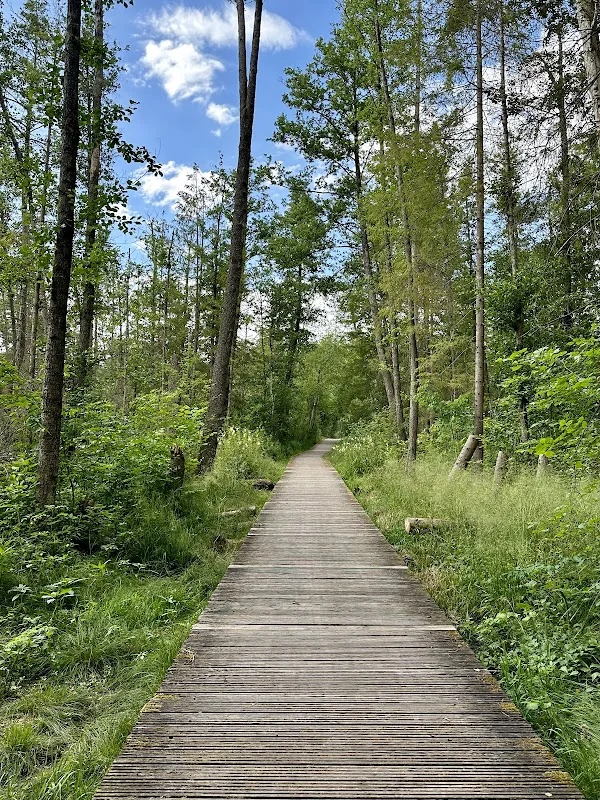
Those looking for a walk in the Leutstettener Moos will find a natural area that, despite its proximity to the city, appears surprisingly quiet. The LBV describes the landscape as shaped by the Würm, which flows through the protected area for about three kilometers, accompanied by a side arm of about 900 meters in the south. In addition, there are four lakes and residual waters that divide the moor and give the area its typical character. For walkers, this mixture is particularly attractive: sometimes it goes through open, moist areas, sometimes through forest and meadow sections, sometimes along the water. The official tour has been classified as very easy in the region and is family-friendly. This is important because the Leutstettener Moos does not want to be an alpine challenge but a well-walkable round for everyone who wants to experience nature without haste. The atmosphere thrives on the alternation between openness and closeness, between reeds and open views, between natural areas and clear path directions. Those who walk leisurely will quickly realize that here, it is not about athletic performance but about observation: light on the water, moist meadows, birds in the reeds, and the slow flow of the Würm shape the picture. ([starnberg.lbv.de](https://starnberg.lbv.de/ornithologie/vogelwelt-im-landkreis-starnberg/leutstettener-moos/))
The area is also ideal for a quiet hike because the paths are not only scenically but also historically varied. The circular path leads past Percha, along the edge of the nature reserve, further to the Villa Rustica and to Leutstetten with the castle tavern and beer garden. This makes the tour interesting for people who like to plan a stop along the way or seek a route with multiple levels of experience. It is particularly pleasant that the round is not overloaded: the route remains clear, the orientation simple, and one can easily switch between longer walking, short breaks, and observation points. Those visiting the Leutstettener Moos as a walk or hike should still be aware that it is a protected area. This means: stay on the paths, be considerate of plants and animals, and understand the landscape not as a backdrop but as a habitat. This is precisely what makes the outing valuable. Many visitors today are not only looking for a beautiful route but for a place that slows down. This feeling is naturally provided by the Leutstettener Moos, without artificial staging and without loud distractions. ([starnbergammersee.de](https://www.starnbergammersee.de/detail/id%3D6075b83ad8fb501ac55de380))
Photos, Nature, and Special Motifs in the Moor
The Leutstettener Moos is particularly grateful for photos because it offers many different motifs in a small space. The municipal documents describe a landscape of reed areas, marsh plants, moor forms, alder, birch, and moor pine forests, willow bushes, reed grass meadows, and reed grass stands. In addition, there are the Würm, the pools, the Galgensee, the Truhensee, the Goldsee, and the Schlossweiher. These are exactly the elements that create strong images in calm moods and changing light: wide water surfaces, narrow shores, open meadows, darker forest edges, and the reflection of the sky. The combination of natural space and cultural layer is also photogenic because the path not only leads through moor and wetland but also passes archaeological and historical points. Particularly appealing are the contrasts between the soft, almost silent moor and the clear lines of the Villa Rustica or the historical references around Leutstetten. Therefore, those who want to take photos in the Leutstettener Moos will not only get nature shots but also a small panorama of landscape, history, and waters. This is exactly what creates the characteristic charm of this area near Starnberg. ([starnberg.de](https://www.starnberg.de/assets/downloads/kultur-freizeit/Stadtgeschichte/Moosrundweg/1.pdf))
The nature itself in the Leutstettener Moos also includes special protection aspects that should be respected when photographing. The city points out that the area provides sensitive habitats for animals and plants and that the Würm in the protected area may not be navigated by boats between March and the end of June to protect breeding bird species. The LBV adds that the areas previously used as hay meadows have remained open and nutrient-poor only through maintenance, allowing specialized plants such as stemless gentian or orchid species to thrive. At the same time, emerging birches and pines should be removed so that the area does not become overgrown. For photography, this means: the best pictures often arise not from entering sensitive areas but from patiently observing from the path. Then the special structures of the low moor reveal themselves best. The birdlife is also remarkable: the LBV mentions, among others, the corncrake, black-throated wheatear, brown-throated wheatear, great snipe, jack snipe, and reed warbler as species that have been observed in the area. So those looking for leutstettener moos photos will not only get landscapes but also nature observation with an eye for detail. ([starnberg.de](https://www.starnberg.de/assets/downloads/kultur-freizeit/Stadtgeschichte/Moosrundweg/1.pdf))
History, Würm, and Villa Rustica at the Leutstettener Moos
The history of the Leutstettener Moos begins long before the current hiking route. According to municipal material, it is a post-glacial moor that formed after the end of the Würm ice age about 10,000 to 15,000 years ago in the northern part of the then Würm lake. The Galgensee, Goldsee, and Truhensee are residual lakes of this silted glacier lake. This also explains why the landscape appears so unique: it is not simply a forest area but the result of a long natural transformation process. In the city's documents, the area is described as being under nature protection since 1980; at the same time, the LBV refers to its inclusion in the FFH area of the Natura 2000 network. The area figures vary depending on the delineation: a municipal information sheet mentions 180 hectares, while the LBV states 215 hectares mainly of low moor areas. For visitors, the important statement is that there is a large-scale significant protected area whose ecological quality is based on moist, nutrient-poor conditions. This long history of formation makes the visit more interesting because you are not just walking through a beautiful landscape but through a space that has grown geologically and ecologically. ([starnberg.de](https://www.starnberg.de/assets/downloads/kultur-freizeit/Stadtgeschichte/Moosrundweg/13a.pdf))
The cultural traces at the edge of the moor are at least as exciting. The Villa Rustica near Leutstetten was excavated in 2002 south of Starnberg-Leutstetten and dated to the 2nd century AD. The city describes a reconstructed floor plan, a well-preserved room with underfloor heating and a bath, as well as finds from wells and buildings. The estate originally consisted of several buildings, and even a millstone indicates grain processing. This makes it clear: the place was not only landscape but already in Roman times a functional living space with economic use. In addition, there is Schloss Leutstetten, which, according to the city, was built in 1565 by Hans Urmiller. The village is already mentioned around 800 AD, in 1875 Prince Ludwig bought the castle, and in 1978 Leutstetten was incorporated into Starnberg. This historical depth is particularly relevant for the search interest around leutstettener moos starnberg and schloss leutstetten because the circular path does not separate nature and culture but elegantly links them together. This is exactly what makes the tour so multi-layered: moor, Würm, Roman and noble history lie almost naturally side by side along the way. ([starnberg.de](https://www.starnberg.de/kultur-freizeit/stadtgeschichte/villa-rustica/))
Komoot, Reviews, and Practical Tips for the Visit
Those planning their tour digitally will also find the Leutstettener Moos in common outdoor portals. Komoot features several overviews of walks, hikes, and cycling tours in Leutstettener Moos, including easy tours and other thematic collections. This fits well with the search behavior around leutstettener moos komoot, as many visitors like to compare length, terrain, and possible variants in advance. For practical planning, this is sensible because the area does not only offer a single rigid path but knows several connection possibilities and starting points. The official regional route describes a very easy path of about 9.8 kilometers, while municipal materials mention a cycling and hiking route of about 12 kilometers. Those who want to photograph or observe nature more intensively should read this difference as an advantage: more time, more stops, more room for detours or breaks. At the same time, it is wise to treat the moor as a protected area. Sturdy paths, consideration for breeding times, no unnecessary detours into sensitive areas, and attentive interaction with other visitors ensure that the tranquility of the area is preserved. This combination of good accessibility and natural sensitivity makes the Leutstettener Moos a place that is not only visited once but is often recommended. ([komoot.com](https://www.komoot.com/de-de/guide/3601788/spaziergaenge-und-leichte-wanderungen-im-leutstettener-moos?utm_source=openai))
The search queries for leutstettener moos reviews also show that visitors today are looking not only for information but also for a feeling for the place. The existing reviews with 4.4 stars from 253 reviews indicate that many guests appreciate the quiet location, the natural character, and the combination of landscape and history. This is understandable: The Leutstettener Moos is not a place for rapid mass tourism but for a slowed-down round with a conscious eye for details. Those coming with children, by bicycle, or on foot benefit from the good signage of the paths, the clear starting points, and the proximity to Starnberg. It is advisable to wear sturdy, weather-appropriate footwear, as moor and wetland paths can be softer depending on the weather. It is also sensible to plan a tour so that there is enough time for Schloss Leutstetten, the Villa Rustica, or simply for a break with a view into the greenery. The Leutstettener Moos rewards no rushing but patience. This is exactly why it works so well as a nature outing, as a photo spot, as a family round, and as a calm counterpoint to everyday life. ([starnberg.lbv.de](https://starnberg.lbv.de/ornithologie/vogelwelt-im-landkreis-starnberg/leutstettener-moos/))
Sources:
- City of Starnberg - Natural Area Leutstettener Moos ([starnberg.de](https://www.starnberg.de/kultur-freizeit/erholungsflaechen/naturraum-leutstettener-moos/))
- City of Starnberg - Nature Reserve Leutstettener Moos PDF ([starnberg.de](https://www.starnberg.de/assets/downloads/kultur-freizeit/Stadtgeschichte/Moosrundweg/1.pdf))
- LBV Starnberg - Leutstettener Moos ([starnberg.lbv.de](https://starnberg.lbv.de/ornithologie/vogelwelt-im-landkreis-starnberg/leutstettener-moos/))
- City of Starnberg - Villa Rustica near Leutstetten ([starnberg.de](https://www.starnberg.de/kultur-freizeit/stadtgeschichte/villa-rustica/))
- Region StarnbergAmmersee - Circular Path through the Leutstettener Moos ([starnbergammersee.de](https://www.starnbergammersee.de/detail/id%3D6075b83ad8fb501ac55de380))
- Komoot - Hiking in the Leutstettener Moos ([komoot.com](https://www.komoot.com/de-de/guide/3205882/wandern-im-leutstettener-moos?utm_source=openai))
Show moreShow less
Leutstettener Moos | Circular Trail & Hike
The Leutstettener Moos near Starnberg is not a classic excursion destination with a stage, hall, or grandstand, but a quiet natural area with remarkable depth. Here, low moor landscape, the slowly flowing Würm, small residual lakes, wet meadows, and historical traces come together. The city of Starnberg describes the area as a natural space and refers to a path that was partially newly created in connection with the Federal Garden Show 2005. The State Association for Bird Protection classifies the area as a regionally significant low moor and as part of the FFH area in the Natura 2000 network. This very mixture makes the Leutstettener Moos so exciting for hikers, cyclists, nature lovers, and anyone looking for a quiet round near Starnberg. With a rating of 4.4 from 253 reviews, the place no longer feels like a hidden gem but rather like a well-established destination for a nature-related outing. Those seeking the Leutstettener Moos will not find a loud spectacle but a landscape that convinces with quiet details: reeds, water, moorland, birdlife, and cultural history lie unusually close together. ([starnberg.de](https://www.starnberg.de/kultur-freizeit/erholungsflaechen/naturraum-leutstettener-moos/))
Circular Trail around the Leutstettener Moos: Length, Stages, and Pace
The circular trail around the Leutstettener Moos is one of the most attractive paths in the Starnberg area because it combines nature experience and good orientation. The StarnbergAmmersee region describes the official tour as approximately 9.8 kilometers long, with 69 meters of elevation gain and a very easy difficulty level. The city of Starnberg, on the other hand, mentions a cycling and hiking path of about 12 kilometers in the Moos circular trail material. This is not a contradiction but shows that different lengths can arise depending on the starting point and variant. In practice, this means: Those who are leisurely will plan for about two and a half to three and a half hours, while those who want to photograph, observe, or take a break should allow a bit more time. According to the official regional description, the tour starts at the district office in Starnberg, leads to Percha, and continues to the nature reserve Leutstettener Moos. At the edge of the moor area, one follows the signage, reaches the Villa Rustica, continues to Leutstetten with the castle tavern, and returns via Petersbrunn and the residential area Starnberger Wiese to the Nord train station and the starting point. This clear loop makes the path very pleasant for beginners, families, and relaxed day visitors. ([starnbergammersee.de](https://www.starnbergammersee.de/detail/id%3D6075b83ad8fb501ac55de380))
It is particularly interesting that the Leutstettener Moos functions not only as a footpath but is explicitly described as a cycling and hiking path. In the municipal documents, the route is presented as one that can also be walked by bicycle; it is also mentioned that guided tours on foot or by bicycle are offered. This makes the search interest for leutstettener moos bicycle absolutely justified. The tour is not a sporting battle against steep ascents but a quiet round through a protected landscape. Those who pay attention while cycling or walking experience the transition from the open lake landscape through Percha into the moorland, lush green space around the Würm. This makes the circular path both varied and very well-planned. Especially because the route does not overwhelm, there is time for breaks, for views of reeds and water, or for detours to historical stations. This combination is also crucial for users looking to hike or stroll in leutstettener moos: The path is long enough for a true nature experience but short and easy enough to remain relaxed. ([starnberg.de](https://www.starnberg.de/assets/downloads/kultur-freizeit/Stadtgeschichte/Moosrundweg/13a.pdf))
Parking and Access to the Leutstettener Moos
When it comes to parking, the Leutstettener Moos is surprisingly uncomplicated if you know the official starting points. The StarnbergAmmersee region mentions the A95 Munich-Garmisch highway as the access route by car, exit Starnberg, and points directly to the parking possibility at the district office Starnberg. That is exactly where the official circular tour starts. Additionally, the region recommends checking parking options and maximum parking duration at other starting points in advance, as the circular tour can also begin at other locations. In the municipal maps and PDF documents, additional practical points appear, such as Percha-Nord, the area at Birkenweg, and the P+R area at Nord train station. For visitors, this means: If you want to explore the Leutstettener Moos comfortably, it is best to drive to a clearly defined starting point and follow the signage from there. Especially on weekends and in good weather, it is advisable to choose the starting location in advance rather than spontaneously driving to the nearby area and then searching for parking space. This way, the visit remains relaxed, and you start the round without losing time. ([starnbergammersee.de](https://www.starnbergammersee.de/detail/id%3D6075b83ad8fb501ac55de380))
Traveling by public transport is also quite feasible. The StarnbergAmmersee region describes the journey with the S6 at 20-minute intervals to Starnberg Nord; from there, it is only about two minutes on foot to the district office Starnberg. This is particularly interesting for day visitors, weekend visitors, and anyone who wants to arrive without a car. The municipal documents also show that the Leutstettener Moos is integrated into a whole network of paths: From the Percha-Nord area, a newer path from the time of the Federal Garden Show runs along the natural area towards Leutstetten, and the map also marks the hiking parking lot Mühlthal as well as the connection towards Gauting, Gilching, Weilheim, Berg, and Munich. For planning, it is therefore important to distinguish between access, starting point, and the actual circular tour. Those who just want to arrive quickly should orient themselves to the district office or Nord train station; those who want to connect the outing with the surroundings can also see the tour as part of a larger walking or cycling network through the Starnberg area. This significantly increases flexibility and explains why the Leutstettener Moos works well for both short and longer excursions. ([starnbergammersee.de](https://www.starnbergammersee.de/detail/id%3D6075b83ad8fb501ac55de380))
Hiking and Walking in the Leutstettener Moos
Those looking for a walk in the Leutstettener Moos will find a natural area that, despite its proximity to the city, appears surprisingly quiet. The LBV describes the landscape as shaped by the Würm, which flows through the protected area for about three kilometers, accompanied by a side arm of about 900 meters in the south. In addition, there are four lakes and residual waters that divide the moor and give the area its typical character. For walkers, this mixture is particularly attractive: sometimes it goes through open, moist areas, sometimes through forest and meadow sections, sometimes along the water. The official tour has been classified as very easy in the region and is family-friendly. This is important because the Leutstettener Moos does not want to be an alpine challenge but a well-walkable round for everyone who wants to experience nature without haste. The atmosphere thrives on the alternation between openness and closeness, between reeds and open views, between natural areas and clear path directions. Those who walk leisurely will quickly realize that here, it is not about athletic performance but about observation: light on the water, moist meadows, birds in the reeds, and the slow flow of the Würm shape the picture. ([starnberg.lbv.de](https://starnberg.lbv.de/ornithologie/vogelwelt-im-landkreis-starnberg/leutstettener-moos/))
The area is also ideal for a quiet hike because the paths are not only scenically but also historically varied. The circular path leads past Percha, along the edge of the nature reserve, further to the Villa Rustica and to Leutstetten with the castle tavern and beer garden. This makes the tour interesting for people who like to plan a stop along the way or seek a route with multiple levels of experience. It is particularly pleasant that the round is not overloaded: the route remains clear, the orientation simple, and one can easily switch between longer walking, short breaks, and observation points. Those visiting the Leutstettener Moos as a walk or hike should still be aware that it is a protected area. This means: stay on the paths, be considerate of plants and animals, and understand the landscape not as a backdrop but as a habitat. This is precisely what makes the outing valuable. Many visitors today are not only looking for a beautiful route but for a place that slows down. This feeling is naturally provided by the Leutstettener Moos, without artificial staging and without loud distractions. ([starnbergammersee.de](https://www.starnbergammersee.de/detail/id%3D6075b83ad8fb501ac55de380))
Photos, Nature, and Special Motifs in the Moor
The Leutstettener Moos is particularly grateful for photos because it offers many different motifs in a small space. The municipal documents describe a landscape of reed areas, marsh plants, moor forms, alder, birch, and moor pine forests, willow bushes, reed grass meadows, and reed grass stands. In addition, there are the Würm, the pools, the Galgensee, the Truhensee, the Goldsee, and the Schlossweiher. These are exactly the elements that create strong images in calm moods and changing light: wide water surfaces, narrow shores, open meadows, darker forest edges, and the reflection of the sky. The combination of natural space and cultural layer is also photogenic because the path not only leads through moor and wetland but also passes archaeological and historical points. Particularly appealing are the contrasts between the soft, almost silent moor and the clear lines of the Villa Rustica or the historical references around Leutstetten. Therefore, those who want to take photos in the Leutstettener Moos will not only get nature shots but also a small panorama of landscape, history, and waters. This is exactly what creates the characteristic charm of this area near Starnberg. ([starnberg.de](https://www.starnberg.de/assets/downloads/kultur-freizeit/Stadtgeschichte/Moosrundweg/1.pdf))
The nature itself in the Leutstettener Moos also includes special protection aspects that should be respected when photographing. The city points out that the area provides sensitive habitats for animals and plants and that the Würm in the protected area may not be navigated by boats between March and the end of June to protect breeding bird species. The LBV adds that the areas previously used as hay meadows have remained open and nutrient-poor only through maintenance, allowing specialized plants such as stemless gentian or orchid species to thrive. At the same time, emerging birches and pines should be removed so that the area does not become overgrown. For photography, this means: the best pictures often arise not from entering sensitive areas but from patiently observing from the path. Then the special structures of the low moor reveal themselves best. The birdlife is also remarkable: the LBV mentions, among others, the corncrake, black-throated wheatear, brown-throated wheatear, great snipe, jack snipe, and reed warbler as species that have been observed in the area. So those looking for leutstettener moos photos will not only get landscapes but also nature observation with an eye for detail. ([starnberg.de](https://www.starnberg.de/assets/downloads/kultur-freizeit/Stadtgeschichte/Moosrundweg/1.pdf))
History, Würm, and Villa Rustica at the Leutstettener Moos
The history of the Leutstettener Moos begins long before the current hiking route. According to municipal material, it is a post-glacial moor that formed after the end of the Würm ice age about 10,000 to 15,000 years ago in the northern part of the then Würm lake. The Galgensee, Goldsee, and Truhensee are residual lakes of this silted glacier lake. This also explains why the landscape appears so unique: it is not simply a forest area but the result of a long natural transformation process. In the city's documents, the area is described as being under nature protection since 1980; at the same time, the LBV refers to its inclusion in the FFH area of the Natura 2000 network. The area figures vary depending on the delineation: a municipal information sheet mentions 180 hectares, while the LBV states 215 hectares mainly of low moor areas. For visitors, the important statement is that there is a large-scale significant protected area whose ecological quality is based on moist, nutrient-poor conditions. This long history of formation makes the visit more interesting because you are not just walking through a beautiful landscape but through a space that has grown geologically and ecologically. ([starnberg.de](https://www.starnberg.de/assets/downloads/kultur-freizeit/Stadtgeschichte/Moosrundweg/13a.pdf))
The cultural traces at the edge of the moor are at least as exciting. The Villa Rustica near Leutstetten was excavated in 2002 south of Starnberg-Leutstetten and dated to the 2nd century AD. The city describes a reconstructed floor plan, a well-preserved room with underfloor heating and a bath, as well as finds from wells and buildings. The estate originally consisted of several buildings, and even a millstone indicates grain processing. This makes it clear: the place was not only landscape but already in Roman times a functional living space with economic use. In addition, there is Schloss Leutstetten, which, according to the city, was built in 1565 by Hans Urmiller. The village is already mentioned around 800 AD, in 1875 Prince Ludwig bought the castle, and in 1978 Leutstetten was incorporated into Starnberg. This historical depth is particularly relevant for the search interest around leutstettener moos starnberg and schloss leutstetten because the circular path does not separate nature and culture but elegantly links them together. This is exactly what makes the tour so multi-layered: moor, Würm, Roman and noble history lie almost naturally side by side along the way. ([starnberg.de](https://www.starnberg.de/kultur-freizeit/stadtgeschichte/villa-rustica/))
Komoot, Reviews, and Practical Tips for the Visit
Those planning their tour digitally will also find the Leutstettener Moos in common outdoor portals. Komoot features several overviews of walks, hikes, and cycling tours in Leutstettener Moos, including easy tours and other thematic collections. This fits well with the search behavior around leutstettener moos komoot, as many visitors like to compare length, terrain, and possible variants in advance. For practical planning, this is sensible because the area does not only offer a single rigid path but knows several connection possibilities and starting points. The official regional route describes a very easy path of about 9.8 kilometers, while municipal materials mention a cycling and hiking route of about 12 kilometers. Those who want to photograph or observe nature more intensively should read this difference as an advantage: more time, more stops, more room for detours or breaks. At the same time, it is wise to treat the moor as a protected area. Sturdy paths, consideration for breeding times, no unnecessary detours into sensitive areas, and attentive interaction with other visitors ensure that the tranquility of the area is preserved. This combination of good accessibility and natural sensitivity makes the Leutstettener Moos a place that is not only visited once but is often recommended. ([komoot.com](https://www.komoot.com/de-de/guide/3601788/spaziergaenge-und-leichte-wanderungen-im-leutstettener-moos?utm_source=openai))
The search queries for leutstettener moos reviews also show that visitors today are looking not only for information but also for a feeling for the place. The existing reviews with 4.4 stars from 253 reviews indicate that many guests appreciate the quiet location, the natural character, and the combination of landscape and history. This is understandable: The Leutstettener Moos is not a place for rapid mass tourism but for a slowed-down round with a conscious eye for details. Those coming with children, by bicycle, or on foot benefit from the good signage of the paths, the clear starting points, and the proximity to Starnberg. It is advisable to wear sturdy, weather-appropriate footwear, as moor and wetland paths can be softer depending on the weather. It is also sensible to plan a tour so that there is enough time for Schloss Leutstetten, the Villa Rustica, or simply for a break with a view into the greenery. The Leutstettener Moos rewards no rushing but patience. This is exactly why it works so well as a nature outing, as a photo spot, as a family round, and as a calm counterpoint to everyday life. ([starnberg.lbv.de](https://starnberg.lbv.de/ornithologie/vogelwelt-im-landkreis-starnberg/leutstettener-moos/))
Sources:
- City of Starnberg - Natural Area Leutstettener Moos ([starnberg.de](https://www.starnberg.de/kultur-freizeit/erholungsflaechen/naturraum-leutstettener-moos/))
- City of Starnberg - Nature Reserve Leutstettener Moos PDF ([starnberg.de](https://www.starnberg.de/assets/downloads/kultur-freizeit/Stadtgeschichte/Moosrundweg/1.pdf))
- LBV Starnberg - Leutstettener Moos ([starnberg.lbv.de](https://starnberg.lbv.de/ornithologie/vogelwelt-im-landkreis-starnberg/leutstettener-moos/))
- City of Starnberg - Villa Rustica near Leutstetten ([starnberg.de](https://www.starnberg.de/kultur-freizeit/stadtgeschichte/villa-rustica/))
- Region StarnbergAmmersee - Circular Path through the Leutstettener Moos ([starnbergammersee.de](https://www.starnbergammersee.de/detail/id%3D6075b83ad8fb501ac55de380))
- Komoot - Hiking in the Leutstettener Moos ([komoot.com](https://www.komoot.com/de-de/guide/3205882/wandern-im-leutstettener-moos?utm_source=openai))
Leutstettener Moos | Circular Trail & Hike
The Leutstettener Moos near Starnberg is not a classic excursion destination with a stage, hall, or grandstand, but a quiet natural area with remarkable depth. Here, low moor landscape, the slowly flowing Würm, small residual lakes, wet meadows, and historical traces come together. The city of Starnberg describes the area as a natural space and refers to a path that was partially newly created in connection with the Federal Garden Show 2005. The State Association for Bird Protection classifies the area as a regionally significant low moor and as part of the FFH area in the Natura 2000 network. This very mixture makes the Leutstettener Moos so exciting for hikers, cyclists, nature lovers, and anyone looking for a quiet round near Starnberg. With a rating of 4.4 from 253 reviews, the place no longer feels like a hidden gem but rather like a well-established destination for a nature-related outing. Those seeking the Leutstettener Moos will not find a loud spectacle but a landscape that convinces with quiet details: reeds, water, moorland, birdlife, and cultural history lie unusually close together. ([starnberg.de](https://www.starnberg.de/kultur-freizeit/erholungsflaechen/naturraum-leutstettener-moos/))
Circular Trail around the Leutstettener Moos: Length, Stages, and Pace
The circular trail around the Leutstettener Moos is one of the most attractive paths in the Starnberg area because it combines nature experience and good orientation. The StarnbergAmmersee region describes the official tour as approximately 9.8 kilometers long, with 69 meters of elevation gain and a very easy difficulty level. The city of Starnberg, on the other hand, mentions a cycling and hiking path of about 12 kilometers in the Moos circular trail material. This is not a contradiction but shows that different lengths can arise depending on the starting point and variant. In practice, this means: Those who are leisurely will plan for about two and a half to three and a half hours, while those who want to photograph, observe, or take a break should allow a bit more time. According to the official regional description, the tour starts at the district office in Starnberg, leads to Percha, and continues to the nature reserve Leutstettener Moos. At the edge of the moor area, one follows the signage, reaches the Villa Rustica, continues to Leutstetten with the castle tavern, and returns via Petersbrunn and the residential area Starnberger Wiese to the Nord train station and the starting point. This clear loop makes the path very pleasant for beginners, families, and relaxed day visitors. ([starnbergammersee.de](https://www.starnbergammersee.de/detail/id%3D6075b83ad8fb501ac55de380))
It is particularly interesting that the Leutstettener Moos functions not only as a footpath but is explicitly described as a cycling and hiking path. In the municipal documents, the route is presented as one that can also be walked by bicycle; it is also mentioned that guided tours on foot or by bicycle are offered. This makes the search interest for leutstettener moos bicycle absolutely justified. The tour is not a sporting battle against steep ascents but a quiet round through a protected landscape. Those who pay attention while cycling or walking experience the transition from the open lake landscape through Percha into the moorland, lush green space around the Würm. This makes the circular path both varied and very well-planned. Especially because the route does not overwhelm, there is time for breaks, for views of reeds and water, or for detours to historical stations. This combination is also crucial for users looking to hike or stroll in leutstettener moos: The path is long enough for a true nature experience but short and easy enough to remain relaxed. ([starnberg.de](https://www.starnberg.de/assets/downloads/kultur-freizeit/Stadtgeschichte/Moosrundweg/13a.pdf))
Parking and Access to the Leutstettener Moos
When it comes to parking, the Leutstettener Moos is surprisingly uncomplicated if you know the official starting points. The StarnbergAmmersee region mentions the A95 Munich-Garmisch highway as the access route by car, exit Starnberg, and points directly to the parking possibility at the district office Starnberg. That is exactly where the official circular tour starts. Additionally, the region recommends checking parking options and maximum parking duration at other starting points in advance, as the circular tour can also begin at other locations. In the municipal maps and PDF documents, additional practical points appear, such as Percha-Nord, the area at Birkenweg, and the P+R area at Nord train station. For visitors, this means: If you want to explore the Leutstettener Moos comfortably, it is best to drive to a clearly defined starting point and follow the signage from there. Especially on weekends and in good weather, it is advisable to choose the starting location in advance rather than spontaneously driving to the nearby area and then searching for parking space. This way, the visit remains relaxed, and you start the round without losing time. ([starnbergammersee.de](https://www.starnbergammersee.de/detail/id%3D6075b83ad8fb501ac55de380))
Traveling by public transport is also quite feasible. The StarnbergAmmersee region describes the journey with the S6 at 20-minute intervals to Starnberg Nord; from there, it is only about two minutes on foot to the district office Starnberg. This is particularly interesting for day visitors, weekend visitors, and anyone who wants to arrive without a car. The municipal documents also show that the Leutstettener Moos is integrated into a whole network of paths: From the Percha-Nord area, a newer path from the time of the Federal Garden Show runs along the natural area towards Leutstetten, and the map also marks the hiking parking lot Mühlthal as well as the connection towards Gauting, Gilching, Weilheim, Berg, and Munich. For planning, it is therefore important to distinguish between access, starting point, and the actual circular tour. Those who just want to arrive quickly should orient themselves to the district office or Nord train station; those who want to connect the outing with the surroundings can also see the tour as part of a larger walking or cycling network through the Starnberg area. This significantly increases flexibility and explains why the Leutstettener Moos works well for both short and longer excursions. ([starnbergammersee.de](https://www.starnbergammersee.de/detail/id%3D6075b83ad8fb501ac55de380))
Hiking and Walking in the Leutstettener Moos
Those looking for a walk in the Leutstettener Moos will find a natural area that, despite its proximity to the city, appears surprisingly quiet. The LBV describes the landscape as shaped by the Würm, which flows through the protected area for about three kilometers, accompanied by a side arm of about 900 meters in the south. In addition, there are four lakes and residual waters that divide the moor and give the area its typical character. For walkers, this mixture is particularly attractive: sometimes it goes through open, moist areas, sometimes through forest and meadow sections, sometimes along the water. The official tour has been classified as very easy in the region and is family-friendly. This is important because the Leutstettener Moos does not want to be an alpine challenge but a well-walkable round for everyone who wants to experience nature without haste. The atmosphere thrives on the alternation between openness and closeness, between reeds and open views, between natural areas and clear path directions. Those who walk leisurely will quickly realize that here, it is not about athletic performance but about observation: light on the water, moist meadows, birds in the reeds, and the slow flow of the Würm shape the picture. ([starnberg.lbv.de](https://starnberg.lbv.de/ornithologie/vogelwelt-im-landkreis-starnberg/leutstettener-moos/))
The area is also ideal for a quiet hike because the paths are not only scenically but also historically varied. The circular path leads past Percha, along the edge of the nature reserve, further to the Villa Rustica and to Leutstetten with the castle tavern and beer garden. This makes the tour interesting for people who like to plan a stop along the way or seek a route with multiple levels of experience. It is particularly pleasant that the round is not overloaded: the route remains clear, the orientation simple, and one can easily switch between longer walking, short breaks, and observation points. Those visiting the Leutstettener Moos as a walk or hike should still be aware that it is a protected area. This means: stay on the paths, be considerate of plants and animals, and understand the landscape not as a backdrop but as a habitat. This is precisely what makes the outing valuable. Many visitors today are not only looking for a beautiful route but for a place that slows down. This feeling is naturally provided by the Leutstettener Moos, without artificial staging and without loud distractions. ([starnbergammersee.de](https://www.starnbergammersee.de/detail/id%3D6075b83ad8fb501ac55de380))
Photos, Nature, and Special Motifs in the Moor
The Leutstettener Moos is particularly grateful for photos because it offers many different motifs in a small space. The municipal documents describe a landscape of reed areas, marsh plants, moor forms, alder, birch, and moor pine forests, willow bushes, reed grass meadows, and reed grass stands. In addition, there are the Würm, the pools, the Galgensee, the Truhensee, the Goldsee, and the Schlossweiher. These are exactly the elements that create strong images in calm moods and changing light: wide water surfaces, narrow shores, open meadows, darker forest edges, and the reflection of the sky. The combination of natural space and cultural layer is also photogenic because the path not only leads through moor and wetland but also passes archaeological and historical points. Particularly appealing are the contrasts between the soft, almost silent moor and the clear lines of the Villa Rustica or the historical references around Leutstetten. Therefore, those who want to take photos in the Leutstettener Moos will not only get nature shots but also a small panorama of landscape, history, and waters. This is exactly what creates the characteristic charm of this area near Starnberg. ([starnberg.de](https://www.starnberg.de/assets/downloads/kultur-freizeit/Stadtgeschichte/Moosrundweg/1.pdf))
The nature itself in the Leutstettener Moos also includes special protection aspects that should be respected when photographing. The city points out that the area provides sensitive habitats for animals and plants and that the Würm in the protected area may not be navigated by boats between March and the end of June to protect breeding bird species. The LBV adds that the areas previously used as hay meadows have remained open and nutrient-poor only through maintenance, allowing specialized plants such as stemless gentian or orchid species to thrive. At the same time, emerging birches and pines should be removed so that the area does not become overgrown. For photography, this means: the best pictures often arise not from entering sensitive areas but from patiently observing from the path. Then the special structures of the low moor reveal themselves best. The birdlife is also remarkable: the LBV mentions, among others, the corncrake, black-throated wheatear, brown-throated wheatear, great snipe, jack snipe, and reed warbler as species that have been observed in the area. So those looking for leutstettener moos photos will not only get landscapes but also nature observation with an eye for detail. ([starnberg.de](https://www.starnberg.de/assets/downloads/kultur-freizeit/Stadtgeschichte/Moosrundweg/1.pdf))
History, Würm, and Villa Rustica at the Leutstettener Moos
The history of the Leutstettener Moos begins long before the current hiking route. According to municipal material, it is a post-glacial moor that formed after the end of the Würm ice age about 10,000 to 15,000 years ago in the northern part of the then Würm lake. The Galgensee, Goldsee, and Truhensee are residual lakes of this silted glacier lake. This also explains why the landscape appears so unique: it is not simply a forest area but the result of a long natural transformation process. In the city's documents, the area is described as being under nature protection since 1980; at the same time, the LBV refers to its inclusion in the FFH area of the Natura 2000 network. The area figures vary depending on the delineation: a municipal information sheet mentions 180 hectares, while the LBV states 215 hectares mainly of low moor areas. For visitors, the important statement is that there is a large-scale significant protected area whose ecological quality is based on moist, nutrient-poor conditions. This long history of formation makes the visit more interesting because you are not just walking through a beautiful landscape but through a space that has grown geologically and ecologically. ([starnberg.de](https://www.starnberg.de/assets/downloads/kultur-freizeit/Stadtgeschichte/Moosrundweg/13a.pdf))
The cultural traces at the edge of the moor are at least as exciting. The Villa Rustica near Leutstetten was excavated in 2002 south of Starnberg-Leutstetten and dated to the 2nd century AD. The city describes a reconstructed floor plan, a well-preserved room with underfloor heating and a bath, as well as finds from wells and buildings. The estate originally consisted of several buildings, and even a millstone indicates grain processing. This makes it clear: the place was not only landscape but already in Roman times a functional living space with economic use. In addition, there is Schloss Leutstetten, which, according to the city, was built in 1565 by Hans Urmiller. The village is already mentioned around 800 AD, in 1875 Prince Ludwig bought the castle, and in 1978 Leutstetten was incorporated into Starnberg. This historical depth is particularly relevant for the search interest around leutstettener moos starnberg and schloss leutstetten because the circular path does not separate nature and culture but elegantly links them together. This is exactly what makes the tour so multi-layered: moor, Würm, Roman and noble history lie almost naturally side by side along the way. ([starnberg.de](https://www.starnberg.de/kultur-freizeit/stadtgeschichte/villa-rustica/))
Komoot, Reviews, and Practical Tips for the Visit
Those planning their tour digitally will also find the Leutstettener Moos in common outdoor portals. Komoot features several overviews of walks, hikes, and cycling tours in Leutstettener Moos, including easy tours and other thematic collections. This fits well with the search behavior around leutstettener moos komoot, as many visitors like to compare length, terrain, and possible variants in advance. For practical planning, this is sensible because the area does not only offer a single rigid path but knows several connection possibilities and starting points. The official regional route describes a very easy path of about 9.8 kilometers, while municipal materials mention a cycling and hiking route of about 12 kilometers. Those who want to photograph or observe nature more intensively should read this difference as an advantage: more time, more stops, more room for detours or breaks. At the same time, it is wise to treat the moor as a protected area. Sturdy paths, consideration for breeding times, no unnecessary detours into sensitive areas, and attentive interaction with other visitors ensure that the tranquility of the area is preserved. This combination of good accessibility and natural sensitivity makes the Leutstettener Moos a place that is not only visited once but is often recommended. ([komoot.com](https://www.komoot.com/de-de/guide/3601788/spaziergaenge-und-leichte-wanderungen-im-leutstettener-moos?utm_source=openai))
The search queries for leutstettener moos reviews also show that visitors today are looking not only for information but also for a feeling for the place. The existing reviews with 4.4 stars from 253 reviews indicate that many guests appreciate the quiet location, the natural character, and the combination of landscape and history. This is understandable: The Leutstettener Moos is not a place for rapid mass tourism but for a slowed-down round with a conscious eye for details. Those coming with children, by bicycle, or on foot benefit from the good signage of the paths, the clear starting points, and the proximity to Starnberg. It is advisable to wear sturdy, weather-appropriate footwear, as moor and wetland paths can be softer depending on the weather. It is also sensible to plan a tour so that there is enough time for Schloss Leutstetten, the Villa Rustica, or simply for a break with a view into the greenery. The Leutstettener Moos rewards no rushing but patience. This is exactly why it works so well as a nature outing, as a photo spot, as a family round, and as a calm counterpoint to everyday life. ([starnberg.lbv.de](https://starnberg.lbv.de/ornithologie/vogelwelt-im-landkreis-starnberg/leutstettener-moos/))
Sources:
- City of Starnberg - Natural Area Leutstettener Moos ([starnberg.de](https://www.starnberg.de/kultur-freizeit/erholungsflaechen/naturraum-leutstettener-moos/))
- City of Starnberg - Nature Reserve Leutstettener Moos PDF ([starnberg.de](https://www.starnberg.de/assets/downloads/kultur-freizeit/Stadtgeschichte/Moosrundweg/1.pdf))
- LBV Starnberg - Leutstettener Moos ([starnberg.lbv.de](https://starnberg.lbv.de/ornithologie/vogelwelt-im-landkreis-starnberg/leutstettener-moos/))
- City of Starnberg - Villa Rustica near Leutstetten ([starnberg.de](https://www.starnberg.de/kultur-freizeit/stadtgeschichte/villa-rustica/))
- Region StarnbergAmmersee - Circular Path through the Leutstettener Moos ([starnbergammersee.de](https://www.starnbergammersee.de/detail/id%3D6075b83ad8fb501ac55de380))
- Komoot - Hiking in the Leutstettener Moos ([komoot.com](https://www.komoot.com/de-de/guide/3205882/wandern-im-leutstettener-moos?utm_source=openai))
Upcoming Events
No events found
Frequently Asked Questions
Reviews
NIRMAL JOHNSON
16. March 2025
We went there on rainy twilight time, it was relaxing, and pleasing and a bit scary. But a nice stroll like this is what we need to get out of this hectic life.
Colin Brooks
25. September 2019
Very serene. Honestly not sure why Google wants me to review a cluster of trees, but whatever. There's no trash on the trails, which vary in material, from grass to gravel to wooden bridges over the little bits of marshland.
Ивайло Чаушев
24. June 2021
Nice place, where you can feel the power of the natural beauty.
Işık Tuna
22. October 2024
It is a really beautiful area to have a walk in nature. The nature is simply amazing and very vibrant, rich. The area is really big and has a long path for walking/cycling. If you are visiting Starnberg, be aware that it is not really easy to walk to the entrance, and I recommend that you cycle. Walking here was a long way from the central part, and combined with the long walking path, it was tiring. Be sure to have water with you as it gets really hot along the way, especially in summer. Not sure if it was my mistake, but I walked until the end of the path and it took me to a small place called Leutstetten. It was not easy to go back to Starnberg :) So plan your walk carefully and consider these when you visit.
Rob Berkley
1. May 2017
Very scenic backdrop to this place. Great for a visit when on a walk.