
Kalvarienbergstraße 16-20, Feldafing
Kalvarienbergstraße 16-20, 82340 Feldafing, Germany
Kalvarienberg Feldafing | Stations of the Cross & Access
The Kalvarienberg in Feldafing is much more than a short walk up a hill: it is a historical Stations of the Cross, a carefully designed monument, and a quiet place of reflection in the townscape of Feldafing on Lake Starnberg. The community describes the site as an ensemble of 14 station houses, a crucifix group, and an old signpost on Kalvarienbergstraße. The site was developed over decades under Pastor and Dean Dr. Eduard Maria Clos, who advanced the project between 1864 and 1892; the Kalvarienberg was consecrated on August 28, 1892. Today, the path is one of the defining historical destinations of the place and is explicitly highlighted by the community and the region as a worthwhile cultural and excursion site. ([feldafing.de](https://www.feldafing.de/index.php?catid=35&id=204&view=article))
Kalvarienberg Significance and History in Feldafing
Those searching for the significance of a Kalvarienberg encounter a long Christian tradition: Stations of the Cross are meant to trace the passion of Jesus, which has its origins in Jerusalem. Katholisch.de explains the emergence of this form of devotion with the 14 stations that can be found today in many churches and historical outdoor sites. A Kalvarienberg is therefore not only a topographical term but primarily a religious place of remembrance and contemplation. In Feldafing, this tradition was consciously placed in the landscape so that faith, art, and nature could connect into a quiet ensemble. The community of Feldafing presents the Kalvarienberg as a historically grown cultural asset that makes the local history visible to this day. ([katholisch.de](https://katholisch.de/artikel/4743-der-weg-des-leidens))
The Feldafing site traces back to the village pastor and dean Eduard Maria Clos, who developed and realized the project over many years. According to community information, the Kalvarienberg was established between 1864 and 1892; thus, the implementation took about 25 years. It is particularly important that the site did not emerge as a quickly erected chapel but as a sustained community project supported by many benefactors. Among the sponsors, notable personalities are mentioned on the community page, including Joseph Anton von Maffei, Max Kustermann, Max Strauch, Gabriel Sedlmayr, Prince Thurn and Taxis, Dean Clos, and Empress Elisabeth of Austria. This makes the Feldafing Kalvarienberg not only religiously significant but also noteworthy in terms of social and cultural history. Its emergence shows how strongly sacred art was understood in the 19th century as an expression of piety, civic spirit, and regional identity. ([feldafing.de](https://www.feldafing.de/index.php?catid=35&id=204&view=article))
The thematic orientation of the crucifix group is also well documented. The community states that the depiction follows the visions of the stigmatized nun Katharina Emmerick in detail, who became known through Clemens Brentano. This spiritual source explains why the Feldafing Kalvarienberg is not simply a decorative Stations of the Cross site but a consciously programmatic work with spiritual depth. The site was consecrated on August 28, 1892, and has since remained a place where local history, Catholic piety, and artistic design converge. Later reports from the region speak of a special commitment from the Feldafing citizenry to preserve this gem. This underscores that the Kalvarienberg in Feldafing is not just a monument from the past but a living part of local culture. ([feldafing.de](https://www.feldafing.de/index.php?catid=35&id=204&view=article))
The recent history also shows how sensitive such sites are and how important maintenance, restoration, and public responsibility remain. The community of Feldafing describes that the Kalvarienberg along with the Stations of the Cross came into the ownership of the community in 2010. Prior to that, an association took care of preservation and restoration; according to Merkur, the renovated Stations of the Cross were reopened in 2006 after donations, municipal funds, and contributions from the Free State made the renovation possible. This development is interesting for visitors as it clarifies that the current good condition is not a matter of course but the result of long-term care for the cultural monument. Thus, those who visit the Kalvarienberg experience not only a historical ensemble but also an example of how local communities actively preserve their culture of remembrance. ([feldafing.de](https://feldafing.de/jdownloads/e-mail_News_B_rgermeister-Brief/Infobrief_10-11_November_2010_-web.pdf?utm_source=openai))
Station Houses, Crucifix Group, and Artistic Design
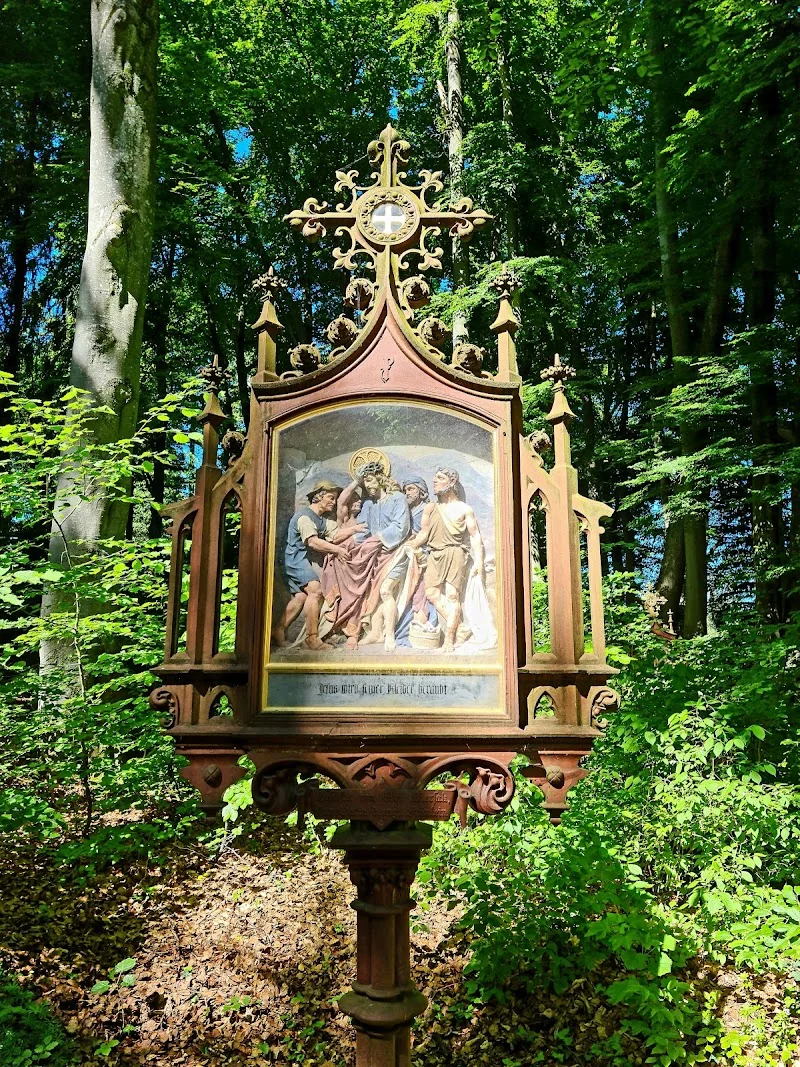
The central feature of the Kalvarienberg is the 14 station houses that make the stations of Christ's passion visible. The community of Feldafing describes them as cast-iron houses with colored reliefs behind glass; they are complemented by a crucifix group in zinc and iron casting. This combination of materials makes the site artistically unusual and simultaneously robust. The interplay of iron, zinc, glass, and reliefs gives the ensemble a special radiance because sacred narrative and industrial production of the 19th century come together. That such details have been preserved to this day demonstrates the high monument preservation value of the site. For visitors, not only the religious significance is interesting, but also the craftsmanship with which each station was designed. ([feldafing.de](https://www.feldafing.de/index.php?catid=35&id=204&view=article))
The design did not come from an anonymous series process but was shaped by specific artists and architects. According to community information, the architect Johann Marggraff designed the cast-iron station frames, while the reliefs were created by the sculptors Gebrüder Preckel, who worked in Stadtamhof. This attribution is important because it identifies the Feldafing Kalvarienberg as a work with a clear artistic signature. The site thematically follows the iconographic program of the visions of Katharina Emmerick; thus, the Stations of the Cross acquire a richly detailed, almost narrative quality. The visitor does not just ascend a path but reads a visual language at each station that translates suffering, comfort, and hope into a landscape form. ([feldafing.de](https://www.feldafing.de/index.php?catid=35&id=204&view=article))
Another special feature is the crucifix group at the summit area. From there, according to the community's presentation, an impressive panoramic view opens to the southeast over Lake Starnberg and the mountain panorama from Benediktenwand to Wetterstein massif. This view makes it understandable why the Kalvarienberg in Feldafing is equally valued as a place of devotion and landscape perception. It is not an overloaded spectacle but a quiet ensemble where art and nature intertwine. This image is complemented by the old iron signpost at the corner of Wielinger and Kalvarienbergstraße, which has been preserved and makes the historical character of the site visible right at the entrance. Such details are particularly relevant for SEO topics around station houses, crucifix groups, and history because they precisely describe what visitors perceive on-site. ([feldafing.de](https://www.feldafing.de/index.php?catid=35&id=204&view=article))
The tourist representation of the region also emphasizes the uniqueness of the ensemble. In the brochure of the StarnbergAmmersee region, the Kalvarienberg is described as a site with 14 station houses and a crucifix group, created over 25 years by Eduard Maria Clos. There, the location is additionally classified as an excursion destination in a culturally rich environment, which also includes other attractions in Feldafing. This is important for the perception of the site: The Kalvarienberg is not an isolated monument but part of a larger cultural landscape between the lake, the town, and the foothills of the Alps. This is precisely what makes it appealing to guests who want to not only visit historical sites but also understand them in their surroundings. ([starnbergammersee.de](https://www.starnbergammersee.de/fileadmin/user_upload/Service/Prospektbestellung/Infos_Tipps_StarnbergAmmersee.pdf))
Access to Kalvarienberg Feldafing by Car and S-Bahn
For access, the Feldafing train station is the most important reference point. The StarnbergAmmersee region recommends traveling to this area by car via the A95 or A995, then taking the Starnberg exit and continuing towards Tutzing; in Feldafing, one should follow the signs towards Feldafing train station. Parking is available there. The arrival by S-Bahn S6 towards Munich or Tutzing to the Feldafing stop is also mentioned. For visitors, this means: The Kalvarienberg is well connected to the regional transport network and can be reached both by car and environmentally friendly by public transport. ([starnbergammersee.de](https://www.starnbergammersee.de/detail/id%3D6075b833d8fb501ac55de354))
The community of Feldafing also emphasizes in its tourism presentation that the site is reachable from Munich by both car and S-Bahn in about 35 minutes. This is not only practical for day visitors but also for anyone planning to include the Kalvarienberg as part of a larger excursion into the Starnberger See area. Those who want to combine the visit with other stops will find a good infrastructure of hotels, restaurants, cycling and hiking paths, as well as other historical sites in Feldafing. This makes the journey to the Kalvarienberg part of a larger leisure concept where nature, culture, and movement play together meaningfully. ([feldafing.de](https://www.feldafing.de/index.php/tourismus-in-feldafing/geschichte-des-tourismus))
For visitors who specifically want to head to the Kalvarienberg, the location on Kalvarienbergstraße is also important. The community has not only documented the site itself there but also mentioned the historical signpost at the corner of Wielinger and Kalvarienbergstraße. This practically means: Those orienting themselves in Feldafing should use the train station, Kalvarienbergstraße, and Wielinger Straße as reference points. In the region, the Kalvarienberg is also recommended as a detour in the König-Ludwig-Active-Tour. This tour starts at Feldafing train station and explicitly points out that the Stations of the Cross with 14 station houses and the crucifix group serve as a complement. This makes it clear that access is not complicated but embedded in a well-described hiking and excursion context. ([starnbergammersee.de](https://www.starnbergammersee.de/detail/id%3D6075b833d8fb501ac55de354))
Those arriving by train benefit from the fact that Feldafing is known as an S-Bahn station in the Munich transport area. This is particularly advantageous for day-trippers without a car, as the Kalvarienberg can be planned as a short walk or as part of a longer round trip from there. The tourist route 08 describes the site as the starting point of a 16.3-kilometer, very easy tour that deliberately marks the Kalvarienberg as a noteworthy stop. However, for a pure visit to the Stations of the Cross, one does not need to walk the entire tour; the information merely shows that the route in the region is logical and well documented. Thus, those searching for access to Kalvarienberg Feldafing will find clear, practical guidance for both train and car travel. ([starnbergammersee.de](https://www.starnbergammersee.de/detail/id%3D6075b833d8fb501ac55de354))
Parking, Route Guidance, and Visit On-Site
When it comes to parking, the Feldafing train station is the most reliable address. According to the StarnbergAmmersee region, parking spaces are available there, and this is also where the recommended arrival by car begins. For many visitors, this is the simplest solution, as one does not have to drive the car into the tighter area of the Stations of the Cross but can comfortably walk from the train station. This keeps the visit relaxed and respectful towards the historical ensemble. Especially with a monument like the Kalvarienberg, it is sensible to choose access in such a way that peace and consideration for the surroundings are maintained. The official tour description makes it clear that one should also pay attention to parking options and possible maximum parking duration at the starting point in advance. ([starnbergammersee.de](https://www.starnbergammersee.de/detail/id%3D6075b833d8fb501ac55de354))
The route itself is uncomplicated and historically interesting. The Kalvarienberg is accessed via Kalvarienbergstraße; at the corner of Wielinger/Kalvarienbergstraße stands the old cast-iron signpost that has marked the access for a long time. This type of orientation is pleasant for visitors because they are not led into modern event or leisure architecture but into a grown path situation. The site thus does not appear artificially staged but is organically integrated into the landscape. As one ascends the stations, one experiences the historical logic of the site step by step: from the lower access through the individual stations to the crucifix group at the top. The region explicitly describes the detour as worthwhile, which shows that the path itself is part of the experience and not just the destination. ([feldafing.de](https://www.feldafing.de/index.php?catid=35&id=204&view=article))
For the actual visit, it is worthwhile to understand the site as a place of devotion and culture. The Kalvarienberg is not a stage for large events but a historical Stations of the Cross that is suitable for quiet contemplation and a short, conscious walk. This is precisely its strength: it is close enough to the town to be easily accessible and yet quiet enough to step out of everyday life. The community of Feldafing and the region indirectly highlight this character by placing the Kalvarienberg in the context of nature, churches, villas, museums, and other excursion destinations. Therefore, those looking for just a quick photo stop will find it, but will gain more if they take some time for the individual stations. The special nature of the Kalvarienberg reveals itself precisely in slow walking. ([feldafing.de](https://www.feldafing.de/index.php/tourismus-in-feldafing/geschichte-des-tourismus))
The history of maintenance is also relevant for an on-site visit. According to reports from the community and the regional press, the preservation of the Stations of the Cross was the focus of civic engagement for years. In 2006, the renovated Stations of the Cross were reopened; later, the Kalvarienberg along with the stations came into the ownership of the community. This information explains why the site appears relatively well-maintained today and why it is sensible to behave respectfully during the visit. The Kalvarienberg is not an anonymous backdrop but a monument preserved by the community. Thus, those who park here, arrive, and walk up the path move through a space that has been preserved by many people over generations. ([merkur.de](https://www.merkur.de/lokales/starnberg/landkreis/feldafinger-kalvarienbergverein-loest-sich-4869869.html))
Practical Tips, Short Guide, and Excursion Ideas in Feldafing
Those wishing to visit the Kalvarienberg Feldafing should look beyond the monument to the town itself. The community describes Feldafing as a recreational area with nature, Lenné Park, Rose Island, a beach bath, a golf course, and a wide range of offerings for hikers, cyclists, and culture enthusiasts. In this context, the Kalvarienberg fits perfectly as a short, content-rich cultural stop on a day trip. The tourist side of the community also makes it clear that Feldafing is attractive regardless of the weather and has hotels as well as private rentals. This is practical for guests who plan to consider the Kalvarienberg not just as a stopover but as part of a larger stay at Lake Starnberg. ([feldafing.de](https://www.feldafing.de/index.php/tourismus-in-feldafing/geschichte-des-tourismus))
A particularly sensible addition to the visit is the official short guide. The community explicitly points out that a short guide to the history and design of the Kalvarienberg is available for a donation of 3.00 euros. This is helpful for culture-historically interested visitors because it allows for a more precise understanding of the visual language of the stations and the role of Eduard Maria Clos. Especially with a monument that consists not only of paths and stones but also of iconographically charged details, background knowledge is worthwhile. Those who use the short guide can view the individual stations more consciously and better understand the connection between local history, benefactor culture, and sacred art. ([feldafing.de](https://www.feldafing.de/index.php?catid=35&id=204&view=article))
The integration into regional tours is a strong argument for a visit. The König-Ludwig-Active-Tour starts directly at Feldafing train station and explicitly recommends the Kalvarienberg as a detour. At the same time, the community of Feldafing points to other cultural sites in the vicinity, including churches, castles, and the broad tourist offerings between Munich and the lakes. This makes the Kalvarienberg Feldafing an ideal component for travelers who are not just looking for a single attraction but a content-rich excursion with history, landscape, and movement. The combination of short accessibility, historical depth, and landscape quality makes the site a strong SEO topic for search queries around significance, access, parking, and historical peculiarities. ([starnbergammersee.de](https://www.starnbergammersee.de/detail/id%3D6075b833d8fb501ac55de354))
In the end, the Kalvarienberg remains memorable primarily because it is many things at once: a way of devotion, a monument, a local identity marker, and a quiet viewpoint. The official community page emphasizes the historical design and the panoramic view, while the tourist information highlights the good accessibility and integration into the regional path network. This combination makes the site so attractive for visitors seeking an authentic place rather than a generic attraction. Those who visit the Kalvarienberg in Feldafing experience not just a name on the map but a piece of Upper Bavarian cultural history in a landscape that is still cared for and consciously preserved today. ([feldafing.de](https://www.feldafing.de/index.php?catid=35&id=204&view=article))
Sources:
- Community Feldafing – Kalvarienberg ([feldafing.de](https://www.feldafing.de/index.php?catid=35&id=204&view=article))
- Community Feldafing – Beyond the Railway Line ([feldafing.de](https://www.feldafing.de/index.php?id=35&view=category))
- Community Feldafing – History of Tourism ([feldafing.de](https://www.feldafing.de/index.php/tourismus-in-feldafing/geschichte-des-tourismus))
- StarnbergAmmersee – Kalvarienberg in the Brochure Info & Tips ([starnbergammersee.de](https://www.starnbergammersee.de/fileadmin/user_upload/Service/Prospektbestellung/Infos_Tipps_StarnbergAmmersee.pdf))
- StarnbergAmmersee – Route 08: König-Ludwig-Active-Tour ([starnbergammersee.de](https://www.starnbergammersee.de/detail/id%3D6075b833d8fb501ac55de354))
- Community Feldafing – Building Plan Justification with Monument Protection Note ([feldafing.de](https://www.feldafing.de/jdownloads/Bebauungspl_ne/bp37_20240409_Feld_BP_37_Wielinger-Begruendung.pdf))
- Water Supply Feldafing Pöcking gKU – History ([wasserversorgung-gku.de](https://www.wasserversorgung-gku.de/verband-old__trashed/historie/))
- Merkur – Kalvarienberg Association Dissolves ([merkur.de](https://www.merkur.de/lokales/starnberg/landkreis/feldafinger-kalvarienbergverein-loest-sich-4869869.html))
- Katholisch.de – The Way of Suffering ([katholisch.de](https://katholisch.de/artikel/4743-der-weg-des-leidens))
Show moreShow less
Kalvarienberg Feldafing | Stations of the Cross & Access
The Kalvarienberg in Feldafing is much more than a short walk up a hill: it is a historical Stations of the Cross, a carefully designed monument, and a quiet place of reflection in the townscape of Feldafing on Lake Starnberg. The community describes the site as an ensemble of 14 station houses, a crucifix group, and an old signpost on Kalvarienbergstraße. The site was developed over decades under Pastor and Dean Dr. Eduard Maria Clos, who advanced the project between 1864 and 1892; the Kalvarienberg was consecrated on August 28, 1892. Today, the path is one of the defining historical destinations of the place and is explicitly highlighted by the community and the region as a worthwhile cultural and excursion site. ([feldafing.de](https://www.feldafing.de/index.php?catid=35&id=204&view=article))
Kalvarienberg Significance and History in Feldafing
Those searching for the significance of a Kalvarienberg encounter a long Christian tradition: Stations of the Cross are meant to trace the passion of Jesus, which has its origins in Jerusalem. Katholisch.de explains the emergence of this form of devotion with the 14 stations that can be found today in many churches and historical outdoor sites. A Kalvarienberg is therefore not only a topographical term but primarily a religious place of remembrance and contemplation. In Feldafing, this tradition was consciously placed in the landscape so that faith, art, and nature could connect into a quiet ensemble. The community of Feldafing presents the Kalvarienberg as a historically grown cultural asset that makes the local history visible to this day. ([katholisch.de](https://katholisch.de/artikel/4743-der-weg-des-leidens))
The Feldafing site traces back to the village pastor and dean Eduard Maria Clos, who developed and realized the project over many years. According to community information, the Kalvarienberg was established between 1864 and 1892; thus, the implementation took about 25 years. It is particularly important that the site did not emerge as a quickly erected chapel but as a sustained community project supported by many benefactors. Among the sponsors, notable personalities are mentioned on the community page, including Joseph Anton von Maffei, Max Kustermann, Max Strauch, Gabriel Sedlmayr, Prince Thurn and Taxis, Dean Clos, and Empress Elisabeth of Austria. This makes the Feldafing Kalvarienberg not only religiously significant but also noteworthy in terms of social and cultural history. Its emergence shows how strongly sacred art was understood in the 19th century as an expression of piety, civic spirit, and regional identity. ([feldafing.de](https://www.feldafing.de/index.php?catid=35&id=204&view=article))
The thematic orientation of the crucifix group is also well documented. The community states that the depiction follows the visions of the stigmatized nun Katharina Emmerick in detail, who became known through Clemens Brentano. This spiritual source explains why the Feldafing Kalvarienberg is not simply a decorative Stations of the Cross site but a consciously programmatic work with spiritual depth. The site was consecrated on August 28, 1892, and has since remained a place where local history, Catholic piety, and artistic design converge. Later reports from the region speak of a special commitment from the Feldafing citizenry to preserve this gem. This underscores that the Kalvarienberg in Feldafing is not just a monument from the past but a living part of local culture. ([feldafing.de](https://www.feldafing.de/index.php?catid=35&id=204&view=article))
The recent history also shows how sensitive such sites are and how important maintenance, restoration, and public responsibility remain. The community of Feldafing describes that the Kalvarienberg along with the Stations of the Cross came into the ownership of the community in 2010. Prior to that, an association took care of preservation and restoration; according to Merkur, the renovated Stations of the Cross were reopened in 2006 after donations, municipal funds, and contributions from the Free State made the renovation possible. This development is interesting for visitors as it clarifies that the current good condition is not a matter of course but the result of long-term care for the cultural monument. Thus, those who visit the Kalvarienberg experience not only a historical ensemble but also an example of how local communities actively preserve their culture of remembrance. ([feldafing.de](https://feldafing.de/jdownloads/e-mail_News_B_rgermeister-Brief/Infobrief_10-11_November_2010_-web.pdf?utm_source=openai))
Station Houses, Crucifix Group, and Artistic Design
The central feature of the Kalvarienberg is the 14 station houses that make the stations of Christ's passion visible. The community of Feldafing describes them as cast-iron houses with colored reliefs behind glass; they are complemented by a crucifix group in zinc and iron casting. This combination of materials makes the site artistically unusual and simultaneously robust. The interplay of iron, zinc, glass, and reliefs gives the ensemble a special radiance because sacred narrative and industrial production of the 19th century come together. That such details have been preserved to this day demonstrates the high monument preservation value of the site. For visitors, not only the religious significance is interesting, but also the craftsmanship with which each station was designed. ([feldafing.de](https://www.feldafing.de/index.php?catid=35&id=204&view=article))
The design did not come from an anonymous series process but was shaped by specific artists and architects. According to community information, the architect Johann Marggraff designed the cast-iron station frames, while the reliefs were created by the sculptors Gebrüder Preckel, who worked in Stadtamhof. This attribution is important because it identifies the Feldafing Kalvarienberg as a work with a clear artistic signature. The site thematically follows the iconographic program of the visions of Katharina Emmerick; thus, the Stations of the Cross acquire a richly detailed, almost narrative quality. The visitor does not just ascend a path but reads a visual language at each station that translates suffering, comfort, and hope into a landscape form. ([feldafing.de](https://www.feldafing.de/index.php?catid=35&id=204&view=article))
Another special feature is the crucifix group at the summit area. From there, according to the community's presentation, an impressive panoramic view opens to the southeast over Lake Starnberg and the mountain panorama from Benediktenwand to Wetterstein massif. This view makes it understandable why the Kalvarienberg in Feldafing is equally valued as a place of devotion and landscape perception. It is not an overloaded spectacle but a quiet ensemble where art and nature intertwine. This image is complemented by the old iron signpost at the corner of Wielinger and Kalvarienbergstraße, which has been preserved and makes the historical character of the site visible right at the entrance. Such details are particularly relevant for SEO topics around station houses, crucifix groups, and history because they precisely describe what visitors perceive on-site. ([feldafing.de](https://www.feldafing.de/index.php?catid=35&id=204&view=article))
The tourist representation of the region also emphasizes the uniqueness of the ensemble. In the brochure of the StarnbergAmmersee region, the Kalvarienberg is described as a site with 14 station houses and a crucifix group, created over 25 years by Eduard Maria Clos. There, the location is additionally classified as an excursion destination in a culturally rich environment, which also includes other attractions in Feldafing. This is important for the perception of the site: The Kalvarienberg is not an isolated monument but part of a larger cultural landscape between the lake, the town, and the foothills of the Alps. This is precisely what makes it appealing to guests who want to not only visit historical sites but also understand them in their surroundings. ([starnbergammersee.de](https://www.starnbergammersee.de/fileadmin/user_upload/Service/Prospektbestellung/Infos_Tipps_StarnbergAmmersee.pdf))
Access to Kalvarienberg Feldafing by Car and S-Bahn
For access, the Feldafing train station is the most important reference point. The StarnbergAmmersee region recommends traveling to this area by car via the A95 or A995, then taking the Starnberg exit and continuing towards Tutzing; in Feldafing, one should follow the signs towards Feldafing train station. Parking is available there. The arrival by S-Bahn S6 towards Munich or Tutzing to the Feldafing stop is also mentioned. For visitors, this means: The Kalvarienberg is well connected to the regional transport network and can be reached both by car and environmentally friendly by public transport. ([starnbergammersee.de](https://www.starnbergammersee.de/detail/id%3D6075b833d8fb501ac55de354))
The community of Feldafing also emphasizes in its tourism presentation that the site is reachable from Munich by both car and S-Bahn in about 35 minutes. This is not only practical for day visitors but also for anyone planning to include the Kalvarienberg as part of a larger excursion into the Starnberger See area. Those who want to combine the visit with other stops will find a good infrastructure of hotels, restaurants, cycling and hiking paths, as well as other historical sites in Feldafing. This makes the journey to the Kalvarienberg part of a larger leisure concept where nature, culture, and movement play together meaningfully. ([feldafing.de](https://www.feldafing.de/index.php/tourismus-in-feldafing/geschichte-des-tourismus))
For visitors who specifically want to head to the Kalvarienberg, the location on Kalvarienbergstraße is also important. The community has not only documented the site itself there but also mentioned the historical signpost at the corner of Wielinger and Kalvarienbergstraße. This practically means: Those orienting themselves in Feldafing should use the train station, Kalvarienbergstraße, and Wielinger Straße as reference points. In the region, the Kalvarienberg is also recommended as a detour in the König-Ludwig-Active-Tour. This tour starts at Feldafing train station and explicitly points out that the Stations of the Cross with 14 station houses and the crucifix group serve as a complement. This makes it clear that access is not complicated but embedded in a well-described hiking and excursion context. ([starnbergammersee.de](https://www.starnbergammersee.de/detail/id%3D6075b833d8fb501ac55de354))
Those arriving by train benefit from the fact that Feldafing is known as an S-Bahn station in the Munich transport area. This is particularly advantageous for day-trippers without a car, as the Kalvarienberg can be planned as a short walk or as part of a longer round trip from there. The tourist route 08 describes the site as the starting point of a 16.3-kilometer, very easy tour that deliberately marks the Kalvarienberg as a noteworthy stop. However, for a pure visit to the Stations of the Cross, one does not need to walk the entire tour; the information merely shows that the route in the region is logical and well documented. Thus, those searching for access to Kalvarienberg Feldafing will find clear, practical guidance for both train and car travel. ([starnbergammersee.de](https://www.starnbergammersee.de/detail/id%3D6075b833d8fb501ac55de354))
Parking, Route Guidance, and Visit On-Site
When it comes to parking, the Feldafing train station is the most reliable address. According to the StarnbergAmmersee region, parking spaces are available there, and this is also where the recommended arrival by car begins. For many visitors, this is the simplest solution, as one does not have to drive the car into the tighter area of the Stations of the Cross but can comfortably walk from the train station. This keeps the visit relaxed and respectful towards the historical ensemble. Especially with a monument like the Kalvarienberg, it is sensible to choose access in such a way that peace and consideration for the surroundings are maintained. The official tour description makes it clear that one should also pay attention to parking options and possible maximum parking duration at the starting point in advance. ([starnbergammersee.de](https://www.starnbergammersee.de/detail/id%3D6075b833d8fb501ac55de354))
The route itself is uncomplicated and historically interesting. The Kalvarienberg is accessed via Kalvarienbergstraße; at the corner of Wielinger/Kalvarienbergstraße stands the old cast-iron signpost that has marked the access for a long time. This type of orientation is pleasant for visitors because they are not led into modern event or leisure architecture but into a grown path situation. The site thus does not appear artificially staged but is organically integrated into the landscape. As one ascends the stations, one experiences the historical logic of the site step by step: from the lower access through the individual stations to the crucifix group at the top. The region explicitly describes the detour as worthwhile, which shows that the path itself is part of the experience and not just the destination. ([feldafing.de](https://www.feldafing.de/index.php?catid=35&id=204&view=article))
For the actual visit, it is worthwhile to understand the site as a place of devotion and culture. The Kalvarienberg is not a stage for large events but a historical Stations of the Cross that is suitable for quiet contemplation and a short, conscious walk. This is precisely its strength: it is close enough to the town to be easily accessible and yet quiet enough to step out of everyday life. The community of Feldafing and the region indirectly highlight this character by placing the Kalvarienberg in the context of nature, churches, villas, museums, and other excursion destinations. Therefore, those looking for just a quick photo stop will find it, but will gain more if they take some time for the individual stations. The special nature of the Kalvarienberg reveals itself precisely in slow walking. ([feldafing.de](https://www.feldafing.de/index.php/tourismus-in-feldafing/geschichte-des-tourismus))
The history of maintenance is also relevant for an on-site visit. According to reports from the community and the regional press, the preservation of the Stations of the Cross was the focus of civic engagement for years. In 2006, the renovated Stations of the Cross were reopened; later, the Kalvarienberg along with the stations came into the ownership of the community. This information explains why the site appears relatively well-maintained today and why it is sensible to behave respectfully during the visit. The Kalvarienberg is not an anonymous backdrop but a monument preserved by the community. Thus, those who park here, arrive, and walk up the path move through a space that has been preserved by many people over generations. ([merkur.de](https://www.merkur.de/lokales/starnberg/landkreis/feldafinger-kalvarienbergverein-loest-sich-4869869.html))
Practical Tips, Short Guide, and Excursion Ideas in Feldafing
Those wishing to visit the Kalvarienberg Feldafing should look beyond the monument to the town itself. The community describes Feldafing as a recreational area with nature, Lenné Park, Rose Island, a beach bath, a golf course, and a wide range of offerings for hikers, cyclists, and culture enthusiasts. In this context, the Kalvarienberg fits perfectly as a short, content-rich cultural stop on a day trip. The tourist side of the community also makes it clear that Feldafing is attractive regardless of the weather and has hotels as well as private rentals. This is practical for guests who plan to consider the Kalvarienberg not just as a stopover but as part of a larger stay at Lake Starnberg. ([feldafing.de](https://www.feldafing.de/index.php/tourismus-in-feldafing/geschichte-des-tourismus))
A particularly sensible addition to the visit is the official short guide. The community explicitly points out that a short guide to the history and design of the Kalvarienberg is available for a donation of 3.00 euros. This is helpful for culture-historically interested visitors because it allows for a more precise understanding of the visual language of the stations and the role of Eduard Maria Clos. Especially with a monument that consists not only of paths and stones but also of iconographically charged details, background knowledge is worthwhile. Those who use the short guide can view the individual stations more consciously and better understand the connection between local history, benefactor culture, and sacred art. ([feldafing.de](https://www.feldafing.de/index.php?catid=35&id=204&view=article))
The integration into regional tours is a strong argument for a visit. The König-Ludwig-Active-Tour starts directly at Feldafing train station and explicitly recommends the Kalvarienberg as a detour. At the same time, the community of Feldafing points to other cultural sites in the vicinity, including churches, castles, and the broad tourist offerings between Munich and the lakes. This makes the Kalvarienberg Feldafing an ideal component for travelers who are not just looking for a single attraction but a content-rich excursion with history, landscape, and movement. The combination of short accessibility, historical depth, and landscape quality makes the site a strong SEO topic for search queries around significance, access, parking, and historical peculiarities. ([starnbergammersee.de](https://www.starnbergammersee.de/detail/id%3D6075b833d8fb501ac55de354))
In the end, the Kalvarienberg remains memorable primarily because it is many things at once: a way of devotion, a monument, a local identity marker, and a quiet viewpoint. The official community page emphasizes the historical design and the panoramic view, while the tourist information highlights the good accessibility and integration into the regional path network. This combination makes the site so attractive for visitors seeking an authentic place rather than a generic attraction. Those who visit the Kalvarienberg in Feldafing experience not just a name on the map but a piece of Upper Bavarian cultural history in a landscape that is still cared for and consciously preserved today. ([feldafing.de](https://www.feldafing.de/index.php?catid=35&id=204&view=article))
Sources:
- Community Feldafing – Kalvarienberg ([feldafing.de](https://www.feldafing.de/index.php?catid=35&id=204&view=article))
- Community Feldafing – Beyond the Railway Line ([feldafing.de](https://www.feldafing.de/index.php?id=35&view=category))
- Community Feldafing – History of Tourism ([feldafing.de](https://www.feldafing.de/index.php/tourismus-in-feldafing/geschichte-des-tourismus))
- StarnbergAmmersee – Kalvarienberg in the Brochure Info & Tips ([starnbergammersee.de](https://www.starnbergammersee.de/fileadmin/user_upload/Service/Prospektbestellung/Infos_Tipps_StarnbergAmmersee.pdf))
- StarnbergAmmersee – Route 08: König-Ludwig-Active-Tour ([starnbergammersee.de](https://www.starnbergammersee.de/detail/id%3D6075b833d8fb501ac55de354))
- Community Feldafing – Building Plan Justification with Monument Protection Note ([feldafing.de](https://www.feldafing.de/jdownloads/Bebauungspl_ne/bp37_20240409_Feld_BP_37_Wielinger-Begruendung.pdf))
- Water Supply Feldafing Pöcking gKU – History ([wasserversorgung-gku.de](https://www.wasserversorgung-gku.de/verband-old__trashed/historie/))
- Merkur – Kalvarienberg Association Dissolves ([merkur.de](https://www.merkur.de/lokales/starnberg/landkreis/feldafinger-kalvarienbergverein-loest-sich-4869869.html))
- Katholisch.de – The Way of Suffering ([katholisch.de](https://katholisch.de/artikel/4743-der-weg-des-leidens))
Kalvarienberg Feldafing | Stations of the Cross & Access
The Kalvarienberg in Feldafing is much more than a short walk up a hill: it is a historical Stations of the Cross, a carefully designed monument, and a quiet place of reflection in the townscape of Feldafing on Lake Starnberg. The community describes the site as an ensemble of 14 station houses, a crucifix group, and an old signpost on Kalvarienbergstraße. The site was developed over decades under Pastor and Dean Dr. Eduard Maria Clos, who advanced the project between 1864 and 1892; the Kalvarienberg was consecrated on August 28, 1892. Today, the path is one of the defining historical destinations of the place and is explicitly highlighted by the community and the region as a worthwhile cultural and excursion site. ([feldafing.de](https://www.feldafing.de/index.php?catid=35&id=204&view=article))
Kalvarienberg Significance and History in Feldafing
Those searching for the significance of a Kalvarienberg encounter a long Christian tradition: Stations of the Cross are meant to trace the passion of Jesus, which has its origins in Jerusalem. Katholisch.de explains the emergence of this form of devotion with the 14 stations that can be found today in many churches and historical outdoor sites. A Kalvarienberg is therefore not only a topographical term but primarily a religious place of remembrance and contemplation. In Feldafing, this tradition was consciously placed in the landscape so that faith, art, and nature could connect into a quiet ensemble. The community of Feldafing presents the Kalvarienberg as a historically grown cultural asset that makes the local history visible to this day. ([katholisch.de](https://katholisch.de/artikel/4743-der-weg-des-leidens))
The Feldafing site traces back to the village pastor and dean Eduard Maria Clos, who developed and realized the project over many years. According to community information, the Kalvarienberg was established between 1864 and 1892; thus, the implementation took about 25 years. It is particularly important that the site did not emerge as a quickly erected chapel but as a sustained community project supported by many benefactors. Among the sponsors, notable personalities are mentioned on the community page, including Joseph Anton von Maffei, Max Kustermann, Max Strauch, Gabriel Sedlmayr, Prince Thurn and Taxis, Dean Clos, and Empress Elisabeth of Austria. This makes the Feldafing Kalvarienberg not only religiously significant but also noteworthy in terms of social and cultural history. Its emergence shows how strongly sacred art was understood in the 19th century as an expression of piety, civic spirit, and regional identity. ([feldafing.de](https://www.feldafing.de/index.php?catid=35&id=204&view=article))
The thematic orientation of the crucifix group is also well documented. The community states that the depiction follows the visions of the stigmatized nun Katharina Emmerick in detail, who became known through Clemens Brentano. This spiritual source explains why the Feldafing Kalvarienberg is not simply a decorative Stations of the Cross site but a consciously programmatic work with spiritual depth. The site was consecrated on August 28, 1892, and has since remained a place where local history, Catholic piety, and artistic design converge. Later reports from the region speak of a special commitment from the Feldafing citizenry to preserve this gem. This underscores that the Kalvarienberg in Feldafing is not just a monument from the past but a living part of local culture. ([feldafing.de](https://www.feldafing.de/index.php?catid=35&id=204&view=article))
The recent history also shows how sensitive such sites are and how important maintenance, restoration, and public responsibility remain. The community of Feldafing describes that the Kalvarienberg along with the Stations of the Cross came into the ownership of the community in 2010. Prior to that, an association took care of preservation and restoration; according to Merkur, the renovated Stations of the Cross were reopened in 2006 after donations, municipal funds, and contributions from the Free State made the renovation possible. This development is interesting for visitors as it clarifies that the current good condition is not a matter of course but the result of long-term care for the cultural monument. Thus, those who visit the Kalvarienberg experience not only a historical ensemble but also an example of how local communities actively preserve their culture of remembrance. ([feldafing.de](https://feldafing.de/jdownloads/e-mail_News_B_rgermeister-Brief/Infobrief_10-11_November_2010_-web.pdf?utm_source=openai))
Station Houses, Crucifix Group, and Artistic Design
The central feature of the Kalvarienberg is the 14 station houses that make the stations of Christ's passion visible. The community of Feldafing describes them as cast-iron houses with colored reliefs behind glass; they are complemented by a crucifix group in zinc and iron casting. This combination of materials makes the site artistically unusual and simultaneously robust. The interplay of iron, zinc, glass, and reliefs gives the ensemble a special radiance because sacred narrative and industrial production of the 19th century come together. That such details have been preserved to this day demonstrates the high monument preservation value of the site. For visitors, not only the religious significance is interesting, but also the craftsmanship with which each station was designed. ([feldafing.de](https://www.feldafing.de/index.php?catid=35&id=204&view=article))
The design did not come from an anonymous series process but was shaped by specific artists and architects. According to community information, the architect Johann Marggraff designed the cast-iron station frames, while the reliefs were created by the sculptors Gebrüder Preckel, who worked in Stadtamhof. This attribution is important because it identifies the Feldafing Kalvarienberg as a work with a clear artistic signature. The site thematically follows the iconographic program of the visions of Katharina Emmerick; thus, the Stations of the Cross acquire a richly detailed, almost narrative quality. The visitor does not just ascend a path but reads a visual language at each station that translates suffering, comfort, and hope into a landscape form. ([feldafing.de](https://www.feldafing.de/index.php?catid=35&id=204&view=article))
Another special feature is the crucifix group at the summit area. From there, according to the community's presentation, an impressive panoramic view opens to the southeast over Lake Starnberg and the mountain panorama from Benediktenwand to Wetterstein massif. This view makes it understandable why the Kalvarienberg in Feldafing is equally valued as a place of devotion and landscape perception. It is not an overloaded spectacle but a quiet ensemble where art and nature intertwine. This image is complemented by the old iron signpost at the corner of Wielinger and Kalvarienbergstraße, which has been preserved and makes the historical character of the site visible right at the entrance. Such details are particularly relevant for SEO topics around station houses, crucifix groups, and history because they precisely describe what visitors perceive on-site. ([feldafing.de](https://www.feldafing.de/index.php?catid=35&id=204&view=article))
The tourist representation of the region also emphasizes the uniqueness of the ensemble. In the brochure of the StarnbergAmmersee region, the Kalvarienberg is described as a site with 14 station houses and a crucifix group, created over 25 years by Eduard Maria Clos. There, the location is additionally classified as an excursion destination in a culturally rich environment, which also includes other attractions in Feldafing. This is important for the perception of the site: The Kalvarienberg is not an isolated monument but part of a larger cultural landscape between the lake, the town, and the foothills of the Alps. This is precisely what makes it appealing to guests who want to not only visit historical sites but also understand them in their surroundings. ([starnbergammersee.de](https://www.starnbergammersee.de/fileadmin/user_upload/Service/Prospektbestellung/Infos_Tipps_StarnbergAmmersee.pdf))
Access to Kalvarienberg Feldafing by Car and S-Bahn
For access, the Feldafing train station is the most important reference point. The StarnbergAmmersee region recommends traveling to this area by car via the A95 or A995, then taking the Starnberg exit and continuing towards Tutzing; in Feldafing, one should follow the signs towards Feldafing train station. Parking is available there. The arrival by S-Bahn S6 towards Munich or Tutzing to the Feldafing stop is also mentioned. For visitors, this means: The Kalvarienberg is well connected to the regional transport network and can be reached both by car and environmentally friendly by public transport. ([starnbergammersee.de](https://www.starnbergammersee.de/detail/id%3D6075b833d8fb501ac55de354))
The community of Feldafing also emphasizes in its tourism presentation that the site is reachable from Munich by both car and S-Bahn in about 35 minutes. This is not only practical for day visitors but also for anyone planning to include the Kalvarienberg as part of a larger excursion into the Starnberger See area. Those who want to combine the visit with other stops will find a good infrastructure of hotels, restaurants, cycling and hiking paths, as well as other historical sites in Feldafing. This makes the journey to the Kalvarienberg part of a larger leisure concept where nature, culture, and movement play together meaningfully. ([feldafing.de](https://www.feldafing.de/index.php/tourismus-in-feldafing/geschichte-des-tourismus))
For visitors who specifically want to head to the Kalvarienberg, the location on Kalvarienbergstraße is also important. The community has not only documented the site itself there but also mentioned the historical signpost at the corner of Wielinger and Kalvarienbergstraße. This practically means: Those orienting themselves in Feldafing should use the train station, Kalvarienbergstraße, and Wielinger Straße as reference points. In the region, the Kalvarienberg is also recommended as a detour in the König-Ludwig-Active-Tour. This tour starts at Feldafing train station and explicitly points out that the Stations of the Cross with 14 station houses and the crucifix group serve as a complement. This makes it clear that access is not complicated but embedded in a well-described hiking and excursion context. ([starnbergammersee.de](https://www.starnbergammersee.de/detail/id%3D6075b833d8fb501ac55de354))
Those arriving by train benefit from the fact that Feldafing is known as an S-Bahn station in the Munich transport area. This is particularly advantageous for day-trippers without a car, as the Kalvarienberg can be planned as a short walk or as part of a longer round trip from there. The tourist route 08 describes the site as the starting point of a 16.3-kilometer, very easy tour that deliberately marks the Kalvarienberg as a noteworthy stop. However, for a pure visit to the Stations of the Cross, one does not need to walk the entire tour; the information merely shows that the route in the region is logical and well documented. Thus, those searching for access to Kalvarienberg Feldafing will find clear, practical guidance for both train and car travel. ([starnbergammersee.de](https://www.starnbergammersee.de/detail/id%3D6075b833d8fb501ac55de354))
Parking, Route Guidance, and Visit On-Site
When it comes to parking, the Feldafing train station is the most reliable address. According to the StarnbergAmmersee region, parking spaces are available there, and this is also where the recommended arrival by car begins. For many visitors, this is the simplest solution, as one does not have to drive the car into the tighter area of the Stations of the Cross but can comfortably walk from the train station. This keeps the visit relaxed and respectful towards the historical ensemble. Especially with a monument like the Kalvarienberg, it is sensible to choose access in such a way that peace and consideration for the surroundings are maintained. The official tour description makes it clear that one should also pay attention to parking options and possible maximum parking duration at the starting point in advance. ([starnbergammersee.de](https://www.starnbergammersee.de/detail/id%3D6075b833d8fb501ac55de354))
The route itself is uncomplicated and historically interesting. The Kalvarienberg is accessed via Kalvarienbergstraße; at the corner of Wielinger/Kalvarienbergstraße stands the old cast-iron signpost that has marked the access for a long time. This type of orientation is pleasant for visitors because they are not led into modern event or leisure architecture but into a grown path situation. The site thus does not appear artificially staged but is organically integrated into the landscape. As one ascends the stations, one experiences the historical logic of the site step by step: from the lower access through the individual stations to the crucifix group at the top. The region explicitly describes the detour as worthwhile, which shows that the path itself is part of the experience and not just the destination. ([feldafing.de](https://www.feldafing.de/index.php?catid=35&id=204&view=article))
For the actual visit, it is worthwhile to understand the site as a place of devotion and culture. The Kalvarienberg is not a stage for large events but a historical Stations of the Cross that is suitable for quiet contemplation and a short, conscious walk. This is precisely its strength: it is close enough to the town to be easily accessible and yet quiet enough to step out of everyday life. The community of Feldafing and the region indirectly highlight this character by placing the Kalvarienberg in the context of nature, churches, villas, museums, and other excursion destinations. Therefore, those looking for just a quick photo stop will find it, but will gain more if they take some time for the individual stations. The special nature of the Kalvarienberg reveals itself precisely in slow walking. ([feldafing.de](https://www.feldafing.de/index.php/tourismus-in-feldafing/geschichte-des-tourismus))
The history of maintenance is also relevant for an on-site visit. According to reports from the community and the regional press, the preservation of the Stations of the Cross was the focus of civic engagement for years. In 2006, the renovated Stations of the Cross were reopened; later, the Kalvarienberg along with the stations came into the ownership of the community. This information explains why the site appears relatively well-maintained today and why it is sensible to behave respectfully during the visit. The Kalvarienberg is not an anonymous backdrop but a monument preserved by the community. Thus, those who park here, arrive, and walk up the path move through a space that has been preserved by many people over generations. ([merkur.de](https://www.merkur.de/lokales/starnberg/landkreis/feldafinger-kalvarienbergverein-loest-sich-4869869.html))
Practical Tips, Short Guide, and Excursion Ideas in Feldafing
Those wishing to visit the Kalvarienberg Feldafing should look beyond the monument to the town itself. The community describes Feldafing as a recreational area with nature, Lenné Park, Rose Island, a beach bath, a golf course, and a wide range of offerings for hikers, cyclists, and culture enthusiasts. In this context, the Kalvarienberg fits perfectly as a short, content-rich cultural stop on a day trip. The tourist side of the community also makes it clear that Feldafing is attractive regardless of the weather and has hotels as well as private rentals. This is practical for guests who plan to consider the Kalvarienberg not just as a stopover but as part of a larger stay at Lake Starnberg. ([feldafing.de](https://www.feldafing.de/index.php/tourismus-in-feldafing/geschichte-des-tourismus))
A particularly sensible addition to the visit is the official short guide. The community explicitly points out that a short guide to the history and design of the Kalvarienberg is available for a donation of 3.00 euros. This is helpful for culture-historically interested visitors because it allows for a more precise understanding of the visual language of the stations and the role of Eduard Maria Clos. Especially with a monument that consists not only of paths and stones but also of iconographically charged details, background knowledge is worthwhile. Those who use the short guide can view the individual stations more consciously and better understand the connection between local history, benefactor culture, and sacred art. ([feldafing.de](https://www.feldafing.de/index.php?catid=35&id=204&view=article))
The integration into regional tours is a strong argument for a visit. The König-Ludwig-Active-Tour starts directly at Feldafing train station and explicitly recommends the Kalvarienberg as a detour. At the same time, the community of Feldafing points to other cultural sites in the vicinity, including churches, castles, and the broad tourist offerings between Munich and the lakes. This makes the Kalvarienberg Feldafing an ideal component for travelers who are not just looking for a single attraction but a content-rich excursion with history, landscape, and movement. The combination of short accessibility, historical depth, and landscape quality makes the site a strong SEO topic for search queries around significance, access, parking, and historical peculiarities. ([starnbergammersee.de](https://www.starnbergammersee.de/detail/id%3D6075b833d8fb501ac55de354))
In the end, the Kalvarienberg remains memorable primarily because it is many things at once: a way of devotion, a monument, a local identity marker, and a quiet viewpoint. The official community page emphasizes the historical design and the panoramic view, while the tourist information highlights the good accessibility and integration into the regional path network. This combination makes the site so attractive for visitors seeking an authentic place rather than a generic attraction. Those who visit the Kalvarienberg in Feldafing experience not just a name on the map but a piece of Upper Bavarian cultural history in a landscape that is still cared for and consciously preserved today. ([feldafing.de](https://www.feldafing.de/index.php?catid=35&id=204&view=article))
Sources:
- Community Feldafing – Kalvarienberg ([feldafing.de](https://www.feldafing.de/index.php?catid=35&id=204&view=article))
- Community Feldafing – Beyond the Railway Line ([feldafing.de](https://www.feldafing.de/index.php?id=35&view=category))
- Community Feldafing – History of Tourism ([feldafing.de](https://www.feldafing.de/index.php/tourismus-in-feldafing/geschichte-des-tourismus))
- StarnbergAmmersee – Kalvarienberg in the Brochure Info & Tips ([starnbergammersee.de](https://www.starnbergammersee.de/fileadmin/user_upload/Service/Prospektbestellung/Infos_Tipps_StarnbergAmmersee.pdf))
- StarnbergAmmersee – Route 08: König-Ludwig-Active-Tour ([starnbergammersee.de](https://www.starnbergammersee.de/detail/id%3D6075b833d8fb501ac55de354))
- Community Feldafing – Building Plan Justification with Monument Protection Note ([feldafing.de](https://www.feldafing.de/jdownloads/Bebauungspl_ne/bp37_20240409_Feld_BP_37_Wielinger-Begruendung.pdf))
- Water Supply Feldafing Pöcking gKU – History ([wasserversorgung-gku.de](https://www.wasserversorgung-gku.de/verband-old__trashed/historie/))
- Merkur – Kalvarienberg Association Dissolves ([merkur.de](https://www.merkur.de/lokales/starnberg/landkreis/feldafinger-kalvarienbergverein-loest-sich-4869869.html))
- Katholisch.de – The Way of Suffering ([katholisch.de](https://katholisch.de/artikel/4743-der-weg-des-leidens))
Upcoming Events
No events found
Frequently Asked Questions
Reviews
Tanja B.
3. August 2022
Guided tours are available at Calvary Hill. To book, you must call the municipality of Feldafing. It's a very peaceful and contemplative place.
Ulrich M.
20. May 2020
A short Stations of the Cross leads from Kalvarienbergstraße to the crucifixion group. Dense trees isolate the site from the surrounding area. Anyone expecting a viewpoint over Lake Starnberg from the "mountain" will be disappointed.
Hans Gebhart
1. June 2020
Beautiful Stations of the Cross and group of crosses at the top of the hill.
Christian Hütter
8. January 2017
A quiet, short walk in Feldafing.
Michael Folkmer
17. May 2022
Place of peace and reflection.