
Landsberg am Lech
Hauptpl., 86899 Landsberg am Lech, Deutschland
Main Square Landsberg am Lech | Markets & History
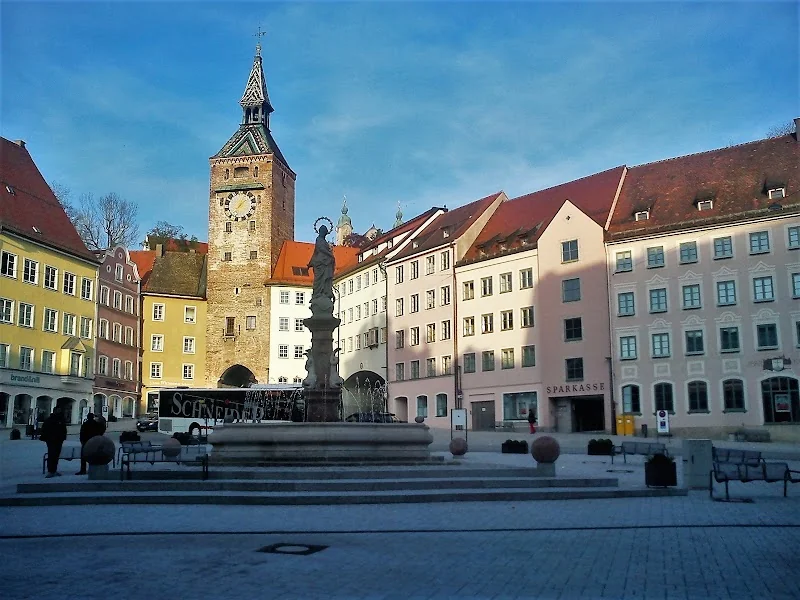
The main square in Landsberg am Lech is much more than just a central location on the city map. It is the historical center of the old town, a square with clear recognizability and a unique character. The city itself describes the main square as its living room, and it indeed feels that way: open, vibrant, rich in history, and still a place where everyday life meets special occasions. It is surrounded by the magnificent Historical Town Hall, the medieval Schmalzturm, and a series of stately townhouses, most of which date back to the 15th and 16th centuries. In its center stands the Mary Fountain from 1783, which adds tranquility and orientation to the square. Those visiting Landsberg am Lech for the first time will find here an ideal entry point into the city, as the main square provides easy access to the most important paths, sights, and shopping areas. The Tourist Information is located directly at the square in the Historical Town Hall, allowing visitors to arrive conveniently. ([landsberg.de](https://www.landsberg.de/tourismus/erlebnisse/sehenswuerdigkeiten/historisches-rathaus-hauptplatz/))
Historical Town Hall and Main Square as the Heart of the Old Town
The Historical Town Hall is the most prominent building at the main square and shapes the entire ensemble with its narrow, towering stucco façade. The building was constructed in several phases starting in 1699 and received its current baroque form between 1717 and 1721 through Dominikus Zimmermann. The city points out that the façade was deliberately designed to make wealth and significance visible. This is still felt today: The town hall does not appear as a mere administrative building, but as an architectural statement in the urban space. Zimmermann is considered one of the great masters of southern German baroque, and his work in Landsberg is among the most important secular works of his career. The building symbolically represents the city's ambition to present itself impressively to the outside world. Additionally, the Tourist Information is located on the ground floor of the Historical Town Hall, making the square not only historically significant but also practically the center of the visit. From here, city tours, walks, and spontaneous explorations of the old town begin. ([landsberg.de](https://www.landsberg.de/tourismus/erlebnisse/sehenswuerdigkeiten/historisches-rathaus-hauptplatz/))
The shape of the main square also makes it special. It stretches from west to east and stands out with its triangular base shape, which is explicitly highlighted as an urban planning feature in the city description. This shape gives the square an open, almost theatrical spatial feeling. The façades of the buildings do not strictly converge in a rectangle but frame the square in a widening that directs the view while making the stay pleasant. For this reason, the main square is particularly suitable for strolling and observing. The surrounding townhouses predominantly date from the 15th and 16th centuries, giving the ensemble a historical depth that goes well beyond the tourist impression of a beautiful town square. Historically, the square was also a place of trade and consultation, thus a center of urban life. The fact that the first town hall was located there shows how enduring this place has been used as a political and social focal point. To this day, the main square is not just a backdrop but a functioning urban space where history, meetings, markets, and events come together. ([landsberg.de](https://www.landsberg.de/tourismus/erlebnisse/sehenswuerdigkeiten/historisches-rathaus-hauptplatz/))
Mary Fountain, Schmalzturm, and the History of the Square
In the center of the main square stands the Mary Fountain from 1783 with the figure of Maria Immaculata, the patron saint of Bavaria. The fountain marks not only the spatial center but also the historical continuity of the square. At exactly this spot stood the first town hall of the city until 1698, which makes the main square appear even more as a grown center of the city's history. Those standing here do not simply see a fountain but a place where administration, trade, and urban self-understanding have overlapped for centuries. Therefore, the main square is not just a randomly beautiful place but a historically charged space where different eras remain visible. Its appearance thrives on this mix of representative architecture, public use, and a clear historical reference point in the center. For visitors, this means that even a short stay conveys a lot about the city's identity. The fountain, the façades, the sightlines, and the open square shape together create a coherent image that vividly illustrates the historical core of Landsberg. ([landsberg.de](https://www.landsberg.de/tourismus/erlebnisse/sehenswuerdigkeiten/historisches-rathaus-hauptplatz/))
At the eastern end of the square stands the Schmalzturm, also known as the Beautiful Tower. It was part of the first city wall in the 13th century and served as the first eastern city gate as well as an important customs station for travelers and merchants. With the later city expansion in the 15th century, its original function shifted, but as a prominent city tower, it remained a defining element of the main square. The current name comes from the market women who stood in the shade of the gate with their goods, including lard, on beautiful days; thus, the name became established. The tower features cloverleaf friezes, colorful roof tiles in the city colors, and above the passage, a cannonball that recalls the Napoleonic occupation period of 1796. These details show how closely traffic history, urban development, and memory culture overlap at a single building. Today, the Schmalzturm is a popular photo motif and forms a strong counterpoint to the Historical Town Hall at the other end of the square. Together, both buildings frame the square like a historical stage. ([landsberg.de](https://www.landsberg.de/tourismus/erlebnisse/sehenswuerdigkeiten/historisches-rathaus-hauptplatz/))
Even beyond the large buildings, the main square tells a lot about the early development of the city. The official city history points out that the house numbering of the old town begins with number 1 at the main square and that the first city district already developed around the main square within the oldest city wall by the 13th century. For further development, monasteries and Seelberg as well as the hospital district and the Old Mountain Road were opened up in the 14th century, and later the area in front of the Salzgasse was added. This information is important because it shows that the main square is not just a beautiful center but the starting point of the entire urban growth. Today, those walking across the square are moving on historical ground that makes the early city structure visible up to the present day. This is what makes the main square interesting for everyone who is interested in urban development, early history, or simply authentic old town atmosphere. The combination of urban history, baroque representation, and medieval structure is rarely as compactly experienced as here. ([landsberg.de](https://www.landsberg.de/kultur/stadtgeschichte/altstadtnummerierung/))
Weekly Market, Farmers' Market, and Festivals at the Main Square
The main square is not only a historical site but still an active marketplace. This is particularly evident at the Landsberg weekly market, which takes place every Wednesday and Saturday at the main square. From April 1st to September 30th, it is open from 7:30 AM to 1:00 PM, and from October 1st to March 31st from 8:00 AM to 1:00 PM. The city describes it as a market for all senses: fruits, vegetables, bread, local specialties, and seasonal products shape the scene, and the personal atmosphere is appreciated by many locals as a meeting place. This is precisely the strength of the square: it is not a museum-like open space but a lively place where the city's perception is condensed in everyday life. Those who come to the square in the morning experience not only a historical backdrop but also regional supply, short distances, and urban togetherness. The weekly market thus ensures continuity between the past and the present. This fits particularly well with a square where trade and consultation took place in the past and which continues to function as a center of urban life to this day. ([landsberg.de](https://www.landsberg.de/rathaus/meine-stadt/maerkte/?utm_source=openai))
In addition to the weekly market, there is the farmers' market, which takes place every Thursday from 2:00 PM to 6:00 PM at the main square. Here, local farmers and producers sell their goods directly, from fruits and vegetables to eggs, baked goods, fish, honey, cheese, and regional specialties. This complements the regular market activities with an even stronger agricultural focus on the products of the region. Furthermore, the main square is often part of larger city festivals. During the LechStadtFest 2026, the old town will transform into a large stage on July 4th and 5th, 2026; music, dance, and family offerings are planned at the main square itself. The traditional Veitsmarkt also utilizes the main square along with the Georg-Hellmair-Platz and the pedestrian zone, and the Christkindlmarkt also plays an important role at the main square, such as with the large Christmas tree and the opening from the window of the Historical Town Hall. Thus, the square is continually re-staged throughout the year without losing its identity. It remains a marketplace, festival site, and meeting point at the same time. ([landsberg.de](https://www.landsberg.de/rathaus/meine-stadt/maerkte/))
Parking, Access, and Practical Ways to the City Center
For all those who wish to visit the main square, the parking situation around the old town is well described. The city points out that there are two underground garages in the city center: the Lechgarage in the west of the old town, directly at the island pool and the city library, and the Schloßberggarage in the east of the old town, which was extensively renovated in 2018 and offers centrally located parking spaces. For those who only want to stay briefly in the city, there are also above-ground parking spaces with parking ticket machines in various areas of the center. For longer stays, the city explicitly recommends the Waitzinger Wiese parking lot, which is inexpensive and only a few minutes' walk from the center. There is also a service station for motorhomes. This combination of underground garages, short walking distances, and affordable alternatives is very helpful for a visit to the old town because the main square itself is located in a sensitive historical area, and the city does not open the center exclusively for car traffic but offers various forms of access. Therefore, those who want to experience the old town in a relaxed manner can weigh comfort, price, and proximity right from the start. ([landsberg.de](https://www.landsberg.de/rathaus/meine-stadt/oepnv-parken/))
The city also publishes specific tariff information for parking in the old town area. On weekdays from Monday to Saturday, parking is free between 12:01 AM and 8:59 AM, between 9:00 AM and 6:00 PM each commenced 20 minutes costs 0.60 euros, with a maximum parking duration of two hours, and between 6:01 PM and 12:00 AM 0.20 euros per commenced 20 minutes. On Sundays and public holidays, parking is free from 12:01 AM to 11:59 AM, after which time tiered fees apply. Additionally, the city names parking spaces for motorcycles, buses, and free parking at selected locations such as the parking lot at Schlüsselanger, Max-Friesenegger-Straße, and the Park & Ride lot on Münchener Straße. E-mobility is also taken into account: centrally located charging stations are available, among others, at Lechstraße 10, in the Lechstraße parking garage, in the Schloßberggarage, at the English Garden, in Von-Kühlmann-Straße, at Infanterieplatz, at Waitzinger Wiese, and in Sandauer Straße. For visitors, this means very good practical accessibility to the old town, even though the main square itself, as a historical space, is consciously not dominated by large-scale traffic. ([landsberg.de](https://www.landsberg.de/rathaus/meine-stadt/oepnv-parken/))
Tourist Information, Strolling, and Discovering Around the Square
Those who wish to explore the main square in Landsberg am Lech can find the Tourist Information directly on site in the Historical Town Hall. The visitor address is Hauptplatz 152, 86899 Landsberg am Lech. The opening hours are from May to October, Monday to Sunday from 9:30 AM to 12:30 PM and from 1:30 PM to 5:00 PM. From November to April, the Tourist Information is open Monday to Friday from 9:30 AM to 12:30 PM and from 1:30 PM to 4:00 PM. Here, guests receive city maps, information about city tours, and tips for further exploration. This is precisely why the main square is an ideal starting point for a stay in Landsberg: one can arrive here, orient themselves, and then gradually walk into the old town. This makes the square particularly attractive for day visitors who are not just looking for a beautiful view but want to meaningfully combine their time with seeing, walking, and stopping by. The surroundings of the square are also designed for this. The city points out the footpaths to the old town alleys, the multitude of sights, and the short distances between the town hall, towers, churches, alleys, and shopping areas. ([landsberg.de](https://www.landsberg.de/tourismus/service/autoladestationen/))
Around the main square, one can also stroll and shop very well. The city describes the area around the main square, the Vorderen Anger, the Hinteranger, and the Alte Bergstraße as particularly suitable addresses for unusual gift ideas, local products, fashion, and souvenirs. This fits excellently with the character of the square, as historical backdrop and modern city life come together directly here. Those who take some time can not only admire the façades from the main square but also linger in cafés, visit market stalls, and then continue into the surrounding alleys. The Schmalzturm at the eastern end serves as a point of orientation, while the Historical Town Hall with its façade forms the western counterpoint. This creates a clear route through a space that is suitable for both spontaneous visits and planned city discoveries. Nearby, there are also further sights such as the Bayer Gate, the old town district, and the Lech Park, so the main square is often just the first, but very formative part of a longer city visit. Those who want to understand Landsberg am Lech should start best right here: at the main square, where history, market life, encounters, and architecture overlap most visibly. ([landsberg.de](https://www.landsberg.de/tourismus/schlemmen-shoppen/shoppen/?utm_source=openai))
Sources:
Mehr anzeigenWeniger anzeigen
Main Square Landsberg am Lech | Markets & History
The main square in Landsberg am Lech is much more than just a central location on the city map. It is the historical center of the old town, a square with clear recognizability and a unique character. The city itself describes the main square as its living room, and it indeed feels that way: open, vibrant, rich in history, and still a place where everyday life meets special occasions. It is surrounded by the magnificent Historical Town Hall, the medieval Schmalzturm, and a series of stately townhouses, most of which date back to the 15th and 16th centuries. In its center stands the Mary Fountain from 1783, which adds tranquility and orientation to the square. Those visiting Landsberg am Lech for the first time will find here an ideal entry point into the city, as the main square provides easy access to the most important paths, sights, and shopping areas. The Tourist Information is located directly at the square in the Historical Town Hall, allowing visitors to arrive conveniently. ([landsberg.de](https://www.landsberg.de/tourismus/erlebnisse/sehenswuerdigkeiten/historisches-rathaus-hauptplatz/))
Historical Town Hall and Main Square as the Heart of the Old Town
The Historical Town Hall is the most prominent building at the main square and shapes the entire ensemble with its narrow, towering stucco façade. The building was constructed in several phases starting in 1699 and received its current baroque form between 1717 and 1721 through Dominikus Zimmermann. The city points out that the façade was deliberately designed to make wealth and significance visible. This is still felt today: The town hall does not appear as a mere administrative building, but as an architectural statement in the urban space. Zimmermann is considered one of the great masters of southern German baroque, and his work in Landsberg is among the most important secular works of his career. The building symbolically represents the city's ambition to present itself impressively to the outside world. Additionally, the Tourist Information is located on the ground floor of the Historical Town Hall, making the square not only historically significant but also practically the center of the visit. From here, city tours, walks, and spontaneous explorations of the old town begin. ([landsberg.de](https://www.landsberg.de/tourismus/erlebnisse/sehenswuerdigkeiten/historisches-rathaus-hauptplatz/))
The shape of the main square also makes it special. It stretches from west to east and stands out with its triangular base shape, which is explicitly highlighted as an urban planning feature in the city description. This shape gives the square an open, almost theatrical spatial feeling. The façades of the buildings do not strictly converge in a rectangle but frame the square in a widening that directs the view while making the stay pleasant. For this reason, the main square is particularly suitable for strolling and observing. The surrounding townhouses predominantly date from the 15th and 16th centuries, giving the ensemble a historical depth that goes well beyond the tourist impression of a beautiful town square. Historically, the square was also a place of trade and consultation, thus a center of urban life. The fact that the first town hall was located there shows how enduring this place has been used as a political and social focal point. To this day, the main square is not just a backdrop but a functioning urban space where history, meetings, markets, and events come together. ([landsberg.de](https://www.landsberg.de/tourismus/erlebnisse/sehenswuerdigkeiten/historisches-rathaus-hauptplatz/))
Mary Fountain, Schmalzturm, and the History of the Square
In the center of the main square stands the Mary Fountain from 1783 with the figure of Maria Immaculata, the patron saint of Bavaria. The fountain marks not only the spatial center but also the historical continuity of the square. At exactly this spot stood the first town hall of the city until 1698, which makes the main square appear even more as a grown center of the city's history. Those standing here do not simply see a fountain but a place where administration, trade, and urban self-understanding have overlapped for centuries. Therefore, the main square is not just a randomly beautiful place but a historically charged space where different eras remain visible. Its appearance thrives on this mix of representative architecture, public use, and a clear historical reference point in the center. For visitors, this means that even a short stay conveys a lot about the city's identity. The fountain, the façades, the sightlines, and the open square shape together create a coherent image that vividly illustrates the historical core of Landsberg. ([landsberg.de](https://www.landsberg.de/tourismus/erlebnisse/sehenswuerdigkeiten/historisches-rathaus-hauptplatz/))
At the eastern end of the square stands the Schmalzturm, also known as the Beautiful Tower. It was part of the first city wall in the 13th century and served as the first eastern city gate as well as an important customs station for travelers and merchants. With the later city expansion in the 15th century, its original function shifted, but as a prominent city tower, it remained a defining element of the main square. The current name comes from the market women who stood in the shade of the gate with their goods, including lard, on beautiful days; thus, the name became established. The tower features cloverleaf friezes, colorful roof tiles in the city colors, and above the passage, a cannonball that recalls the Napoleonic occupation period of 1796. These details show how closely traffic history, urban development, and memory culture overlap at a single building. Today, the Schmalzturm is a popular photo motif and forms a strong counterpoint to the Historical Town Hall at the other end of the square. Together, both buildings frame the square like a historical stage. ([landsberg.de](https://www.landsberg.de/tourismus/erlebnisse/sehenswuerdigkeiten/historisches-rathaus-hauptplatz/))
Even beyond the large buildings, the main square tells a lot about the early development of the city. The official city history points out that the house numbering of the old town begins with number 1 at the main square and that the first city district already developed around the main square within the oldest city wall by the 13th century. For further development, monasteries and Seelberg as well as the hospital district and the Old Mountain Road were opened up in the 14th century, and later the area in front of the Salzgasse was added. This information is important because it shows that the main square is not just a beautiful center but the starting point of the entire urban growth. Today, those walking across the square are moving on historical ground that makes the early city structure visible up to the present day. This is what makes the main square interesting for everyone who is interested in urban development, early history, or simply authentic old town atmosphere. The combination of urban history, baroque representation, and medieval structure is rarely as compactly experienced as here. ([landsberg.de](https://www.landsberg.de/kultur/stadtgeschichte/altstadtnummerierung/))
Weekly Market, Farmers' Market, and Festivals at the Main Square
The main square is not only a historical site but still an active marketplace. This is particularly evident at the Landsberg weekly market, which takes place every Wednesday and Saturday at the main square. From April 1st to September 30th, it is open from 7:30 AM to 1:00 PM, and from October 1st to March 31st from 8:00 AM to 1:00 PM. The city describes it as a market for all senses: fruits, vegetables, bread, local specialties, and seasonal products shape the scene, and the personal atmosphere is appreciated by many locals as a meeting place. This is precisely the strength of the square: it is not a museum-like open space but a lively place where the city's perception is condensed in everyday life. Those who come to the square in the morning experience not only a historical backdrop but also regional supply, short distances, and urban togetherness. The weekly market thus ensures continuity between the past and the present. This fits particularly well with a square where trade and consultation took place in the past and which continues to function as a center of urban life to this day. ([landsberg.de](https://www.landsberg.de/rathaus/meine-stadt/maerkte/?utm_source=openai))
In addition to the weekly market, there is the farmers' market, which takes place every Thursday from 2:00 PM to 6:00 PM at the main square. Here, local farmers and producers sell their goods directly, from fruits and vegetables to eggs, baked goods, fish, honey, cheese, and regional specialties. This complements the regular market activities with an even stronger agricultural focus on the products of the region. Furthermore, the main square is often part of larger city festivals. During the LechStadtFest 2026, the old town will transform into a large stage on July 4th and 5th, 2026; music, dance, and family offerings are planned at the main square itself. The traditional Veitsmarkt also utilizes the main square along with the Georg-Hellmair-Platz and the pedestrian zone, and the Christkindlmarkt also plays an important role at the main square, such as with the large Christmas tree and the opening from the window of the Historical Town Hall. Thus, the square is continually re-staged throughout the year without losing its identity. It remains a marketplace, festival site, and meeting point at the same time. ([landsberg.de](https://www.landsberg.de/rathaus/meine-stadt/maerkte/))
Parking, Access, and Practical Ways to the City Center
For all those who wish to visit the main square, the parking situation around the old town is well described. The city points out that there are two underground garages in the city center: the Lechgarage in the west of the old town, directly at the island pool and the city library, and the Schloßberggarage in the east of the old town, which was extensively renovated in 2018 and offers centrally located parking spaces. For those who only want to stay briefly in the city, there are also above-ground parking spaces with parking ticket machines in various areas of the center. For longer stays, the city explicitly recommends the Waitzinger Wiese parking lot, which is inexpensive and only a few minutes' walk from the center. There is also a service station for motorhomes. This combination of underground garages, short walking distances, and affordable alternatives is very helpful for a visit to the old town because the main square itself is located in a sensitive historical area, and the city does not open the center exclusively for car traffic but offers various forms of access. Therefore, those who want to experience the old town in a relaxed manner can weigh comfort, price, and proximity right from the start. ([landsberg.de](https://www.landsberg.de/rathaus/meine-stadt/oepnv-parken/))
The city also publishes specific tariff information for parking in the old town area. On weekdays from Monday to Saturday, parking is free between 12:01 AM and 8:59 AM, between 9:00 AM and 6:00 PM each commenced 20 minutes costs 0.60 euros, with a maximum parking duration of two hours, and between 6:01 PM and 12:00 AM 0.20 euros per commenced 20 minutes. On Sundays and public holidays, parking is free from 12:01 AM to 11:59 AM, after which time tiered fees apply. Additionally, the city names parking spaces for motorcycles, buses, and free parking at selected locations such as the parking lot at Schlüsselanger, Max-Friesenegger-Straße, and the Park & Ride lot on Münchener Straße. E-mobility is also taken into account: centrally located charging stations are available, among others, at Lechstraße 10, in the Lechstraße parking garage, in the Schloßberggarage, at the English Garden, in Von-Kühlmann-Straße, at Infanterieplatz, at Waitzinger Wiese, and in Sandauer Straße. For visitors, this means very good practical accessibility to the old town, even though the main square itself, as a historical space, is consciously not dominated by large-scale traffic. ([landsberg.de](https://www.landsberg.de/rathaus/meine-stadt/oepnv-parken/))
Tourist Information, Strolling, and Discovering Around the Square
Those who wish to explore the main square in Landsberg am Lech can find the Tourist Information directly on site in the Historical Town Hall. The visitor address is Hauptplatz 152, 86899 Landsberg am Lech. The opening hours are from May to October, Monday to Sunday from 9:30 AM to 12:30 PM and from 1:30 PM to 5:00 PM. From November to April, the Tourist Information is open Monday to Friday from 9:30 AM to 12:30 PM and from 1:30 PM to 4:00 PM. Here, guests receive city maps, information about city tours, and tips for further exploration. This is precisely why the main square is an ideal starting point for a stay in Landsberg: one can arrive here, orient themselves, and then gradually walk into the old town. This makes the square particularly attractive for day visitors who are not just looking for a beautiful view but want to meaningfully combine their time with seeing, walking, and stopping by. The surroundings of the square are also designed for this. The city points out the footpaths to the old town alleys, the multitude of sights, and the short distances between the town hall, towers, churches, alleys, and shopping areas. ([landsberg.de](https://www.landsberg.de/tourismus/service/autoladestationen/))
Around the main square, one can also stroll and shop very well. The city describes the area around the main square, the Vorderen Anger, the Hinteranger, and the Alte Bergstraße as particularly suitable addresses for unusual gift ideas, local products, fashion, and souvenirs. This fits excellently with the character of the square, as historical backdrop and modern city life come together directly here. Those who take some time can not only admire the façades from the main square but also linger in cafés, visit market stalls, and then continue into the surrounding alleys. The Schmalzturm at the eastern end serves as a point of orientation, while the Historical Town Hall with its façade forms the western counterpoint. This creates a clear route through a space that is suitable for both spontaneous visits and planned city discoveries. Nearby, there are also further sights such as the Bayer Gate, the old town district, and the Lech Park, so the main square is often just the first, but very formative part of a longer city visit. Those who want to understand Landsberg am Lech should start best right here: at the main square, where history, market life, encounters, and architecture overlap most visibly. ([landsberg.de](https://www.landsberg.de/tourismus/schlemmen-shoppen/shoppen/?utm_source=openai))
Sources:
Main Square Landsberg am Lech | Markets & History
The main square in Landsberg am Lech is much more than just a central location on the city map. It is the historical center of the old town, a square with clear recognizability and a unique character. The city itself describes the main square as its living room, and it indeed feels that way: open, vibrant, rich in history, and still a place where everyday life meets special occasions. It is surrounded by the magnificent Historical Town Hall, the medieval Schmalzturm, and a series of stately townhouses, most of which date back to the 15th and 16th centuries. In its center stands the Mary Fountain from 1783, which adds tranquility and orientation to the square. Those visiting Landsberg am Lech for the first time will find here an ideal entry point into the city, as the main square provides easy access to the most important paths, sights, and shopping areas. The Tourist Information is located directly at the square in the Historical Town Hall, allowing visitors to arrive conveniently. ([landsberg.de](https://www.landsberg.de/tourismus/erlebnisse/sehenswuerdigkeiten/historisches-rathaus-hauptplatz/))
Historical Town Hall and Main Square as the Heart of the Old Town
The Historical Town Hall is the most prominent building at the main square and shapes the entire ensemble with its narrow, towering stucco façade. The building was constructed in several phases starting in 1699 and received its current baroque form between 1717 and 1721 through Dominikus Zimmermann. The city points out that the façade was deliberately designed to make wealth and significance visible. This is still felt today: The town hall does not appear as a mere administrative building, but as an architectural statement in the urban space. Zimmermann is considered one of the great masters of southern German baroque, and his work in Landsberg is among the most important secular works of his career. The building symbolically represents the city's ambition to present itself impressively to the outside world. Additionally, the Tourist Information is located on the ground floor of the Historical Town Hall, making the square not only historically significant but also practically the center of the visit. From here, city tours, walks, and spontaneous explorations of the old town begin. ([landsberg.de](https://www.landsberg.de/tourismus/erlebnisse/sehenswuerdigkeiten/historisches-rathaus-hauptplatz/))
The shape of the main square also makes it special. It stretches from west to east and stands out with its triangular base shape, which is explicitly highlighted as an urban planning feature in the city description. This shape gives the square an open, almost theatrical spatial feeling. The façades of the buildings do not strictly converge in a rectangle but frame the square in a widening that directs the view while making the stay pleasant. For this reason, the main square is particularly suitable for strolling and observing. The surrounding townhouses predominantly date from the 15th and 16th centuries, giving the ensemble a historical depth that goes well beyond the tourist impression of a beautiful town square. Historically, the square was also a place of trade and consultation, thus a center of urban life. The fact that the first town hall was located there shows how enduring this place has been used as a political and social focal point. To this day, the main square is not just a backdrop but a functioning urban space where history, meetings, markets, and events come together. ([landsberg.de](https://www.landsberg.de/tourismus/erlebnisse/sehenswuerdigkeiten/historisches-rathaus-hauptplatz/))
Mary Fountain, Schmalzturm, and the History of the Square
In the center of the main square stands the Mary Fountain from 1783 with the figure of Maria Immaculata, the patron saint of Bavaria. The fountain marks not only the spatial center but also the historical continuity of the square. At exactly this spot stood the first town hall of the city until 1698, which makes the main square appear even more as a grown center of the city's history. Those standing here do not simply see a fountain but a place where administration, trade, and urban self-understanding have overlapped for centuries. Therefore, the main square is not just a randomly beautiful place but a historically charged space where different eras remain visible. Its appearance thrives on this mix of representative architecture, public use, and a clear historical reference point in the center. For visitors, this means that even a short stay conveys a lot about the city's identity. The fountain, the façades, the sightlines, and the open square shape together create a coherent image that vividly illustrates the historical core of Landsberg. ([landsberg.de](https://www.landsberg.de/tourismus/erlebnisse/sehenswuerdigkeiten/historisches-rathaus-hauptplatz/))
At the eastern end of the square stands the Schmalzturm, also known as the Beautiful Tower. It was part of the first city wall in the 13th century and served as the first eastern city gate as well as an important customs station for travelers and merchants. With the later city expansion in the 15th century, its original function shifted, but as a prominent city tower, it remained a defining element of the main square. The current name comes from the market women who stood in the shade of the gate with their goods, including lard, on beautiful days; thus, the name became established. The tower features cloverleaf friezes, colorful roof tiles in the city colors, and above the passage, a cannonball that recalls the Napoleonic occupation period of 1796. These details show how closely traffic history, urban development, and memory culture overlap at a single building. Today, the Schmalzturm is a popular photo motif and forms a strong counterpoint to the Historical Town Hall at the other end of the square. Together, both buildings frame the square like a historical stage. ([landsberg.de](https://www.landsberg.de/tourismus/erlebnisse/sehenswuerdigkeiten/historisches-rathaus-hauptplatz/))
Even beyond the large buildings, the main square tells a lot about the early development of the city. The official city history points out that the house numbering of the old town begins with number 1 at the main square and that the first city district already developed around the main square within the oldest city wall by the 13th century. For further development, monasteries and Seelberg as well as the hospital district and the Old Mountain Road were opened up in the 14th century, and later the area in front of the Salzgasse was added. This information is important because it shows that the main square is not just a beautiful center but the starting point of the entire urban growth. Today, those walking across the square are moving on historical ground that makes the early city structure visible up to the present day. This is what makes the main square interesting for everyone who is interested in urban development, early history, or simply authentic old town atmosphere. The combination of urban history, baroque representation, and medieval structure is rarely as compactly experienced as here. ([landsberg.de](https://www.landsberg.de/kultur/stadtgeschichte/altstadtnummerierung/))
Weekly Market, Farmers' Market, and Festivals at the Main Square
The main square is not only a historical site but still an active marketplace. This is particularly evident at the Landsberg weekly market, which takes place every Wednesday and Saturday at the main square. From April 1st to September 30th, it is open from 7:30 AM to 1:00 PM, and from October 1st to March 31st from 8:00 AM to 1:00 PM. The city describes it as a market for all senses: fruits, vegetables, bread, local specialties, and seasonal products shape the scene, and the personal atmosphere is appreciated by many locals as a meeting place. This is precisely the strength of the square: it is not a museum-like open space but a lively place where the city's perception is condensed in everyday life. Those who come to the square in the morning experience not only a historical backdrop but also regional supply, short distances, and urban togetherness. The weekly market thus ensures continuity between the past and the present. This fits particularly well with a square where trade and consultation took place in the past and which continues to function as a center of urban life to this day. ([landsberg.de](https://www.landsberg.de/rathaus/meine-stadt/maerkte/?utm_source=openai))
In addition to the weekly market, there is the farmers' market, which takes place every Thursday from 2:00 PM to 6:00 PM at the main square. Here, local farmers and producers sell their goods directly, from fruits and vegetables to eggs, baked goods, fish, honey, cheese, and regional specialties. This complements the regular market activities with an even stronger agricultural focus on the products of the region. Furthermore, the main square is often part of larger city festivals. During the LechStadtFest 2026, the old town will transform into a large stage on July 4th and 5th, 2026; music, dance, and family offerings are planned at the main square itself. The traditional Veitsmarkt also utilizes the main square along with the Georg-Hellmair-Platz and the pedestrian zone, and the Christkindlmarkt also plays an important role at the main square, such as with the large Christmas tree and the opening from the window of the Historical Town Hall. Thus, the square is continually re-staged throughout the year without losing its identity. It remains a marketplace, festival site, and meeting point at the same time. ([landsberg.de](https://www.landsberg.de/rathaus/meine-stadt/maerkte/))
Parking, Access, and Practical Ways to the City Center
For all those who wish to visit the main square, the parking situation around the old town is well described. The city points out that there are two underground garages in the city center: the Lechgarage in the west of the old town, directly at the island pool and the city library, and the Schloßberggarage in the east of the old town, which was extensively renovated in 2018 and offers centrally located parking spaces. For those who only want to stay briefly in the city, there are also above-ground parking spaces with parking ticket machines in various areas of the center. For longer stays, the city explicitly recommends the Waitzinger Wiese parking lot, which is inexpensive and only a few minutes' walk from the center. There is also a service station for motorhomes. This combination of underground garages, short walking distances, and affordable alternatives is very helpful for a visit to the old town because the main square itself is located in a sensitive historical area, and the city does not open the center exclusively for car traffic but offers various forms of access. Therefore, those who want to experience the old town in a relaxed manner can weigh comfort, price, and proximity right from the start. ([landsberg.de](https://www.landsberg.de/rathaus/meine-stadt/oepnv-parken/))
The city also publishes specific tariff information for parking in the old town area. On weekdays from Monday to Saturday, parking is free between 12:01 AM and 8:59 AM, between 9:00 AM and 6:00 PM each commenced 20 minutes costs 0.60 euros, with a maximum parking duration of two hours, and between 6:01 PM and 12:00 AM 0.20 euros per commenced 20 minutes. On Sundays and public holidays, parking is free from 12:01 AM to 11:59 AM, after which time tiered fees apply. Additionally, the city names parking spaces for motorcycles, buses, and free parking at selected locations such as the parking lot at Schlüsselanger, Max-Friesenegger-Straße, and the Park & Ride lot on Münchener Straße. E-mobility is also taken into account: centrally located charging stations are available, among others, at Lechstraße 10, in the Lechstraße parking garage, in the Schloßberggarage, at the English Garden, in Von-Kühlmann-Straße, at Infanterieplatz, at Waitzinger Wiese, and in Sandauer Straße. For visitors, this means very good practical accessibility to the old town, even though the main square itself, as a historical space, is consciously not dominated by large-scale traffic. ([landsberg.de](https://www.landsberg.de/rathaus/meine-stadt/oepnv-parken/))
Tourist Information, Strolling, and Discovering Around the Square
Those who wish to explore the main square in Landsberg am Lech can find the Tourist Information directly on site in the Historical Town Hall. The visitor address is Hauptplatz 152, 86899 Landsberg am Lech. The opening hours are from May to October, Monday to Sunday from 9:30 AM to 12:30 PM and from 1:30 PM to 5:00 PM. From November to April, the Tourist Information is open Monday to Friday from 9:30 AM to 12:30 PM and from 1:30 PM to 4:00 PM. Here, guests receive city maps, information about city tours, and tips for further exploration. This is precisely why the main square is an ideal starting point for a stay in Landsberg: one can arrive here, orient themselves, and then gradually walk into the old town. This makes the square particularly attractive for day visitors who are not just looking for a beautiful view but want to meaningfully combine their time with seeing, walking, and stopping by. The surroundings of the square are also designed for this. The city points out the footpaths to the old town alleys, the multitude of sights, and the short distances between the town hall, towers, churches, alleys, and shopping areas. ([landsberg.de](https://www.landsberg.de/tourismus/service/autoladestationen/))
Around the main square, one can also stroll and shop very well. The city describes the area around the main square, the Vorderen Anger, the Hinteranger, and the Alte Bergstraße as particularly suitable addresses for unusual gift ideas, local products, fashion, and souvenirs. This fits excellently with the character of the square, as historical backdrop and modern city life come together directly here. Those who take some time can not only admire the façades from the main square but also linger in cafés, visit market stalls, and then continue into the surrounding alleys. The Schmalzturm at the eastern end serves as a point of orientation, while the Historical Town Hall with its façade forms the western counterpoint. This creates a clear route through a space that is suitable for both spontaneous visits and planned city discoveries. Nearby, there are also further sights such as the Bayer Gate, the old town district, and the Lech Park, so the main square is often just the first, but very formative part of a longer city visit. Those who want to understand Landsberg am Lech should start best right here: at the main square, where history, market life, encounters, and architecture overlap most visibly. ([landsberg.de](https://www.landsberg.de/tourismus/schlemmen-shoppen/shoppen/?utm_source=openai))
Sources:
Frequently Asked Questions
Reviews
No reviews found