
Peiting
Von-Kahl-Straße 4, 86971 Peiting, Deutschland
Diakonie Herzogsägmühle gGmbH | Address & Events
The Diakonie village Herzogsägmühle in Peiting is not an ordinary place that can be described by just an address or a single institution. Here, living, working, learning, remembering, culture, and everyday life come together in close proximity, and that is what makes the search for Herzogsägmühle so special. Those looking for photos, reviews, directions, or events are actually searching for a place with many faces: a social village in Upper Bavaria, supported by the Diakonie Munich and Upper Bavaria, where people live, help, and shape together. The office is located at Von-Kahl-Straße 4, 86971 Peiting-Herzogsägmühle. The official website showcases images, archival material, and a video that already before the visit shows how versatile this place is. Between café, market, nursery, church, exhibitions, and social offerings, a comprehensive picture emerges that goes far beyond a single location. That is why it is worth taking a closer look at the topics that come up most frequently in searches: address, parking, events, history, photos, and the question of what Herzogsägmühle actually is at its core. ([herzogsaegmuehle.de](https://www.herzogsaegmuehle.de/))
Directions, Parking, and Bus Connection to Von-Kahl-Straße 4
For traveling to Herzogsägmühle, the official directions are the most reliable basis. Currently, entry to the village is only possible via the northern access from Von-Kahl-Straße. The exit is possible either down the Unteroblandstraße or also via the northern exit. Pedestrians can continue to use the Johannes-Schmidt-Weg at the carpentry shop, while cyclists should also take the northern access and not ride against the one-way rule. Those arriving by car will find specific routes from several directions on the website: from Augsburg via Schongau-Nord, from Munich via Weilheim and Peiting-East, from Garmisch-Partenkirchen or Füssen via Peiting-South or Peiting-West, as well as from Kempten via Schongau. In all cases, Herzogsägmühle is directly signposted about two kilometers after leaving the town. For train travelers, the website mentions the Peiting-Nord or Schongau train stations; from there, it continues with a bus or taxi. Additionally, there are bus schedules for the routes Herzogsägmühle–Peiting and Herzogsägmühle–Schongau. Especially because the current situation on site is influenced by construction work in the area of Werkstraße and Ringstraße, it is advisable to check the information on the official site before traveling to ensure a relaxed arrival and parking. ([herzogsaegmuehle.de](https://www.herzogsaegmuehle.de/zum-dorf/hier-findest-du-uns))
Events, Dates, and Culinary Offers Throughout the Year
Those looking for the current program of Herzogsägmühle will find a remarkably lively mix of culture, encounters, and seasonal festivals on the official event page. For 2026, the opening of the exhibition Willy Zielke, the serenade, the harvest festival, the autumn flea market, and the Herzogsägmühle Christmas market are announced, among others. In addition, there are culinary formats in the Café & Wirtshaus Herzog, such as half a chicken, burger night, or breakfast offers. This shows that Herzogsägmühle is not only a place of social work but also a public meeting point with recurring events, to which guests from the region are explicitly welcome. Notably, there is also a connection between tradition and the present: since 1986, the Herzogsägmühle cultural days have been organized annually, alternating between art exhibitions, music weeks, and theater days. This continuity continues to shape the character of the place today. Furthermore, individual events like the Christmas market rely on freely accessible offerings, which underscores the open, inviting character. Therefore, those searching for Herzogsägmühle events are not just looking for dates but a year-round program that connects culture, community, and everyday life. ([herzogsaegmuehle.de](https://www.herzogsaegmuehle.de/erleben/veranstaltungen))
History of Herzogsägmühle: From Worker Colony to Social Village
The history of Herzogsägmühle began in 1894 when the Association for Worker Colonies in Bavaria acquired the properties in Unterobland. From the original project of a worker colony, a place with a tumultuous, sometimes heavily burdened history developed over decades. The official timeline mentions milestones such as the transfer of ownership to the state association for itinerant service in 1935, the transfer of operational management to the Association for Inner Mission in Munich from 1946, and the construction of the Protestant church in 1949. Particularly influential is the Martinskirche, which was built according to the plans of Bauhaus co-founder Professor Otto Bartning and is now a listed building. The history is also a place of learning and remembrance: during the Nazi era, Herzogsägmühle became part of a system of forced care and exclusion, and the memorial site solemnly remembers this chapter. The website explicitly states that during this period, thousands of people went through the measures, and at least 430 men did not survive their stay. The transition from the institution to the community was marked in 1984 with the self-understanding of a place to live; in 1986, the annual cultural days followed. Today, history is not suppressed but actively addressed: with exhibitions such as In the Sidelines or In the Middle? and with guided tours that make the transition from the worker colony to the central wander farm to the present social village comprehensible. ([herzogsaegmuehle.de](https://www.herzogsaegmuehle.de/zum-dorf/geschichte?utm_source=openai))
Photos, Impressions, and the Special Atmosphere in the Diakonie Village
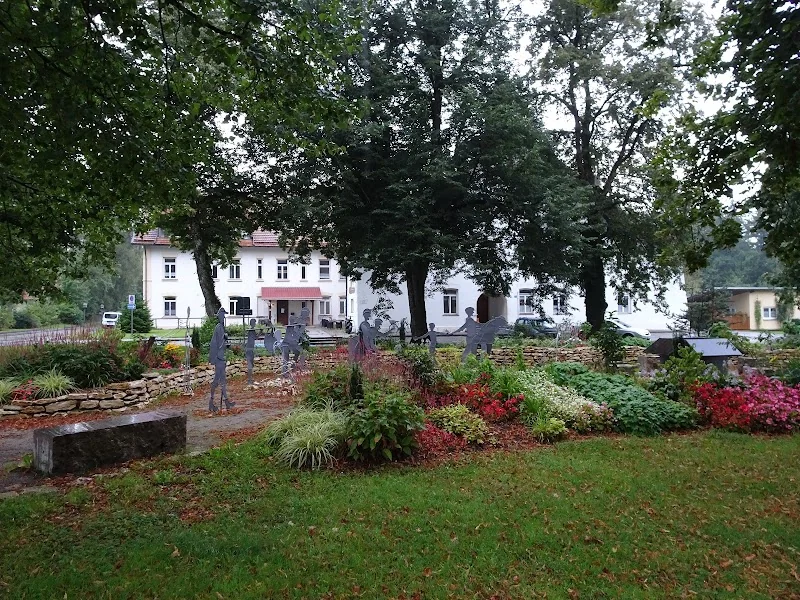
Many search queries about Herzogsägmühle revolve around photos and impressions, and that is quite understandable: the place does not live from a single facade but from a variety of motifs, moods, and perspectives. The official website works with large images, photo series from everyday life, and a video that shows the place in motion. Additionally, there are archival photos that make Herzogsägmühle's history visible and not just told. For visitors, this already creates a realistic impression that here stands not a classic event building, but a whole village with a village square, church, cafés, shops, nursery, exhibitions, and green spaces. Also, the view of individual offerings shows why the place appears photogenic and atmospheric: the Café & Wirtshaus Herzog describes itself as a public café and inn with a playground, mini-golf, and two bowling alleys; the MühlenMarkt presents itself with bread, meat, vegetables, and self-service offerings; the nursery brings flowers, plants, and gardening into the picture. This creates a mix of everyday life and excursions, of social claims and pleasant stay quality. Therefore, those searching for images of Herzogsägmühle find not an interchangeable backdrop but a place where work, encounters, and public life merge. This connection creates the special atmosphere and also explains why so many people first look for photos before deciding to visit. ([herzogsaegmuehle.de](https://www.herzogsaegmuehle.de/))
MühlenMarkt, Nursery, and Café Herzog as Public Contact Points
Herzogsägmühle is not only administration, history, and social offerings but also a place with clearly recognizable public contact points. The MühlenMarkt is one of the most important addresses on site and offers a butcher shop, bakery, fruits and vegetables, self-service items, and a food vending machine. The official opening hours are also publicly accessible; on Mondays, the market is open in the morning, longer hours are indicated from Tuesday to Friday, and it is closed on Saturdays. Particularly interesting is the connection between shopping and social mission: shopping at the MühlenMarkt supports qualification and jobs for people with and without disabilities. The nursery complements this offering with floristry, houseplants, indoor greening, flower and balcony plants, perennials, potted plants, organic vegetable plants, herbs, as well as gardening and landscaping. At the MühlenMarkt, even organic vegetables from the Herzogsägmühle nursery are available. The Café & Wirtshaus Herzog, in turn, is deliberately designed as a public meeting point and offers breakfast, lunch, ice cream sundaes, and homemade cakes. Wherever possible, regional and sustainably produced products are processed, including from their own businesses such as butcher shop and nursery. The fact that the restaurant is barrier-free and has been awarded multiple times for child- and family-friendly service makes it additionally attractive for guests who want to combine a relaxed visit with good catering. ([herzogsaegmuehle.de](https://www.herzogsaegmuehle.de/laeden-und-betriebe/muehlenmarkt))
It is precisely this combination of shopping, dining, and participating that is a central feature of Herzogsägmühle. Those who come in the morning for fresh groceries can sit in the café at noon, visit the nursery in the afternoon, and experience the village square or an event in between. The website makes it clear that all these areas do not run alongside each other but are part of a comprehensive concept. The MühlenMarkt ensures qualification beyond sales, the café connects gastronomy with family-friendly stays, and the nursery supplies both plants and organic products for the market. This creates a local cycle that connects economic, social, and ecological aspects. For visitors, this means: Herzogsägmühle is a place where a short stop is just as meaningful as a longer excursion. Therefore, those specifically looking for Café Herzogsägmühle, MühlenMarkt, or nursery will find not isolated subpages but components of a vibrant village that is publicly accessible and organized in a professionally and socially sound manner. ([herzogsaegmuehle.de](https://www.herzogsaegmuehle.de/laeden-und-betriebe/muehlenmarkt))
Diakonie, Training, and Social Offers Under One Roof
The perhaps most important aspect of Herzogsägmühle is its self-understanding as a diaconal social village. The Diakonie Munich and Upper Bavaria describes itself as the largest social provider in the region and mentions more than 5,500 full-time and about 2,000 volunteer employees. Herzogsägmühle is embedded in this structure and bundles numerous areas on site, ranging from housing to work and education to counseling and encounters. The pages on work and integration describe, among other things, vocational orientation, qualification offers, training professions, inclusive training, jobs for people with disabilities, business partners, and animal-assisted therapy. The Herzogsägmühle craft businesses, agriculture, and other production and service areas are also included. Agriculture has over 100 years of history; according to the website, up to 33 people entitled to assistance from various areas work there, accompanied by four instructors. The nursery is presented as a specialized and training company in several professions, and in the overall model of the place, there is even a guidance service that bundles inquiries and directs visitors or those seeking help. This explains why Herzogsägmühle is not just a tourist station but a social organism: here, not only is managed but structured support, qualification, accompaniment, and facilitation take place. ([herzogsaegmuehle.de](https://www.herzogsaegmuehle.de/wir-sind-diakonie))
For visitors, relatives, professionals, or interested parties, this is a significant difference. Herzogsägmühle is not a pure event location but a place where social work becomes visible and close to everyday life. The mix of training, inclusive employment, public gastronomy, market offerings, historical learning sites, and cultural events creates an unusual density of functions. This makes the search for reviews and photos understandable, as many want to know in advance whether they will find an open, friendly, and well-connected place. The official pages answer this question in their own way: with transparency, with concrete service information, and with a clear commitment to community and participation. The fact that the website describes the place as lively, warm, and special fits with the many offerings that are not tailored to a single audience but bring together various life situations. Therefore, those who visit Herzogsägmühle encounter a village that intertwines social support, everyday provision, and public encounters. This is precisely where the special strength of this place in Peiting lies, which offers far more than just an entry on the map at its address at Von-Kahl-Straße 4. ([herzogsaegmuehle.de](https://www.herzogsaegmuehle.de/))
Sources:
Mehr anzeigenWeniger anzeigen
Diakonie Herzogsägmühle gGmbH | Address & Events
The Diakonie village Herzogsägmühle in Peiting is not an ordinary place that can be described by just an address or a single institution. Here, living, working, learning, remembering, culture, and everyday life come together in close proximity, and that is what makes the search for Herzogsägmühle so special. Those looking for photos, reviews, directions, or events are actually searching for a place with many faces: a social village in Upper Bavaria, supported by the Diakonie Munich and Upper Bavaria, where people live, help, and shape together. The office is located at Von-Kahl-Straße 4, 86971 Peiting-Herzogsägmühle. The official website showcases images, archival material, and a video that already before the visit shows how versatile this place is. Between café, market, nursery, church, exhibitions, and social offerings, a comprehensive picture emerges that goes far beyond a single location. That is why it is worth taking a closer look at the topics that come up most frequently in searches: address, parking, events, history, photos, and the question of what Herzogsägmühle actually is at its core. ([herzogsaegmuehle.de](https://www.herzogsaegmuehle.de/))
Directions, Parking, and Bus Connection to Von-Kahl-Straße 4
For traveling to Herzogsägmühle, the official directions are the most reliable basis. Currently, entry to the village is only possible via the northern access from Von-Kahl-Straße. The exit is possible either down the Unteroblandstraße or also via the northern exit. Pedestrians can continue to use the Johannes-Schmidt-Weg at the carpentry shop, while cyclists should also take the northern access and not ride against the one-way rule. Those arriving by car will find specific routes from several directions on the website: from Augsburg via Schongau-Nord, from Munich via Weilheim and Peiting-East, from Garmisch-Partenkirchen or Füssen via Peiting-South or Peiting-West, as well as from Kempten via Schongau. In all cases, Herzogsägmühle is directly signposted about two kilometers after leaving the town. For train travelers, the website mentions the Peiting-Nord or Schongau train stations; from there, it continues with a bus or taxi. Additionally, there are bus schedules for the routes Herzogsägmühle–Peiting and Herzogsägmühle–Schongau. Especially because the current situation on site is influenced by construction work in the area of Werkstraße and Ringstraße, it is advisable to check the information on the official site before traveling to ensure a relaxed arrival and parking. ([herzogsaegmuehle.de](https://www.herzogsaegmuehle.de/zum-dorf/hier-findest-du-uns))
Events, Dates, and Culinary Offers Throughout the Year
Those looking for the current program of Herzogsägmühle will find a remarkably lively mix of culture, encounters, and seasonal festivals on the official event page. For 2026, the opening of the exhibition Willy Zielke, the serenade, the harvest festival, the autumn flea market, and the Herzogsägmühle Christmas market are announced, among others. In addition, there are culinary formats in the Café & Wirtshaus Herzog, such as half a chicken, burger night, or breakfast offers. This shows that Herzogsägmühle is not only a place of social work but also a public meeting point with recurring events, to which guests from the region are explicitly welcome. Notably, there is also a connection between tradition and the present: since 1986, the Herzogsägmühle cultural days have been organized annually, alternating between art exhibitions, music weeks, and theater days. This continuity continues to shape the character of the place today. Furthermore, individual events like the Christmas market rely on freely accessible offerings, which underscores the open, inviting character. Therefore, those searching for Herzogsägmühle events are not just looking for dates but a year-round program that connects culture, community, and everyday life. ([herzogsaegmuehle.de](https://www.herzogsaegmuehle.de/erleben/veranstaltungen))
History of Herzogsägmühle: From Worker Colony to Social Village
The history of Herzogsägmühle began in 1894 when the Association for Worker Colonies in Bavaria acquired the properties in Unterobland. From the original project of a worker colony, a place with a tumultuous, sometimes heavily burdened history developed over decades. The official timeline mentions milestones such as the transfer of ownership to the state association for itinerant service in 1935, the transfer of operational management to the Association for Inner Mission in Munich from 1946, and the construction of the Protestant church in 1949. Particularly influential is the Martinskirche, which was built according to the plans of Bauhaus co-founder Professor Otto Bartning and is now a listed building. The history is also a place of learning and remembrance: during the Nazi era, Herzogsägmühle became part of a system of forced care and exclusion, and the memorial site solemnly remembers this chapter. The website explicitly states that during this period, thousands of people went through the measures, and at least 430 men did not survive their stay. The transition from the institution to the community was marked in 1984 with the self-understanding of a place to live; in 1986, the annual cultural days followed. Today, history is not suppressed but actively addressed: with exhibitions such as In the Sidelines or In the Middle? and with guided tours that make the transition from the worker colony to the central wander farm to the present social village comprehensible. ([herzogsaegmuehle.de](https://www.herzogsaegmuehle.de/zum-dorf/geschichte?utm_source=openai))
Photos, Impressions, and the Special Atmosphere in the Diakonie Village
Many search queries about Herzogsägmühle revolve around photos and impressions, and that is quite understandable: the place does not live from a single facade but from a variety of motifs, moods, and perspectives. The official website works with large images, photo series from everyday life, and a video that shows the place in motion. Additionally, there are archival photos that make Herzogsägmühle's history visible and not just told. For visitors, this already creates a realistic impression that here stands not a classic event building, but a whole village with a village square, church, cafés, shops, nursery, exhibitions, and green spaces. Also, the view of individual offerings shows why the place appears photogenic and atmospheric: the Café & Wirtshaus Herzog describes itself as a public café and inn with a playground, mini-golf, and two bowling alleys; the MühlenMarkt presents itself with bread, meat, vegetables, and self-service offerings; the nursery brings flowers, plants, and gardening into the picture. This creates a mix of everyday life and excursions, of social claims and pleasant stay quality. Therefore, those searching for images of Herzogsägmühle find not an interchangeable backdrop but a place where work, encounters, and public life merge. This connection creates the special atmosphere and also explains why so many people first look for photos before deciding to visit. ([herzogsaegmuehle.de](https://www.herzogsaegmuehle.de/))
MühlenMarkt, Nursery, and Café Herzog as Public Contact Points
Herzogsägmühle is not only administration, history, and social offerings but also a place with clearly recognizable public contact points. The MühlenMarkt is one of the most important addresses on site and offers a butcher shop, bakery, fruits and vegetables, self-service items, and a food vending machine. The official opening hours are also publicly accessible; on Mondays, the market is open in the morning, longer hours are indicated from Tuesday to Friday, and it is closed on Saturdays. Particularly interesting is the connection between shopping and social mission: shopping at the MühlenMarkt supports qualification and jobs for people with and without disabilities. The nursery complements this offering with floristry, houseplants, indoor greening, flower and balcony plants, perennials, potted plants, organic vegetable plants, herbs, as well as gardening and landscaping. At the MühlenMarkt, even organic vegetables from the Herzogsägmühle nursery are available. The Café & Wirtshaus Herzog, in turn, is deliberately designed as a public meeting point and offers breakfast, lunch, ice cream sundaes, and homemade cakes. Wherever possible, regional and sustainably produced products are processed, including from their own businesses such as butcher shop and nursery. The fact that the restaurant is barrier-free and has been awarded multiple times for child- and family-friendly service makes it additionally attractive for guests who want to combine a relaxed visit with good catering. ([herzogsaegmuehle.de](https://www.herzogsaegmuehle.de/laeden-und-betriebe/muehlenmarkt))
It is precisely this combination of shopping, dining, and participating that is a central feature of Herzogsägmühle. Those who come in the morning for fresh groceries can sit in the café at noon, visit the nursery in the afternoon, and experience the village square or an event in between. The website makes it clear that all these areas do not run alongside each other but are part of a comprehensive concept. The MühlenMarkt ensures qualification beyond sales, the café connects gastronomy with family-friendly stays, and the nursery supplies both plants and organic products for the market. This creates a local cycle that connects economic, social, and ecological aspects. For visitors, this means: Herzogsägmühle is a place where a short stop is just as meaningful as a longer excursion. Therefore, those specifically looking for Café Herzogsägmühle, MühlenMarkt, or nursery will find not isolated subpages but components of a vibrant village that is publicly accessible and organized in a professionally and socially sound manner. ([herzogsaegmuehle.de](https://www.herzogsaegmuehle.de/laeden-und-betriebe/muehlenmarkt))
Diakonie, Training, and Social Offers Under One Roof
The perhaps most important aspect of Herzogsägmühle is its self-understanding as a diaconal social village. The Diakonie Munich and Upper Bavaria describes itself as the largest social provider in the region and mentions more than 5,500 full-time and about 2,000 volunteer employees. Herzogsägmühle is embedded in this structure and bundles numerous areas on site, ranging from housing to work and education to counseling and encounters. The pages on work and integration describe, among other things, vocational orientation, qualification offers, training professions, inclusive training, jobs for people with disabilities, business partners, and animal-assisted therapy. The Herzogsägmühle craft businesses, agriculture, and other production and service areas are also included. Agriculture has over 100 years of history; according to the website, up to 33 people entitled to assistance from various areas work there, accompanied by four instructors. The nursery is presented as a specialized and training company in several professions, and in the overall model of the place, there is even a guidance service that bundles inquiries and directs visitors or those seeking help. This explains why Herzogsägmühle is not just a tourist station but a social organism: here, not only is managed but structured support, qualification, accompaniment, and facilitation take place. ([herzogsaegmuehle.de](https://www.herzogsaegmuehle.de/wir-sind-diakonie))
For visitors, relatives, professionals, or interested parties, this is a significant difference. Herzogsägmühle is not a pure event location but a place where social work becomes visible and close to everyday life. The mix of training, inclusive employment, public gastronomy, market offerings, historical learning sites, and cultural events creates an unusual density of functions. This makes the search for reviews and photos understandable, as many want to know in advance whether they will find an open, friendly, and well-connected place. The official pages answer this question in their own way: with transparency, with concrete service information, and with a clear commitment to community and participation. The fact that the website describes the place as lively, warm, and special fits with the many offerings that are not tailored to a single audience but bring together various life situations. Therefore, those who visit Herzogsägmühle encounter a village that intertwines social support, everyday provision, and public encounters. This is precisely where the special strength of this place in Peiting lies, which offers far more than just an entry on the map at its address at Von-Kahl-Straße 4. ([herzogsaegmuehle.de](https://www.herzogsaegmuehle.de/))
Sources:
Diakonie Herzogsägmühle gGmbH | Address & Events
The Diakonie village Herzogsägmühle in Peiting is not an ordinary place that can be described by just an address or a single institution. Here, living, working, learning, remembering, culture, and everyday life come together in close proximity, and that is what makes the search for Herzogsägmühle so special. Those looking for photos, reviews, directions, or events are actually searching for a place with many faces: a social village in Upper Bavaria, supported by the Diakonie Munich and Upper Bavaria, where people live, help, and shape together. The office is located at Von-Kahl-Straße 4, 86971 Peiting-Herzogsägmühle. The official website showcases images, archival material, and a video that already before the visit shows how versatile this place is. Between café, market, nursery, church, exhibitions, and social offerings, a comprehensive picture emerges that goes far beyond a single location. That is why it is worth taking a closer look at the topics that come up most frequently in searches: address, parking, events, history, photos, and the question of what Herzogsägmühle actually is at its core. ([herzogsaegmuehle.de](https://www.herzogsaegmuehle.de/))
Directions, Parking, and Bus Connection to Von-Kahl-Straße 4
For traveling to Herzogsägmühle, the official directions are the most reliable basis. Currently, entry to the village is only possible via the northern access from Von-Kahl-Straße. The exit is possible either down the Unteroblandstraße or also via the northern exit. Pedestrians can continue to use the Johannes-Schmidt-Weg at the carpentry shop, while cyclists should also take the northern access and not ride against the one-way rule. Those arriving by car will find specific routes from several directions on the website: from Augsburg via Schongau-Nord, from Munich via Weilheim and Peiting-East, from Garmisch-Partenkirchen or Füssen via Peiting-South or Peiting-West, as well as from Kempten via Schongau. In all cases, Herzogsägmühle is directly signposted about two kilometers after leaving the town. For train travelers, the website mentions the Peiting-Nord or Schongau train stations; from there, it continues with a bus or taxi. Additionally, there are bus schedules for the routes Herzogsägmühle–Peiting and Herzogsägmühle–Schongau. Especially because the current situation on site is influenced by construction work in the area of Werkstraße and Ringstraße, it is advisable to check the information on the official site before traveling to ensure a relaxed arrival and parking. ([herzogsaegmuehle.de](https://www.herzogsaegmuehle.de/zum-dorf/hier-findest-du-uns))
Events, Dates, and Culinary Offers Throughout the Year
Those looking for the current program of Herzogsägmühle will find a remarkably lively mix of culture, encounters, and seasonal festivals on the official event page. For 2026, the opening of the exhibition Willy Zielke, the serenade, the harvest festival, the autumn flea market, and the Herzogsägmühle Christmas market are announced, among others. In addition, there are culinary formats in the Café & Wirtshaus Herzog, such as half a chicken, burger night, or breakfast offers. This shows that Herzogsägmühle is not only a place of social work but also a public meeting point with recurring events, to which guests from the region are explicitly welcome. Notably, there is also a connection between tradition and the present: since 1986, the Herzogsägmühle cultural days have been organized annually, alternating between art exhibitions, music weeks, and theater days. This continuity continues to shape the character of the place today. Furthermore, individual events like the Christmas market rely on freely accessible offerings, which underscores the open, inviting character. Therefore, those searching for Herzogsägmühle events are not just looking for dates but a year-round program that connects culture, community, and everyday life. ([herzogsaegmuehle.de](https://www.herzogsaegmuehle.de/erleben/veranstaltungen))
History of Herzogsägmühle: From Worker Colony to Social Village
The history of Herzogsägmühle began in 1894 when the Association for Worker Colonies in Bavaria acquired the properties in Unterobland. From the original project of a worker colony, a place with a tumultuous, sometimes heavily burdened history developed over decades. The official timeline mentions milestones such as the transfer of ownership to the state association for itinerant service in 1935, the transfer of operational management to the Association for Inner Mission in Munich from 1946, and the construction of the Protestant church in 1949. Particularly influential is the Martinskirche, which was built according to the plans of Bauhaus co-founder Professor Otto Bartning and is now a listed building. The history is also a place of learning and remembrance: during the Nazi era, Herzogsägmühle became part of a system of forced care and exclusion, and the memorial site solemnly remembers this chapter. The website explicitly states that during this period, thousands of people went through the measures, and at least 430 men did not survive their stay. The transition from the institution to the community was marked in 1984 with the self-understanding of a place to live; in 1986, the annual cultural days followed. Today, history is not suppressed but actively addressed: with exhibitions such as In the Sidelines or In the Middle? and with guided tours that make the transition from the worker colony to the central wander farm to the present social village comprehensible. ([herzogsaegmuehle.de](https://www.herzogsaegmuehle.de/zum-dorf/geschichte?utm_source=openai))
Photos, Impressions, and the Special Atmosphere in the Diakonie Village
Many search queries about Herzogsägmühle revolve around photos and impressions, and that is quite understandable: the place does not live from a single facade but from a variety of motifs, moods, and perspectives. The official website works with large images, photo series from everyday life, and a video that shows the place in motion. Additionally, there are archival photos that make Herzogsägmühle's history visible and not just told. For visitors, this already creates a realistic impression that here stands not a classic event building, but a whole village with a village square, church, cafés, shops, nursery, exhibitions, and green spaces. Also, the view of individual offerings shows why the place appears photogenic and atmospheric: the Café & Wirtshaus Herzog describes itself as a public café and inn with a playground, mini-golf, and two bowling alleys; the MühlenMarkt presents itself with bread, meat, vegetables, and self-service offerings; the nursery brings flowers, plants, and gardening into the picture. This creates a mix of everyday life and excursions, of social claims and pleasant stay quality. Therefore, those searching for images of Herzogsägmühle find not an interchangeable backdrop but a place where work, encounters, and public life merge. This connection creates the special atmosphere and also explains why so many people first look for photos before deciding to visit. ([herzogsaegmuehle.de](https://www.herzogsaegmuehle.de/))
MühlenMarkt, Nursery, and Café Herzog as Public Contact Points
Herzogsägmühle is not only administration, history, and social offerings but also a place with clearly recognizable public contact points. The MühlenMarkt is one of the most important addresses on site and offers a butcher shop, bakery, fruits and vegetables, self-service items, and a food vending machine. The official opening hours are also publicly accessible; on Mondays, the market is open in the morning, longer hours are indicated from Tuesday to Friday, and it is closed on Saturdays. Particularly interesting is the connection between shopping and social mission: shopping at the MühlenMarkt supports qualification and jobs for people with and without disabilities. The nursery complements this offering with floristry, houseplants, indoor greening, flower and balcony plants, perennials, potted plants, organic vegetable plants, herbs, as well as gardening and landscaping. At the MühlenMarkt, even organic vegetables from the Herzogsägmühle nursery are available. The Café & Wirtshaus Herzog, in turn, is deliberately designed as a public meeting point and offers breakfast, lunch, ice cream sundaes, and homemade cakes. Wherever possible, regional and sustainably produced products are processed, including from their own businesses such as butcher shop and nursery. The fact that the restaurant is barrier-free and has been awarded multiple times for child- and family-friendly service makes it additionally attractive for guests who want to combine a relaxed visit with good catering. ([herzogsaegmuehle.de](https://www.herzogsaegmuehle.de/laeden-und-betriebe/muehlenmarkt))
It is precisely this combination of shopping, dining, and participating that is a central feature of Herzogsägmühle. Those who come in the morning for fresh groceries can sit in the café at noon, visit the nursery in the afternoon, and experience the village square or an event in between. The website makes it clear that all these areas do not run alongside each other but are part of a comprehensive concept. The MühlenMarkt ensures qualification beyond sales, the café connects gastronomy with family-friendly stays, and the nursery supplies both plants and organic products for the market. This creates a local cycle that connects economic, social, and ecological aspects. For visitors, this means: Herzogsägmühle is a place where a short stop is just as meaningful as a longer excursion. Therefore, those specifically looking for Café Herzogsägmühle, MühlenMarkt, or nursery will find not isolated subpages but components of a vibrant village that is publicly accessible and organized in a professionally and socially sound manner. ([herzogsaegmuehle.de](https://www.herzogsaegmuehle.de/laeden-und-betriebe/muehlenmarkt))
Diakonie, Training, and Social Offers Under One Roof
The perhaps most important aspect of Herzogsägmühle is its self-understanding as a diaconal social village. The Diakonie Munich and Upper Bavaria describes itself as the largest social provider in the region and mentions more than 5,500 full-time and about 2,000 volunteer employees. Herzogsägmühle is embedded in this structure and bundles numerous areas on site, ranging from housing to work and education to counseling and encounters. The pages on work and integration describe, among other things, vocational orientation, qualification offers, training professions, inclusive training, jobs for people with disabilities, business partners, and animal-assisted therapy. The Herzogsägmühle craft businesses, agriculture, and other production and service areas are also included. Agriculture has over 100 years of history; according to the website, up to 33 people entitled to assistance from various areas work there, accompanied by four instructors. The nursery is presented as a specialized and training company in several professions, and in the overall model of the place, there is even a guidance service that bundles inquiries and directs visitors or those seeking help. This explains why Herzogsägmühle is not just a tourist station but a social organism: here, not only is managed but structured support, qualification, accompaniment, and facilitation take place. ([herzogsaegmuehle.de](https://www.herzogsaegmuehle.de/wir-sind-diakonie))
For visitors, relatives, professionals, or interested parties, this is a significant difference. Herzogsägmühle is not a pure event location but a place where social work becomes visible and close to everyday life. The mix of training, inclusive employment, public gastronomy, market offerings, historical learning sites, and cultural events creates an unusual density of functions. This makes the search for reviews and photos understandable, as many want to know in advance whether they will find an open, friendly, and well-connected place. The official pages answer this question in their own way: with transparency, with concrete service information, and with a clear commitment to community and participation. The fact that the website describes the place as lively, warm, and special fits with the many offerings that are not tailored to a single audience but bring together various life situations. Therefore, those who visit Herzogsägmühle encounter a village that intertwines social support, everyday provision, and public encounters. This is precisely where the special strength of this place in Peiting lies, which offers far more than just an entry on the map at its address at Von-Kahl-Straße 4. ([herzogsaegmuehle.de](https://www.herzogsaegmuehle.de/))
Sources:
Frequently Asked Questions
Reviews
No reviews found