
Dießen am Ammersee
Ziegelstadl 1, 86911 Dießen am Ammersee, Deutschland
COMU – Carl Orff Museum | Opening Hours & Directions
The COMU – Carl Orff Museum in Dießen am Ammersee is much more than a classic composer museum. It opens the authentic living and working place of Carl Orff with a residential and working house, original preserved study, park-like grounds, and a new building for visitors who want to not only read about music history but experience it spatially. The official website presents the house as a place of encounter, learning, and inspiration and also gives a first impression of the exhibition concept, rooms, and open spaces. That is exactly why the COMU is also interesting for everyone who is looking for images, impressions, and a clear visit plan in advance. ([carl-orff.org](https://www.carl-orff.org/?utm_source=openai))
Opening Hours, Tickets, and Planning Your Visit
Anyone planning a visit to the COMU should first check the current opening hours. The official website currently states that the museum is open from Tuesday to Friday from 12:00 PM to 5:00 PM and on Saturday and Sunday from 10:00 AM to 5:00 PM; closing times on public holidays are published separately. This is important for good planning because the COMU is not only an exhibition house but also a venue, a learning place, and a destination for excursions. Therefore, anyone who wants to get the most out of their visit should bring enough time and not just plan a quick stop. ([carl-orff.org](https://www.carl-orff.org/?utm_source=openai))
The website explicitly invites visitors to get to know the world of Carl Orff, the Orff Schulwerk, and the exhibition idea, as well as to get a taste of the museum with its rooms and open spaces. This means: A visit is especially worthwhile if one thinks of it as a total experience. For example, those traveling with family, choir, friends, or musical interests can connect the exhibition, garden, and KLANGBAR well together. Even for guests who are initially only looking for photos or a first visual impression, the digital preview is helpful because it shows that the COMU works with a clear mix of culture, architecture, and landscape. ([carl-orff.org](https://www.carl-orff.org/?utm_source=openai))
It is also practical that the foundation offers contact options for inquiries on its website. This allows groups, families, or people with special requirements to better coordinate their planning. Especially in a house that combines guided tours, family offers, special themes, and seasonal opening hours, this transparency is an advantage. For the search intent around opening hours, tickets, and visit planning, the COMU thus provides a good mix of orientation, reliability, and anticipation. ([carl-orff.org](https://carl-orff.org/en?utm_source=openai))
Directions to Dießen am Ammersee
The official directions page makes traveling to the COMU very concrete. Visitors can reach Dießen am Ammersee by car, train, or in summer also by boat from Herrsching. For drivers, the website describes the route via the A96 to the Greifenberg exit, then further via the St2055 towards Dießen and Landsberg. Along the way, one passes Schondorf am Ammersee, Utting am Ammersee, and Riederau am Ammersee before reaching Dießen on Lachener Straße or Prinz-Ludwig-Straße and finally arriving at the destination via Vogelherdstraße and Ziegelstadel. ([carl-orff.com](https://www.carl-orff.com/en/anfahrt))
The train connection is also well described: According to the website, there is a direct BRB connection from Geltendorf or Weilheim to Dießen am Ammersee. The journey takes about 27 minutes from Geltendorf and approximately 10 minutes from Weilheim; the train usually runs hourly. From the Dießen station to Ziegelstadel, it is about 2.5 kilometers on foot, which takes about 40 minutes of walking time. Those who do not want to walk can additionally use the bus. This is a clear advantage, especially for guests from the region or for day trips, as it allows planning a visit to the museum without complicated transfers. ([carl-orff.com](https://www.carl-orff.com/en/anfahrt))
In summer, there is also a particularly beautiful option: The Ammersee ferry connects Herrsching and Dießen directly in about 20 to 25 minutes, with several departures per day. However, from the landing stage in Dießen, there is still a footpath to Ziegelstadel. For many visitors, this combination of traveling over the lake, walking through the town, and experiencing the museum is an additional attraction. The COMU is not isolated but embedded in a landscape that makes the visit a small excursion even on the way there. Therefore, those looking for directions, location, and excursion ideas get not only an address here but a very concrete way through the Ammersee region. ([carl-orff.com](https://www.carl-orff.com/en/anfahrt))
History of the Ziegelstadel and the New Building
The history of the place is closely connected to Carl Orff himself. In 1954, Carl Orff and his then-wife, the writer Luise Rinser, purchased the property at Ziegelstadel 1 in Dießen-St. Georgen. The two buildings date back to the mid-19th century and have been altered several times over the years. Orff's brother-in-law, the landscape architect Alwin Seifert, had brought the house with its park-like garden into play; the couple was immediately enthusiastic and had the estate fundamentally renewed. In her autobiographical novel, Luise Rinser describes the house as her dream place with a wide view over the Ammersee to Andechs and the mountains. ([carl-orff.com](https://www.carl-orff.com/en/geschichte-und-neubau))
The renovation was carried out in the architectural language of Sep Ruf and the 1950s, and in 1956 Orff and Rinser moved into the estate. For both, it was a retreat from war-destroyed Munich, where they wanted to work in peace. Particularly important for the current museum is that Carl Orff's study has been preserved in its original form since his death and is now part of the museum tour. Since 2018, the property and garden have been under monument protection. This not only emphasizes the cultural value of the place but also explains why the COMU places such strong emphasis on authenticity, preservation, and regional identity. ([carl-orff.com](https://www.carl-orff.com/en/geschichte-und-neubau))
The new building itself was deliberately designed to be understated so that the charm of the ensemble would not be overshadowed. The official description mentions a high special exhibition hall with a distinctive barrel vault, clearly structured exhibition rooms, and a recurring material language of exposed concrete and oak furniture. Particularly relevant for visitors is the barrier-free tour that opens up the entire ensemble. This connects the COMU's historical substance with modern museum technology and creates an architecture that does not seem loud but makes the place, the collection, and Carl Orff's living environment as readable as possible. ([carl-orff.com](https://www.carl-orff.com/en/geschichte-und-neubau))
Exhibition, Rooms, and First Impressions
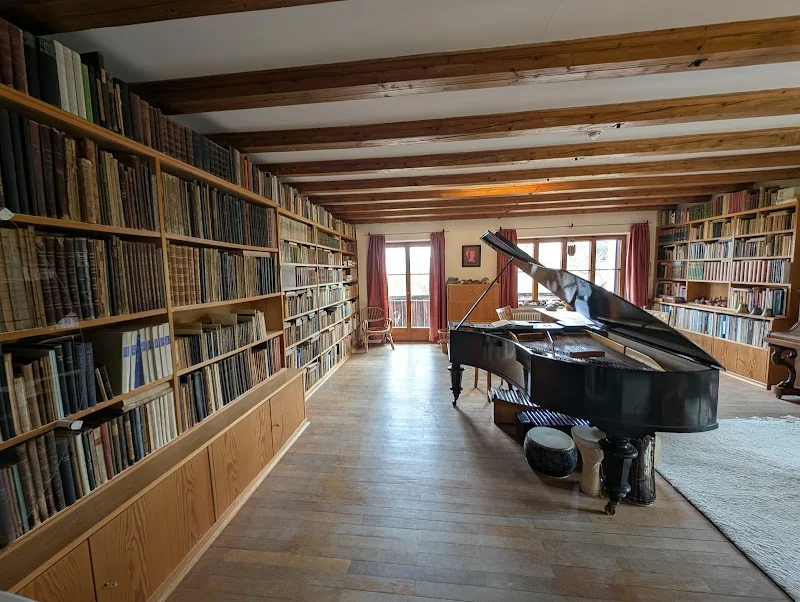
The COMU does not see itself as a mere showcase collection but as a walkable narrative about the life, work, and environment of Carl Orff. The website states that visitors will get a taste of the exhibition concept, the rooms, and the beautiful open spaces. This is crucial for search queries for photos, images, and first impressions: One does not get an abstract overview but an impression of how space, light, and content interact. The museum makes it clear that it does not want to welcome its visitors with dry chronology but with an atmosphere in which music, architecture, and landscape intertwine. ([carl-orff.org](https://www.carl-orff.org/?utm_source=openai))
Architecturally, it is particularly exciting that the new extension not only creates space but also organizes sight lines and perspectives. The large special exhibition room with barrel vault emphasizes the address, while the exhibition modules inside are clearly and diversely laid out. The supporting structure consciously recalls the ceilings of the existing building and makes the rooms both column-free and flexible to use. This allows the museum to offer various formats side by side: permanent exhibition, special exhibition, activity areas, and educational offerings. This is important because the contents related to Carl Orff, his Schulwerk, and his artistic work should not only be viewed but also experienced. ([carl-orff.com](https://www.carl-orff.com/en/geschichte-und-neubau))
The outdoor spaces are also part of the exhibition experience. The park, the open areas, and the view of the landscape are not just a backdrop but part of the narrative about the place. The COMU thus presents itself as a museum that makes the composer’s living world visible and does not just explain his work abstractly. Therefore, those looking for a house that convinces in images, spaces, and atmosphere will find a strong mix of historical authenticity, contemporary museum architecture, and regional landscape here. ([carl-orff.com](https://www.carl-orff.com/en/geschichte-und-neubau))
Carl Orff, Carmina Burana, and the Orff Schulwerk
Carl Orff was born on July 10, 1895, in Munich and grew up in a musical family. The official museum pages describe him as a fascinating, versatile personality who was not only a composer but also an educator, word creator, and theater maker. This versatility makes the COMU interesting: It is not just about a famous work but about an artist whose thinking brings together music, language, movement, and stage. The museum thus shows an Orff who reaches far beyond the classical concert repertoire and continues to resonate in education, theater, and music pedagogy to this day. ([carl-orff.com](https://www.carl-orff.org/?utm_source=openai))
A central reference point is Carmina Burana. The official page describes the work as one of the most successful choral works of the 20th century and emphasizes that it became, in a way, Orff's own starting point, the work with which he re-evaluated his previously composed pieces. This is relevant for visitors because it explains why Orff appears not just as a name in music books but as a composer with a very distinctive sound language. Those who visit the COMU can not only trace this energy historically in the museum but also find it as an acoustic and content-related trace in the exhibition rooms. ([carl-orff.com](https://carl-orff.org/en/carmina-burana?utm_source=openai))
Equally important is the Orff Schulwerk. The museum pages explain that Orff and Gunild Keetman worked with simple instruments and elementary methods so that everyone can make music, even without prior knowledge. This is precisely where the educational significance of the house lies: The COMU not only preserves an estate but also conveys an idea of music as a communal, physical, and creative practice. For families, school classes, music enthusiasts, and international Orff communities, this is a strong argument because it gives the museum an additional level. It is about art history, but also about lively communication. ([carl-orff.com](https://www.carl-orff.org/?utm_source=openai))
Guided Tours, Children, and Families at the COMU
The COMU is explicitly designed as an active learning and meeting place. The official guided tours page announces a comprehensive offering: monthly open tours focusing on the permanent exhibition or on special topics related to Carl Orff, as well as thematic tours that can be booked individually or as a group. This is an important point for anyone looking for tours, group offers, or a more structured museum visit. Especially in a house with so many levels – biography, music, pedagogy, architecture, garden – a guided tour helps to understand the most important connections more quickly and to focus one's attention on the crucial details. ([carl-orff.com](https://www.carl-orff.com/en/fuehrungen))
The family page shows that the museum consciously wants to appeal to young guests as well. There, the tour with children is described as playful: children and adults sing, laugh, drum, and clap together while learning about percussion instruments, choral music, the pets of the Orffs, and their lives. This mix of participation and learning is particularly attractive for family outings because it positions the museum not as a silent obligation but as a shared experience. Even children's birthdays are possible in the museum according to the website. For the search intent around child-friendly excursion destinations, the COMU thus provides exactly what many parents are looking for: culture, activity, and an atmosphere in which children are truly addressed. ([carl-orff.com](https://www.carl-orff.com/en/kinder-familien))
Also for choir groups or music associations, the house is interesting because Orff is understood not only as a composer but as a voice of a vibrant music practice. The website explicitly states that the offerings are aimed at culture and music enthusiasts, the region, the international Orff community, as well as schools and educational institutions. Thus, the COMU is not a museum for a single target group but a place where different visitor groups can find their own access. This makes the guided tours and educational offerings a real core of the experience. ([carl-orff.com](https://carl-orff.org/en?utm_source=openai))
Garden, KLANGBAR, and Barrier-Free Tour
One of the strongest reasons to visit the COMU is the garden area. According to the official page, the park-like garden covers four hectares and combines elements of a cottage garden with those of an English cottage garden. The planting follows the original ideas of Alwin Seifert, the well-known landscape pioneer and brother of Carl Orff's first partner Luise Rinser. The garden is characterized by forest edges, hillside locations, hedges, and a large variety of bushes, trees, and flowers. Those looking for images or a particularly atmospheric backdrop will find here not only a museum environment but a landscape-rich place with clear seasonal effects. ([carl-orff.com](https://www.carl-orff.com/en/garten-und-bauerngarten))
In addition, the KLANGBAR serves as a café and restaurant. The official page mentions 25 seats indoors and 65 seats on the terrace. In good weather, the view opens up to flower meadows, the Bavarian Alps, and the tranquil expanse of the Ammersee. For special events, the garden can even become an open-air stage or concert hall. Thus, the KLANGBAR complements the museum not only gastronomically but also culturally. It makes the visit longer, more relaxed, and atmospheric and offers a place where one can sit, talk, and let the place resonate after the exhibition. ([carl-orff.com](https://www.carl-orff.com/en/cafe-klangbar))
Sustainability and accessibility are also not marginal topics at the COMU. The website describes energy-efficient building planning, a heat pump with photovoltaics, LED lighting, the kitchen garden with processing and direct sales in the café and museum shop, as well as beehives to support biodiversity. In addition, there is a barrier-free path through the entire ensemble. Together, this results in a modern museum that focuses not only on content but also on accessibility, responsibility, and quality of stay. For visitors, this means: The COMU is not only beautiful to look at but also thoughtfully planned and pleasantly experienced in practice. ([carl-orff.com](https://carl-orff.org/en?utm_source=openai))
In the end, it becomes clear why the COMU – Carl Orff Museum fits so well with search queries for photos, opening hours, guided tours, directions, garden, or café: The house combines everything that a strong cultural place needs. It is authentic, scenically appealing, architecturally clear, family-friendly, pedagogically relevant, and musically deeply rooted. Those who understand Carl Orff, Carmina Burana, or the Orff Schulwerk find here a place where these themes are not only explained but become spatially and atmospherically tangible. This makes a visit to Dießen am Ammersee an experience that resonates long after. ([carl-orff.com](https://www.carl-orff.com/en/geschichte-und-neubau))
Sources:
- Carl Orff Museum - Official Homepage
- Carl Orff Museum - Carl Orff: Life & Work
- Carl Orff Museum - Carmina Burana
- Carl Orff Museum - Schulwerk & Music Pedagogy
- Carl Orff Museum - History & New Building
- Carl Orff Museum - Directions
- Carl Orff Museum - Guided Tours
- Carl Orff Museum - Kids & Families
- Carl Orff Museum - Garden & Cottage Garden
- Carl Orff Museum - KLANGBAR Café & Restaurant
Show moreShow less
COMU – Carl Orff Museum | Opening Hours & Directions
The COMU – Carl Orff Museum in Dießen am Ammersee is much more than a classic composer museum. It opens the authentic living and working place of Carl Orff with a residential and working house, original preserved study, park-like grounds, and a new building for visitors who want to not only read about music history but experience it spatially. The official website presents the house as a place of encounter, learning, and inspiration and also gives a first impression of the exhibition concept, rooms, and open spaces. That is exactly why the COMU is also interesting for everyone who is looking for images, impressions, and a clear visit plan in advance. ([carl-orff.org](https://www.carl-orff.org/?utm_source=openai))
Opening Hours, Tickets, and Planning Your Visit
Anyone planning a visit to the COMU should first check the current opening hours. The official website currently states that the museum is open from Tuesday to Friday from 12:00 PM to 5:00 PM and on Saturday and Sunday from 10:00 AM to 5:00 PM; closing times on public holidays are published separately. This is important for good planning because the COMU is not only an exhibition house but also a venue, a learning place, and a destination for excursions. Therefore, anyone who wants to get the most out of their visit should bring enough time and not just plan a quick stop. ([carl-orff.org](https://www.carl-orff.org/?utm_source=openai))
The website explicitly invites visitors to get to know the world of Carl Orff, the Orff Schulwerk, and the exhibition idea, as well as to get a taste of the museum with its rooms and open spaces. This means: A visit is especially worthwhile if one thinks of it as a total experience. For example, those traveling with family, choir, friends, or musical interests can connect the exhibition, garden, and KLANGBAR well together. Even for guests who are initially only looking for photos or a first visual impression, the digital preview is helpful because it shows that the COMU works with a clear mix of culture, architecture, and landscape. ([carl-orff.org](https://www.carl-orff.org/?utm_source=openai))
It is also practical that the foundation offers contact options for inquiries on its website. This allows groups, families, or people with special requirements to better coordinate their planning. Especially in a house that combines guided tours, family offers, special themes, and seasonal opening hours, this transparency is an advantage. For the search intent around opening hours, tickets, and visit planning, the COMU thus provides a good mix of orientation, reliability, and anticipation. ([carl-orff.org](https://carl-orff.org/en?utm_source=openai))
Directions to Dießen am Ammersee
The official directions page makes traveling to the COMU very concrete. Visitors can reach Dießen am Ammersee by car, train, or in summer also by boat from Herrsching. For drivers, the website describes the route via the A96 to the Greifenberg exit, then further via the St2055 towards Dießen and Landsberg. Along the way, one passes Schondorf am Ammersee, Utting am Ammersee, and Riederau am Ammersee before reaching Dießen on Lachener Straße or Prinz-Ludwig-Straße and finally arriving at the destination via Vogelherdstraße and Ziegelstadel. ([carl-orff.com](https://www.carl-orff.com/en/anfahrt))
The train connection is also well described: According to the website, there is a direct BRB connection from Geltendorf or Weilheim to Dießen am Ammersee. The journey takes about 27 minutes from Geltendorf and approximately 10 minutes from Weilheim; the train usually runs hourly. From the Dießen station to Ziegelstadel, it is about 2.5 kilometers on foot, which takes about 40 minutes of walking time. Those who do not want to walk can additionally use the bus. This is a clear advantage, especially for guests from the region or for day trips, as it allows planning a visit to the museum without complicated transfers. ([carl-orff.com](https://www.carl-orff.com/en/anfahrt))
In summer, there is also a particularly beautiful option: The Ammersee ferry connects Herrsching and Dießen directly in about 20 to 25 minutes, with several departures per day. However, from the landing stage in Dießen, there is still a footpath to Ziegelstadel. For many visitors, this combination of traveling over the lake, walking through the town, and experiencing the museum is an additional attraction. The COMU is not isolated but embedded in a landscape that makes the visit a small excursion even on the way there. Therefore, those looking for directions, location, and excursion ideas get not only an address here but a very concrete way through the Ammersee region. ([carl-orff.com](https://www.carl-orff.com/en/anfahrt))
History of the Ziegelstadel and the New Building
The history of the place is closely connected to Carl Orff himself. In 1954, Carl Orff and his then-wife, the writer Luise Rinser, purchased the property at Ziegelstadel 1 in Dießen-St. Georgen. The two buildings date back to the mid-19th century and have been altered several times over the years. Orff's brother-in-law, the landscape architect Alwin Seifert, had brought the house with its park-like garden into play; the couple was immediately enthusiastic and had the estate fundamentally renewed. In her autobiographical novel, Luise Rinser describes the house as her dream place with a wide view over the Ammersee to Andechs and the mountains. ([carl-orff.com](https://www.carl-orff.com/en/geschichte-und-neubau))
The renovation was carried out in the architectural language of Sep Ruf and the 1950s, and in 1956 Orff and Rinser moved into the estate. For both, it was a retreat from war-destroyed Munich, where they wanted to work in peace. Particularly important for the current museum is that Carl Orff's study has been preserved in its original form since his death and is now part of the museum tour. Since 2018, the property and garden have been under monument protection. This not only emphasizes the cultural value of the place but also explains why the COMU places such strong emphasis on authenticity, preservation, and regional identity. ([carl-orff.com](https://www.carl-orff.com/en/geschichte-und-neubau))
The new building itself was deliberately designed to be understated so that the charm of the ensemble would not be overshadowed. The official description mentions a high special exhibition hall with a distinctive barrel vault, clearly structured exhibition rooms, and a recurring material language of exposed concrete and oak furniture. Particularly relevant for visitors is the barrier-free tour that opens up the entire ensemble. This connects the COMU's historical substance with modern museum technology and creates an architecture that does not seem loud but makes the place, the collection, and Carl Orff's living environment as readable as possible. ([carl-orff.com](https://www.carl-orff.com/en/geschichte-und-neubau))
Exhibition, Rooms, and First Impressions
The COMU does not see itself as a mere showcase collection but as a walkable narrative about the life, work, and environment of Carl Orff. The website states that visitors will get a taste of the exhibition concept, the rooms, and the beautiful open spaces. This is crucial for search queries for photos, images, and first impressions: One does not get an abstract overview but an impression of how space, light, and content interact. The museum makes it clear that it does not want to welcome its visitors with dry chronology but with an atmosphere in which music, architecture, and landscape intertwine. ([carl-orff.org](https://www.carl-orff.org/?utm_source=openai))
Architecturally, it is particularly exciting that the new extension not only creates space but also organizes sight lines and perspectives. The large special exhibition room with barrel vault emphasizes the address, while the exhibition modules inside are clearly and diversely laid out. The supporting structure consciously recalls the ceilings of the existing building and makes the rooms both column-free and flexible to use. This allows the museum to offer various formats side by side: permanent exhibition, special exhibition, activity areas, and educational offerings. This is important because the contents related to Carl Orff, his Schulwerk, and his artistic work should not only be viewed but also experienced. ([carl-orff.com](https://www.carl-orff.com/en/geschichte-und-neubau))
The outdoor spaces are also part of the exhibition experience. The park, the open areas, and the view of the landscape are not just a backdrop but part of the narrative about the place. The COMU thus presents itself as a museum that makes the composer’s living world visible and does not just explain his work abstractly. Therefore, those looking for a house that convinces in images, spaces, and atmosphere will find a strong mix of historical authenticity, contemporary museum architecture, and regional landscape here. ([carl-orff.com](https://www.carl-orff.com/en/geschichte-und-neubau))
Carl Orff, Carmina Burana, and the Orff Schulwerk
Carl Orff was born on July 10, 1895, in Munich and grew up in a musical family. The official museum pages describe him as a fascinating, versatile personality who was not only a composer but also an educator, word creator, and theater maker. This versatility makes the COMU interesting: It is not just about a famous work but about an artist whose thinking brings together music, language, movement, and stage. The museum thus shows an Orff who reaches far beyond the classical concert repertoire and continues to resonate in education, theater, and music pedagogy to this day. ([carl-orff.com](https://www.carl-orff.org/?utm_source=openai))
A central reference point is Carmina Burana. The official page describes the work as one of the most successful choral works of the 20th century and emphasizes that it became, in a way, Orff's own starting point, the work with which he re-evaluated his previously composed pieces. This is relevant for visitors because it explains why Orff appears not just as a name in music books but as a composer with a very distinctive sound language. Those who visit the COMU can not only trace this energy historically in the museum but also find it as an acoustic and content-related trace in the exhibition rooms. ([carl-orff.com](https://carl-orff.org/en/carmina-burana?utm_source=openai))
Equally important is the Orff Schulwerk. The museum pages explain that Orff and Gunild Keetman worked with simple instruments and elementary methods so that everyone can make music, even without prior knowledge. This is precisely where the educational significance of the house lies: The COMU not only preserves an estate but also conveys an idea of music as a communal, physical, and creative practice. For families, school classes, music enthusiasts, and international Orff communities, this is a strong argument because it gives the museum an additional level. It is about art history, but also about lively communication. ([carl-orff.com](https://www.carl-orff.org/?utm_source=openai))
Guided Tours, Children, and Families at the COMU
The COMU is explicitly designed as an active learning and meeting place. The official guided tours page announces a comprehensive offering: monthly open tours focusing on the permanent exhibition or on special topics related to Carl Orff, as well as thematic tours that can be booked individually or as a group. This is an important point for anyone looking for tours, group offers, or a more structured museum visit. Especially in a house with so many levels – biography, music, pedagogy, architecture, garden – a guided tour helps to understand the most important connections more quickly and to focus one's attention on the crucial details. ([carl-orff.com](https://www.carl-orff.com/en/fuehrungen))
The family page shows that the museum consciously wants to appeal to young guests as well. There, the tour with children is described as playful: children and adults sing, laugh, drum, and clap together while learning about percussion instruments, choral music, the pets of the Orffs, and their lives. This mix of participation and learning is particularly attractive for family outings because it positions the museum not as a silent obligation but as a shared experience. Even children's birthdays are possible in the museum according to the website. For the search intent around child-friendly excursion destinations, the COMU thus provides exactly what many parents are looking for: culture, activity, and an atmosphere in which children are truly addressed. ([carl-orff.com](https://www.carl-orff.com/en/kinder-familien))
Also for choir groups or music associations, the house is interesting because Orff is understood not only as a composer but as a voice of a vibrant music practice. The website explicitly states that the offerings are aimed at culture and music enthusiasts, the region, the international Orff community, as well as schools and educational institutions. Thus, the COMU is not a museum for a single target group but a place where different visitor groups can find their own access. This makes the guided tours and educational offerings a real core of the experience. ([carl-orff.com](https://carl-orff.org/en?utm_source=openai))
Garden, KLANGBAR, and Barrier-Free Tour
One of the strongest reasons to visit the COMU is the garden area. According to the official page, the park-like garden covers four hectares and combines elements of a cottage garden with those of an English cottage garden. The planting follows the original ideas of Alwin Seifert, the well-known landscape pioneer and brother of Carl Orff's first partner Luise Rinser. The garden is characterized by forest edges, hillside locations, hedges, and a large variety of bushes, trees, and flowers. Those looking for images or a particularly atmospheric backdrop will find here not only a museum environment but a landscape-rich place with clear seasonal effects. ([carl-orff.com](https://www.carl-orff.com/en/garten-und-bauerngarten))
In addition, the KLANGBAR serves as a café and restaurant. The official page mentions 25 seats indoors and 65 seats on the terrace. In good weather, the view opens up to flower meadows, the Bavarian Alps, and the tranquil expanse of the Ammersee. For special events, the garden can even become an open-air stage or concert hall. Thus, the KLANGBAR complements the museum not only gastronomically but also culturally. It makes the visit longer, more relaxed, and atmospheric and offers a place where one can sit, talk, and let the place resonate after the exhibition. ([carl-orff.com](https://www.carl-orff.com/en/cafe-klangbar))
Sustainability and accessibility are also not marginal topics at the COMU. The website describes energy-efficient building planning, a heat pump with photovoltaics, LED lighting, the kitchen garden with processing and direct sales in the café and museum shop, as well as beehives to support biodiversity. In addition, there is a barrier-free path through the entire ensemble. Together, this results in a modern museum that focuses not only on content but also on accessibility, responsibility, and quality of stay. For visitors, this means: The COMU is not only beautiful to look at but also thoughtfully planned and pleasantly experienced in practice. ([carl-orff.com](https://carl-orff.org/en?utm_source=openai))
In the end, it becomes clear why the COMU – Carl Orff Museum fits so well with search queries for photos, opening hours, guided tours, directions, garden, or café: The house combines everything that a strong cultural place needs. It is authentic, scenically appealing, architecturally clear, family-friendly, pedagogically relevant, and musically deeply rooted. Those who understand Carl Orff, Carmina Burana, or the Orff Schulwerk find here a place where these themes are not only explained but become spatially and atmospherically tangible. This makes a visit to Dießen am Ammersee an experience that resonates long after. ([carl-orff.com](https://www.carl-orff.com/en/geschichte-und-neubau))
Sources:
- Carl Orff Museum - Official Homepage
- Carl Orff Museum - Carl Orff: Life & Work
- Carl Orff Museum - Carmina Burana
- Carl Orff Museum - Schulwerk & Music Pedagogy
- Carl Orff Museum - History & New Building
- Carl Orff Museum - Directions
- Carl Orff Museum - Guided Tours
- Carl Orff Museum - Kids & Families
- Carl Orff Museum - Garden & Cottage Garden
- Carl Orff Museum - KLANGBAR Café & Restaurant
COMU – Carl Orff Museum | Opening Hours & Directions
The COMU – Carl Orff Museum in Dießen am Ammersee is much more than a classic composer museum. It opens the authentic living and working place of Carl Orff with a residential and working house, original preserved study, park-like grounds, and a new building for visitors who want to not only read about music history but experience it spatially. The official website presents the house as a place of encounter, learning, and inspiration and also gives a first impression of the exhibition concept, rooms, and open spaces. That is exactly why the COMU is also interesting for everyone who is looking for images, impressions, and a clear visit plan in advance. ([carl-orff.org](https://www.carl-orff.org/?utm_source=openai))
Opening Hours, Tickets, and Planning Your Visit
Anyone planning a visit to the COMU should first check the current opening hours. The official website currently states that the museum is open from Tuesday to Friday from 12:00 PM to 5:00 PM and on Saturday and Sunday from 10:00 AM to 5:00 PM; closing times on public holidays are published separately. This is important for good planning because the COMU is not only an exhibition house but also a venue, a learning place, and a destination for excursions. Therefore, anyone who wants to get the most out of their visit should bring enough time and not just plan a quick stop. ([carl-orff.org](https://www.carl-orff.org/?utm_source=openai))
The website explicitly invites visitors to get to know the world of Carl Orff, the Orff Schulwerk, and the exhibition idea, as well as to get a taste of the museum with its rooms and open spaces. This means: A visit is especially worthwhile if one thinks of it as a total experience. For example, those traveling with family, choir, friends, or musical interests can connect the exhibition, garden, and KLANGBAR well together. Even for guests who are initially only looking for photos or a first visual impression, the digital preview is helpful because it shows that the COMU works with a clear mix of culture, architecture, and landscape. ([carl-orff.org](https://www.carl-orff.org/?utm_source=openai))
It is also practical that the foundation offers contact options for inquiries on its website. This allows groups, families, or people with special requirements to better coordinate their planning. Especially in a house that combines guided tours, family offers, special themes, and seasonal opening hours, this transparency is an advantage. For the search intent around opening hours, tickets, and visit planning, the COMU thus provides a good mix of orientation, reliability, and anticipation. ([carl-orff.org](https://carl-orff.org/en?utm_source=openai))
Directions to Dießen am Ammersee
The official directions page makes traveling to the COMU very concrete. Visitors can reach Dießen am Ammersee by car, train, or in summer also by boat from Herrsching. For drivers, the website describes the route via the A96 to the Greifenberg exit, then further via the St2055 towards Dießen and Landsberg. Along the way, one passes Schondorf am Ammersee, Utting am Ammersee, and Riederau am Ammersee before reaching Dießen on Lachener Straße or Prinz-Ludwig-Straße and finally arriving at the destination via Vogelherdstraße and Ziegelstadel. ([carl-orff.com](https://www.carl-orff.com/en/anfahrt))
The train connection is also well described: According to the website, there is a direct BRB connection from Geltendorf or Weilheim to Dießen am Ammersee. The journey takes about 27 minutes from Geltendorf and approximately 10 minutes from Weilheim; the train usually runs hourly. From the Dießen station to Ziegelstadel, it is about 2.5 kilometers on foot, which takes about 40 minutes of walking time. Those who do not want to walk can additionally use the bus. This is a clear advantage, especially for guests from the region or for day trips, as it allows planning a visit to the museum without complicated transfers. ([carl-orff.com](https://www.carl-orff.com/en/anfahrt))
In summer, there is also a particularly beautiful option: The Ammersee ferry connects Herrsching and Dießen directly in about 20 to 25 minutes, with several departures per day. However, from the landing stage in Dießen, there is still a footpath to Ziegelstadel. For many visitors, this combination of traveling over the lake, walking through the town, and experiencing the museum is an additional attraction. The COMU is not isolated but embedded in a landscape that makes the visit a small excursion even on the way there. Therefore, those looking for directions, location, and excursion ideas get not only an address here but a very concrete way through the Ammersee region. ([carl-orff.com](https://www.carl-orff.com/en/anfahrt))
History of the Ziegelstadel and the New Building
The history of the place is closely connected to Carl Orff himself. In 1954, Carl Orff and his then-wife, the writer Luise Rinser, purchased the property at Ziegelstadel 1 in Dießen-St. Georgen. The two buildings date back to the mid-19th century and have been altered several times over the years. Orff's brother-in-law, the landscape architect Alwin Seifert, had brought the house with its park-like garden into play; the couple was immediately enthusiastic and had the estate fundamentally renewed. In her autobiographical novel, Luise Rinser describes the house as her dream place with a wide view over the Ammersee to Andechs and the mountains. ([carl-orff.com](https://www.carl-orff.com/en/geschichte-und-neubau))
The renovation was carried out in the architectural language of Sep Ruf and the 1950s, and in 1956 Orff and Rinser moved into the estate. For both, it was a retreat from war-destroyed Munich, where they wanted to work in peace. Particularly important for the current museum is that Carl Orff's study has been preserved in its original form since his death and is now part of the museum tour. Since 2018, the property and garden have been under monument protection. This not only emphasizes the cultural value of the place but also explains why the COMU places such strong emphasis on authenticity, preservation, and regional identity. ([carl-orff.com](https://www.carl-orff.com/en/geschichte-und-neubau))
The new building itself was deliberately designed to be understated so that the charm of the ensemble would not be overshadowed. The official description mentions a high special exhibition hall with a distinctive barrel vault, clearly structured exhibition rooms, and a recurring material language of exposed concrete and oak furniture. Particularly relevant for visitors is the barrier-free tour that opens up the entire ensemble. This connects the COMU's historical substance with modern museum technology and creates an architecture that does not seem loud but makes the place, the collection, and Carl Orff's living environment as readable as possible. ([carl-orff.com](https://www.carl-orff.com/en/geschichte-und-neubau))
Exhibition, Rooms, and First Impressions
The COMU does not see itself as a mere showcase collection but as a walkable narrative about the life, work, and environment of Carl Orff. The website states that visitors will get a taste of the exhibition concept, the rooms, and the beautiful open spaces. This is crucial for search queries for photos, images, and first impressions: One does not get an abstract overview but an impression of how space, light, and content interact. The museum makes it clear that it does not want to welcome its visitors with dry chronology but with an atmosphere in which music, architecture, and landscape intertwine. ([carl-orff.org](https://www.carl-orff.org/?utm_source=openai))
Architecturally, it is particularly exciting that the new extension not only creates space but also organizes sight lines and perspectives. The large special exhibition room with barrel vault emphasizes the address, while the exhibition modules inside are clearly and diversely laid out. The supporting structure consciously recalls the ceilings of the existing building and makes the rooms both column-free and flexible to use. This allows the museum to offer various formats side by side: permanent exhibition, special exhibition, activity areas, and educational offerings. This is important because the contents related to Carl Orff, his Schulwerk, and his artistic work should not only be viewed but also experienced. ([carl-orff.com](https://www.carl-orff.com/en/geschichte-und-neubau))
The outdoor spaces are also part of the exhibition experience. The park, the open areas, and the view of the landscape are not just a backdrop but part of the narrative about the place. The COMU thus presents itself as a museum that makes the composer’s living world visible and does not just explain his work abstractly. Therefore, those looking for a house that convinces in images, spaces, and atmosphere will find a strong mix of historical authenticity, contemporary museum architecture, and regional landscape here. ([carl-orff.com](https://www.carl-orff.com/en/geschichte-und-neubau))
Carl Orff, Carmina Burana, and the Orff Schulwerk
Carl Orff was born on July 10, 1895, in Munich and grew up in a musical family. The official museum pages describe him as a fascinating, versatile personality who was not only a composer but also an educator, word creator, and theater maker. This versatility makes the COMU interesting: It is not just about a famous work but about an artist whose thinking brings together music, language, movement, and stage. The museum thus shows an Orff who reaches far beyond the classical concert repertoire and continues to resonate in education, theater, and music pedagogy to this day. ([carl-orff.com](https://www.carl-orff.org/?utm_source=openai))
A central reference point is Carmina Burana. The official page describes the work as one of the most successful choral works of the 20th century and emphasizes that it became, in a way, Orff's own starting point, the work with which he re-evaluated his previously composed pieces. This is relevant for visitors because it explains why Orff appears not just as a name in music books but as a composer with a very distinctive sound language. Those who visit the COMU can not only trace this energy historically in the museum but also find it as an acoustic and content-related trace in the exhibition rooms. ([carl-orff.com](https://carl-orff.org/en/carmina-burana?utm_source=openai))
Equally important is the Orff Schulwerk. The museum pages explain that Orff and Gunild Keetman worked with simple instruments and elementary methods so that everyone can make music, even without prior knowledge. This is precisely where the educational significance of the house lies: The COMU not only preserves an estate but also conveys an idea of music as a communal, physical, and creative practice. For families, school classes, music enthusiasts, and international Orff communities, this is a strong argument because it gives the museum an additional level. It is about art history, but also about lively communication. ([carl-orff.com](https://www.carl-orff.org/?utm_source=openai))
Guided Tours, Children, and Families at the COMU
The COMU is explicitly designed as an active learning and meeting place. The official guided tours page announces a comprehensive offering: monthly open tours focusing on the permanent exhibition or on special topics related to Carl Orff, as well as thematic tours that can be booked individually or as a group. This is an important point for anyone looking for tours, group offers, or a more structured museum visit. Especially in a house with so many levels – biography, music, pedagogy, architecture, garden – a guided tour helps to understand the most important connections more quickly and to focus one's attention on the crucial details. ([carl-orff.com](https://www.carl-orff.com/en/fuehrungen))
The family page shows that the museum consciously wants to appeal to young guests as well. There, the tour with children is described as playful: children and adults sing, laugh, drum, and clap together while learning about percussion instruments, choral music, the pets of the Orffs, and their lives. This mix of participation and learning is particularly attractive for family outings because it positions the museum not as a silent obligation but as a shared experience. Even children's birthdays are possible in the museum according to the website. For the search intent around child-friendly excursion destinations, the COMU thus provides exactly what many parents are looking for: culture, activity, and an atmosphere in which children are truly addressed. ([carl-orff.com](https://www.carl-orff.com/en/kinder-familien))
Also for choir groups or music associations, the house is interesting because Orff is understood not only as a composer but as a voice of a vibrant music practice. The website explicitly states that the offerings are aimed at culture and music enthusiasts, the region, the international Orff community, as well as schools and educational institutions. Thus, the COMU is not a museum for a single target group but a place where different visitor groups can find their own access. This makes the guided tours and educational offerings a real core of the experience. ([carl-orff.com](https://carl-orff.org/en?utm_source=openai))
Garden, KLANGBAR, and Barrier-Free Tour
One of the strongest reasons to visit the COMU is the garden area. According to the official page, the park-like garden covers four hectares and combines elements of a cottage garden with those of an English cottage garden. The planting follows the original ideas of Alwin Seifert, the well-known landscape pioneer and brother of Carl Orff's first partner Luise Rinser. The garden is characterized by forest edges, hillside locations, hedges, and a large variety of bushes, trees, and flowers. Those looking for images or a particularly atmospheric backdrop will find here not only a museum environment but a landscape-rich place with clear seasonal effects. ([carl-orff.com](https://www.carl-orff.com/en/garten-und-bauerngarten))
In addition, the KLANGBAR serves as a café and restaurant. The official page mentions 25 seats indoors and 65 seats on the terrace. In good weather, the view opens up to flower meadows, the Bavarian Alps, and the tranquil expanse of the Ammersee. For special events, the garden can even become an open-air stage or concert hall. Thus, the KLANGBAR complements the museum not only gastronomically but also culturally. It makes the visit longer, more relaxed, and atmospheric and offers a place where one can sit, talk, and let the place resonate after the exhibition. ([carl-orff.com](https://www.carl-orff.com/en/cafe-klangbar))
Sustainability and accessibility are also not marginal topics at the COMU. The website describes energy-efficient building planning, a heat pump with photovoltaics, LED lighting, the kitchen garden with processing and direct sales in the café and museum shop, as well as beehives to support biodiversity. In addition, there is a barrier-free path through the entire ensemble. Together, this results in a modern museum that focuses not only on content but also on accessibility, responsibility, and quality of stay. For visitors, this means: The COMU is not only beautiful to look at but also thoughtfully planned and pleasantly experienced in practice. ([carl-orff.com](https://carl-orff.org/en?utm_source=openai))
In the end, it becomes clear why the COMU – Carl Orff Museum fits so well with search queries for photos, opening hours, guided tours, directions, garden, or café: The house combines everything that a strong cultural place needs. It is authentic, scenically appealing, architecturally clear, family-friendly, pedagogically relevant, and musically deeply rooted. Those who understand Carl Orff, Carmina Burana, or the Orff Schulwerk find here a place where these themes are not only explained but become spatially and atmospherically tangible. This makes a visit to Dießen am Ammersee an experience that resonates long after. ([carl-orff.com](https://www.carl-orff.com/en/geschichte-und-neubau))
Sources:
- Carl Orff Museum - Official Homepage
- Carl Orff Museum - Carl Orff: Life & Work
- Carl Orff Museum - Carmina Burana
- Carl Orff Museum - Schulwerk & Music Pedagogy
- Carl Orff Museum - History & New Building
- Carl Orff Museum - Directions
- Carl Orff Museum - Guided Tours
- Carl Orff Museum - Kids & Families
- Carl Orff Museum - Garden & Cottage Garden
- Carl Orff Museum - KLANGBAR Café & Restaurant
Upcoming Events
No events found
Frequently Asked Questions
Reviews
Couanette
21. April 2026
A modern, compact museum with an audio guide, an interactive music room where you can try things out, as well as several music instruments, and lots of informative exhibits on Carl Orff and his works. Entrance 9.50€ is a bit too high... At the KLANGBAR you can enjoy yummy cakes, drinks as well as some little snacks. Service is very friendly.
Lyndhurst
4. April 2026
Extraordinary!!!
Selina S.
5. January 2026
Great museum. Super modern and interactive, suitable for both young and old. Especially for Dießner, it’s really an experience to have such a treasure in town now. PS: The cake afterwards is also excellent ☺️
Hortulus
15. February 2026
There aren't that many exhibits to see. Of course, there's the study and the replica. Otherwise, there's a lot to listen to and try out. The idea with the audio guide and the listening examples is very well implemented. In a museum for a musician, you also need to hear their music. Unfortunately, his role in the Third Reich is only briefly addressed. The Wikipedia entry is more detailed. I find the entrance fee of 9.50 euros too high. The new building is ugly from the outside and okay inside. The old building is also not exactly a gem and is actually a banal post-war building, even though I believe it is by Sepp Ruf. Nevertheless, I liked the museum and it brought me closer to Orff. There’s also a nice café inside. The grounds still need to grow in. Unfortunately, you can't see anything of the planned country garden yet. And the lawn in front of the museum is currently just a brown wasteland.
Siegfried Schliebs
12. December 2025
Even in dreary weather, it's clear why Carl Orff and Luise Rinser acquired this ensemble. Honoring the composer at this place makes sense. However, whether such a brutal addition in exposed concrete was necessary is debatable. The texts of the media guide voiced by Michaela May are simply too long. The museum café is adorable and a (additional) attraction in summer with nice weather. A few teething problems of the museum, which opened in early November 2025, will surely be resolved with the final completion, and a proper access road will be built. A visit is definitely worthwhile and is a must for music enthusiasts.