
Bernried am Starnberger See
82347 Bernried am Starnberger See, Germany
Bernrieder Park | Photos & Arrival
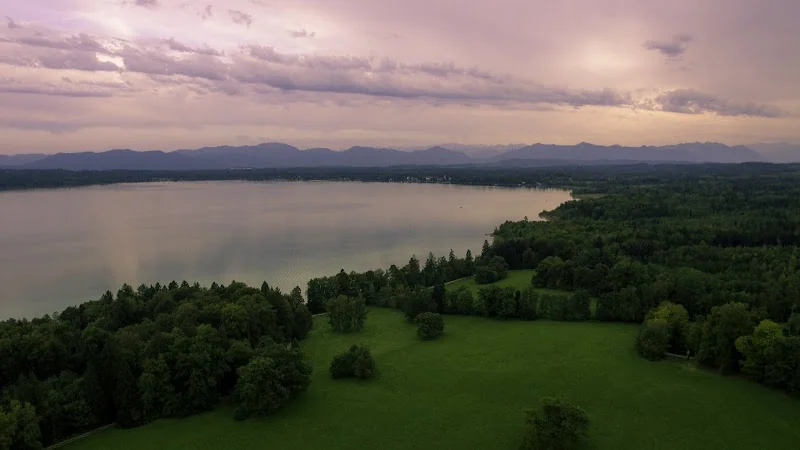
The Bernrieder Park is not a classic event venue, but a historical landscape park on the western shore of Lake Starnberg, which has been open to the public for recreation since 1950. Those looking for photos of Bernrieder Park will primarily find images of ancient oaks and beeches, wide meadows, winding paths, lake views, and quiet benches by the water. This combination of nature, cultural history, and tranquil expanses makes the park a special destination in Bernried on Lake Starnberg. For visitors, it is important to note: The grounds are open year-round, the lakeshore is largely undeveloped, and the park is under landscape and monument protection. ([bernrieder-park.de](https://bernrieder-park.de/))
Photos and First Impressions of Bernrieder Park
Those viewing photos of Bernrieder Park quickly realize that the impact of the place cannot be reduced to a single motif. The official description mentions ancient oaks and beeches, winding paths with views over the meadows, the lake, and the mountains, as well as resting benches and bathing windows with access to the lake. This creates the image of a serene park landscape that does not draw attention to itself loudly but unfolds its quality through details: through tree giants, changes in light, open sightlines, and the immediate proximity to water. The park thrives on contrasts, as dense shrubs alternate with open spaces, and quiet paths lead to surprising viewpoints. ([bernrieder-park.de](https://bernrieder-park.de/))
For those who want to get an impression in advance, the official section "Pictures of the Park" is particularly helpful. There, current photos and archival images are combined, allowing one to experience the park not only as a map or description but also visually. This is especially important for a nature and cultural site like Bernrieder Park, as the atmosphere heavily depends on the season, the light, and the state of vegetation. In spring, the paths appear brighter and fresher; in summer, lake views open up between the trees; in autumn, the old tree shapes stand out particularly clearly; and in winter, the park presents itself clearly and reduced. The images therefore serve not only as a memory but also as guidance and anticipation. ([bernrieder-park.de](https://bernrieder-park.de/bilder-vom-park/?utm_source=openai))
The photographic appeal of the park also lies in the fact that it is not an overly staged backdrop. Instead, it showcases a natural landscape characterized by old trees, wide meadows, lakeshores, and quiet paths. This is precisely why it is suitable for visitors seeking genuine nature rather than loud staging. Those arriving with a camera or smartphone will find motifs at the benches overlooking Lake Starnberg, at the small bathing coves, and at the spots where the tree backdrop acts like a curtain, revealing the view of the water. This results in images that convey the character of the place well: calm, expansive, well-maintained, and simultaneously close to nature. ([bernrieder-park.de](https://bernrieder-park.de/))
History of Bernrieder Park and the Wilhelmina-Busch-Woods Foundation
The history of Bernrieder Park dates back a long way. According to the official park history, the area belonged to the Bernried Monastery of the Augustinian Canons from the 11th century until the secularization. After various changes of ownership, August von Wendland purchased the former monastery property in 1852 and had a park designed in the style of an English landscape park by the Munich head gardener Carl Effner and his son Carl-Josef von Effner between 1853 and 1863. This resulted in the basic form recognizable to this day, with the charming interplay of meadows, shrubbery, and solitary trees, as well as the deliberately created sightlines to the lake and the Alps. This early design still shapes the park today and explains why it is historically, landscape-wise, and horticulturally significant. ([bernrieder-park.de](https://bernrieder-park.de/geschichte-des-parks/?utm_source=openai))
A crucial chapter begins in the 20th century with Wilhelmina Busch-Woods. She gradually acquired the land starting in 1914 and transferred the southern part of her property to the Wilhelmina-Busch-Woods Foundation, named after her, in 1950. After her death in November 1952, the park was opened to the public. This gave Bernrieder Park its current character as a public foundation park that allows for recreation while also being permanently protected. The history also includes the rented tea house by the lakeshore, which originated from an earlier fishing hut and is based on her initiative. The foundation's statutes and the official presentation emphasize that the park should be preserved as a unique natural monument. ([bernrieder-park.de](https://bernrieder-park.de/geschichte-des-parks/?utm_source=openai))
Today, the foundation is managed by a three-member board and receives professional support. Additionally, the official history points out that the park has been under landscape protection since 1959 and has been listed as a monument since 1992. The park maintenance concept from the 1980s, which documents all park elements and describes short-, medium-, and long-term preservation measures, remains an important basis for maintenance to this day. For visitors, this means: They are not moving through an arbitrary green space but in a historically grown and carefully maintained park area, whose development has been documented over generations. This connection of history, foundation, maintenance, and public use makes Bernrieder Park so special. ([bernrieder-park.de](https://bernrieder-park.de/stiftung/))
Arrival and Parking at Bernrieder Park
The arrival at Bernrieder Park is intentionally kept simple, as the park is a destination for many visitors for a walk, a half-day trip, or a quiet nature visit. Officially, train, car, bicycle, and even boat are mentioned as means of arrival. The train is particularly convenient, as no parking space is needed and the park can be reached on foot in about ten minutes. The official site also points out that the route via Parkstraße and Reitweg is particularly short, while the route via Bahnhofstraße and Dorfstraße to the Bernried Monastery is described as particularly beautiful. For guests arriving without a car, this is a clear advantage, as the lakeside location is easily accessible yet pleasantly secluded. ([bernrieder-park.de](https://bernrieder-park.de/))
Those arriving by car can reach Bernried via the state road between Starnberg, Tutzing, Seeshaupt, Penzberg, Benediktbeuren, and Kochel. It is important to note from the park administration that parking in the town center is time-limited. At the same time, the town hall garage is explicitly referred to as public and free of charge. This is particularly helpful for visitors who want to visit the park during peak season or on weekends. Additionally, the official arrival page mentions the bus from Tutzing, the arrival by bicycle, and the possibility of arriving by ship in summer. Thus, Bernrieder Park is not only visible as a destination but also as a well-accessible part of a lake and cultural landscape that is ideal for sustainable excursions. ([bernrieder-park.de](https://bernrieder-park.de/))
Hiking Trails, Lakeshores, and Lake Windows at Lake Starnberg
Among the greatest strengths of Bernrieder Park are its dimensions and the quiet path layout. The official website mentions about 80 hectares of forest and meadows, over 1.7 kilometers of lakeshore, and 7.5 kilometers of hiking trails with numerous resting benches at the viewpoints. The area is large enough for extensive walks but remains manageable and pleasantly natural. Particularly defining is that the lakeshore is undeveloped, except for the rented tea house. This creates the impression of an open, largely undeveloped lakebed that, in combination with old trees, meadows, and gently winding paths, offers plenty of space to breathe. Small bathing coves with sandy bottoms, the so-called lake windows, add additional accents in summer. ([bernrieder-park.de](https://bernrieder-park.de/))
The access points to the park are clearly described and make orientation easy. Entry is possible, among other places, from the monastery courtyard in Bernried, either left towards the boat dock and then along the lakeside path past the lakeside chapel and the Hubl beach, or right along the foot of Binselberg along the monastery hedge until reaching the lakeside path. Other access points are located between the fire station and the new cemetery, as well as at the corner of Parkstraße and Reitweg. The park map also shows numerous named paths and sections, including lakeside path, riding path, King Ludwig hiking trail, prelate path, larch forest path, fountain path, park path, and beech path. This is helpful for visitors who do not want to leave their route to chance but want to consciously choose between shorter and longer walks. ([bernrieder-park.de](https://bernrieder-park.de/der-park/))
It is precisely the combination of wide views and diverse paths that makes the park attractive for hikers, walkers, and guests seeking tranquility. The official texts speak of leisurely walks of varying lengths at any time of the year. This means: Bernrieder Park is not only suitable for a quick stop but also for longer stays, where one can deliberately choose individual sections, benches, and sightlines. Those who enjoy photography will find new perspectives on the lake, meadows, and groups of trees along the paths. Those who prefer to slow down can use the quiet benches at the viewpoints. And those looking for a particularly classic lakeside walk can orient themselves along the lakeside path, which makes the park's shoreline and views of the water particularly enjoyable. ([bernrieder-park.de](https://bernrieder-park.de/))
Tea House, Park Map, and Special Places in Bernrieder Park
A notable place in Bernrieder Park is the so-called tea house. According to the official park history, it originates from the redesign of an earlier fishing hut and was initiated by Wilhelmina Busch-Woods. Today, it is rented out and located in the southern area of the shore. For orientation, this spot is important because a clear functional boundary of the park is drawn around the tea house: to the north are the lake windows and accessible bathing coves, and to the south begins the fish protection area with a reed belt. Thus, the tea house is not only a historical detail but also a geographical reference point in the park. It connects the past, use, and nature conservation in a very illustrative way. ([bernrieder-park.de](https://bernrieder-park.de/geschichte-des-parks/?utm_source=openai))
The official park map makes visible how diverse the layout is. In addition to the main paths, areas such as Grundweiher, Friedhofswiese, Lärchenrondell, Buchenweg, Brunnenweg, Parkstraße, Reitweg, and Seeweg are recorded. Additionally, the map shows that benches are numbered and the park is divided into different zones and path axes. For visitors, this means practical orientation without complicated navigation: One can experience the park as a lakeside path, as a loop through the meadows, or as a longer hike. The long-distance hiking trails King Ludwig hiking trail and prelate path, which cross the park, also emphasize the character of the place as a thoroughfare for walks and longer tours. Thus, the park remains not a static monument but a vibrant landscape for walking, viewing, and lingering. ([bernried.de](https://bernried.de/media/download/cms/media/files/fuer-unsere-gaeste/kunst-kultur-sehenswertes/parkanlagen/bernrieder-parkplan.pdf))
Biodiversity, Rules, and Responsible Visiting
Bernrieder Park is not only beautiful but also ecologically significant. The municipality of Bernried describes the area of the Bernrieder Promontory as ecologically and landscape-historically important; the biodiversity projects between 2011 and 2022 focused on preserving ancient tree giants and their surroundings. The official pages also speak of an unusual richness of nature. Mentioned are near-natural deciduous mixed and wetland areas, species-rich meadows, and the protection of biotope trees. The old trees are not just a romantic backdrop but important habitats and connectivity elements in the landscape. This is precisely why the park is treated as a garden monument and as a particularly valuable natural space. Those walking here are moving through a landscape where cultural maintenance and species diversity go hand in hand. ([bernried.de](https://www.bernried.de/de/rathaus/biodiversitaet/bernrieder-vorsprung))
To maintain this quality, clear behavioral rules apply. The meadows in the park continue to be used as economic meadows and should not be entered, especially during grass growth. Ball or badminton games are also not intended there. Dogs should be kept on a leash, as consideration for wildlife, walkers, and the sensitive park tranquility is important. Open fires are not permitted, there are no barbecue areas, and waste should be taken back with you. Additionally, walkers have priority over cyclists. These rules are not mere formalities but an essential part of the protection concept, so that the park can remain a public recreation area and at the same time a sensitive natural space. Those who observe them contribute directly to the preservation of the facility. ([aktuelles.bernrieder-park.de](https://aktuelles.bernrieder-park.de/dos-donts/))
Particularly important is also the clear order regarding bathing. Bathing is only allowed at the lake windows north of the tea house; south of it begins a fish protection area with its ecologically valuable reed belt. This rule is easy to remember and helps to clearly separate nature and recreation use. At the same time, the foundation supports the park with care concepts, board work, and civic engagement. This way, Bernrieder Park remains more than just a beautiful place for photos: It is a living example of how historical landscape, public accessibility, and nature conservation can work together. Those visiting the park experience tranquility and expanses but should also respect the vulnerability of this special facility. ([aktuelles.bernrieder-park.de](https://aktuelles.bernrieder-park.de/dos-donts/))
Sources:
Show moreShow less
Bernrieder Park | Photos & Arrival
The Bernrieder Park is not a classic event venue, but a historical landscape park on the western shore of Lake Starnberg, which has been open to the public for recreation since 1950. Those looking for photos of Bernrieder Park will primarily find images of ancient oaks and beeches, wide meadows, winding paths, lake views, and quiet benches by the water. This combination of nature, cultural history, and tranquil expanses makes the park a special destination in Bernried on Lake Starnberg. For visitors, it is important to note: The grounds are open year-round, the lakeshore is largely undeveloped, and the park is under landscape and monument protection. ([bernrieder-park.de](https://bernrieder-park.de/))
Photos and First Impressions of Bernrieder Park
Those viewing photos of Bernrieder Park quickly realize that the impact of the place cannot be reduced to a single motif. The official description mentions ancient oaks and beeches, winding paths with views over the meadows, the lake, and the mountains, as well as resting benches and bathing windows with access to the lake. This creates the image of a serene park landscape that does not draw attention to itself loudly but unfolds its quality through details: through tree giants, changes in light, open sightlines, and the immediate proximity to water. The park thrives on contrasts, as dense shrubs alternate with open spaces, and quiet paths lead to surprising viewpoints. ([bernrieder-park.de](https://bernrieder-park.de/))
For those who want to get an impression in advance, the official section "Pictures of the Park" is particularly helpful. There, current photos and archival images are combined, allowing one to experience the park not only as a map or description but also visually. This is especially important for a nature and cultural site like Bernrieder Park, as the atmosphere heavily depends on the season, the light, and the state of vegetation. In spring, the paths appear brighter and fresher; in summer, lake views open up between the trees; in autumn, the old tree shapes stand out particularly clearly; and in winter, the park presents itself clearly and reduced. The images therefore serve not only as a memory but also as guidance and anticipation. ([bernrieder-park.de](https://bernrieder-park.de/bilder-vom-park/?utm_source=openai))
The photographic appeal of the park also lies in the fact that it is not an overly staged backdrop. Instead, it showcases a natural landscape characterized by old trees, wide meadows, lakeshores, and quiet paths. This is precisely why it is suitable for visitors seeking genuine nature rather than loud staging. Those arriving with a camera or smartphone will find motifs at the benches overlooking Lake Starnberg, at the small bathing coves, and at the spots where the tree backdrop acts like a curtain, revealing the view of the water. This results in images that convey the character of the place well: calm, expansive, well-maintained, and simultaneously close to nature. ([bernrieder-park.de](https://bernrieder-park.de/))
History of Bernrieder Park and the Wilhelmina-Busch-Woods Foundation
The history of Bernrieder Park dates back a long way. According to the official park history, the area belonged to the Bernried Monastery of the Augustinian Canons from the 11th century until the secularization. After various changes of ownership, August von Wendland purchased the former monastery property in 1852 and had a park designed in the style of an English landscape park by the Munich head gardener Carl Effner and his son Carl-Josef von Effner between 1853 and 1863. This resulted in the basic form recognizable to this day, with the charming interplay of meadows, shrubbery, and solitary trees, as well as the deliberately created sightlines to the lake and the Alps. This early design still shapes the park today and explains why it is historically, landscape-wise, and horticulturally significant. ([bernrieder-park.de](https://bernrieder-park.de/geschichte-des-parks/?utm_source=openai))
A crucial chapter begins in the 20th century with Wilhelmina Busch-Woods. She gradually acquired the land starting in 1914 and transferred the southern part of her property to the Wilhelmina-Busch-Woods Foundation, named after her, in 1950. After her death in November 1952, the park was opened to the public. This gave Bernrieder Park its current character as a public foundation park that allows for recreation while also being permanently protected. The history also includes the rented tea house by the lakeshore, which originated from an earlier fishing hut and is based on her initiative. The foundation's statutes and the official presentation emphasize that the park should be preserved as a unique natural monument. ([bernrieder-park.de](https://bernrieder-park.de/geschichte-des-parks/?utm_source=openai))
Today, the foundation is managed by a three-member board and receives professional support. Additionally, the official history points out that the park has been under landscape protection since 1959 and has been listed as a monument since 1992. The park maintenance concept from the 1980s, which documents all park elements and describes short-, medium-, and long-term preservation measures, remains an important basis for maintenance to this day. For visitors, this means: They are not moving through an arbitrary green space but in a historically grown and carefully maintained park area, whose development has been documented over generations. This connection of history, foundation, maintenance, and public use makes Bernrieder Park so special. ([bernrieder-park.de](https://bernrieder-park.de/stiftung/))
Arrival and Parking at Bernrieder Park
The arrival at Bernrieder Park is intentionally kept simple, as the park is a destination for many visitors for a walk, a half-day trip, or a quiet nature visit. Officially, train, car, bicycle, and even boat are mentioned as means of arrival. The train is particularly convenient, as no parking space is needed and the park can be reached on foot in about ten minutes. The official site also points out that the route via Parkstraße and Reitweg is particularly short, while the route via Bahnhofstraße and Dorfstraße to the Bernried Monastery is described as particularly beautiful. For guests arriving without a car, this is a clear advantage, as the lakeside location is easily accessible yet pleasantly secluded. ([bernrieder-park.de](https://bernrieder-park.de/))
Those arriving by car can reach Bernried via the state road between Starnberg, Tutzing, Seeshaupt, Penzberg, Benediktbeuren, and Kochel. It is important to note from the park administration that parking in the town center is time-limited. At the same time, the town hall garage is explicitly referred to as public and free of charge. This is particularly helpful for visitors who want to visit the park during peak season or on weekends. Additionally, the official arrival page mentions the bus from Tutzing, the arrival by bicycle, and the possibility of arriving by ship in summer. Thus, Bernrieder Park is not only visible as a destination but also as a well-accessible part of a lake and cultural landscape that is ideal for sustainable excursions. ([bernrieder-park.de](https://bernrieder-park.de/))
Hiking Trails, Lakeshores, and Lake Windows at Lake Starnberg
Among the greatest strengths of Bernrieder Park are its dimensions and the quiet path layout. The official website mentions about 80 hectares of forest and meadows, over 1.7 kilometers of lakeshore, and 7.5 kilometers of hiking trails with numerous resting benches at the viewpoints. The area is large enough for extensive walks but remains manageable and pleasantly natural. Particularly defining is that the lakeshore is undeveloped, except for the rented tea house. This creates the impression of an open, largely undeveloped lakebed that, in combination with old trees, meadows, and gently winding paths, offers plenty of space to breathe. Small bathing coves with sandy bottoms, the so-called lake windows, add additional accents in summer. ([bernrieder-park.de](https://bernrieder-park.de/))
The access points to the park are clearly described and make orientation easy. Entry is possible, among other places, from the monastery courtyard in Bernried, either left towards the boat dock and then along the lakeside path past the lakeside chapel and the Hubl beach, or right along the foot of Binselberg along the monastery hedge until reaching the lakeside path. Other access points are located between the fire station and the new cemetery, as well as at the corner of Parkstraße and Reitweg. The park map also shows numerous named paths and sections, including lakeside path, riding path, King Ludwig hiking trail, prelate path, larch forest path, fountain path, park path, and beech path. This is helpful for visitors who do not want to leave their route to chance but want to consciously choose between shorter and longer walks. ([bernrieder-park.de](https://bernrieder-park.de/der-park/))
It is precisely the combination of wide views and diverse paths that makes the park attractive for hikers, walkers, and guests seeking tranquility. The official texts speak of leisurely walks of varying lengths at any time of the year. This means: Bernrieder Park is not only suitable for a quick stop but also for longer stays, where one can deliberately choose individual sections, benches, and sightlines. Those who enjoy photography will find new perspectives on the lake, meadows, and groups of trees along the paths. Those who prefer to slow down can use the quiet benches at the viewpoints. And those looking for a particularly classic lakeside walk can orient themselves along the lakeside path, which makes the park's shoreline and views of the water particularly enjoyable. ([bernrieder-park.de](https://bernrieder-park.de/))
Tea House, Park Map, and Special Places in Bernrieder Park
A notable place in Bernrieder Park is the so-called tea house. According to the official park history, it originates from the redesign of an earlier fishing hut and was initiated by Wilhelmina Busch-Woods. Today, it is rented out and located in the southern area of the shore. For orientation, this spot is important because a clear functional boundary of the park is drawn around the tea house: to the north are the lake windows and accessible bathing coves, and to the south begins the fish protection area with a reed belt. Thus, the tea house is not only a historical detail but also a geographical reference point in the park. It connects the past, use, and nature conservation in a very illustrative way. ([bernrieder-park.de](https://bernrieder-park.de/geschichte-des-parks/?utm_source=openai))
The official park map makes visible how diverse the layout is. In addition to the main paths, areas such as Grundweiher, Friedhofswiese, Lärchenrondell, Buchenweg, Brunnenweg, Parkstraße, Reitweg, and Seeweg are recorded. Additionally, the map shows that benches are numbered and the park is divided into different zones and path axes. For visitors, this means practical orientation without complicated navigation: One can experience the park as a lakeside path, as a loop through the meadows, or as a longer hike. The long-distance hiking trails King Ludwig hiking trail and prelate path, which cross the park, also emphasize the character of the place as a thoroughfare for walks and longer tours. Thus, the park remains not a static monument but a vibrant landscape for walking, viewing, and lingering. ([bernried.de](https://bernried.de/media/download/cms/media/files/fuer-unsere-gaeste/kunst-kultur-sehenswertes/parkanlagen/bernrieder-parkplan.pdf))
Biodiversity, Rules, and Responsible Visiting
Bernrieder Park is not only beautiful but also ecologically significant. The municipality of Bernried describes the area of the Bernrieder Promontory as ecologically and landscape-historically important; the biodiversity projects between 2011 and 2022 focused on preserving ancient tree giants and their surroundings. The official pages also speak of an unusual richness of nature. Mentioned are near-natural deciduous mixed and wetland areas, species-rich meadows, and the protection of biotope trees. The old trees are not just a romantic backdrop but important habitats and connectivity elements in the landscape. This is precisely why the park is treated as a garden monument and as a particularly valuable natural space. Those walking here are moving through a landscape where cultural maintenance and species diversity go hand in hand. ([bernried.de](https://www.bernried.de/de/rathaus/biodiversitaet/bernrieder-vorsprung))
To maintain this quality, clear behavioral rules apply. The meadows in the park continue to be used as economic meadows and should not be entered, especially during grass growth. Ball or badminton games are also not intended there. Dogs should be kept on a leash, as consideration for wildlife, walkers, and the sensitive park tranquility is important. Open fires are not permitted, there are no barbecue areas, and waste should be taken back with you. Additionally, walkers have priority over cyclists. These rules are not mere formalities but an essential part of the protection concept, so that the park can remain a public recreation area and at the same time a sensitive natural space. Those who observe them contribute directly to the preservation of the facility. ([aktuelles.bernrieder-park.de](https://aktuelles.bernrieder-park.de/dos-donts/))
Particularly important is also the clear order regarding bathing. Bathing is only allowed at the lake windows north of the tea house; south of it begins a fish protection area with its ecologically valuable reed belt. This rule is easy to remember and helps to clearly separate nature and recreation use. At the same time, the foundation supports the park with care concepts, board work, and civic engagement. This way, Bernrieder Park remains more than just a beautiful place for photos: It is a living example of how historical landscape, public accessibility, and nature conservation can work together. Those visiting the park experience tranquility and expanses but should also respect the vulnerability of this special facility. ([aktuelles.bernrieder-park.de](https://aktuelles.bernrieder-park.de/dos-donts/))
Sources:
Bernrieder Park | Photos & Arrival
The Bernrieder Park is not a classic event venue, but a historical landscape park on the western shore of Lake Starnberg, which has been open to the public for recreation since 1950. Those looking for photos of Bernrieder Park will primarily find images of ancient oaks and beeches, wide meadows, winding paths, lake views, and quiet benches by the water. This combination of nature, cultural history, and tranquil expanses makes the park a special destination in Bernried on Lake Starnberg. For visitors, it is important to note: The grounds are open year-round, the lakeshore is largely undeveloped, and the park is under landscape and monument protection. ([bernrieder-park.de](https://bernrieder-park.de/))
Photos and First Impressions of Bernrieder Park
Those viewing photos of Bernrieder Park quickly realize that the impact of the place cannot be reduced to a single motif. The official description mentions ancient oaks and beeches, winding paths with views over the meadows, the lake, and the mountains, as well as resting benches and bathing windows with access to the lake. This creates the image of a serene park landscape that does not draw attention to itself loudly but unfolds its quality through details: through tree giants, changes in light, open sightlines, and the immediate proximity to water. The park thrives on contrasts, as dense shrubs alternate with open spaces, and quiet paths lead to surprising viewpoints. ([bernrieder-park.de](https://bernrieder-park.de/))
For those who want to get an impression in advance, the official section "Pictures of the Park" is particularly helpful. There, current photos and archival images are combined, allowing one to experience the park not only as a map or description but also visually. This is especially important for a nature and cultural site like Bernrieder Park, as the atmosphere heavily depends on the season, the light, and the state of vegetation. In spring, the paths appear brighter and fresher; in summer, lake views open up between the trees; in autumn, the old tree shapes stand out particularly clearly; and in winter, the park presents itself clearly and reduced. The images therefore serve not only as a memory but also as guidance and anticipation. ([bernrieder-park.de](https://bernrieder-park.de/bilder-vom-park/?utm_source=openai))
The photographic appeal of the park also lies in the fact that it is not an overly staged backdrop. Instead, it showcases a natural landscape characterized by old trees, wide meadows, lakeshores, and quiet paths. This is precisely why it is suitable for visitors seeking genuine nature rather than loud staging. Those arriving with a camera or smartphone will find motifs at the benches overlooking Lake Starnberg, at the small bathing coves, and at the spots where the tree backdrop acts like a curtain, revealing the view of the water. This results in images that convey the character of the place well: calm, expansive, well-maintained, and simultaneously close to nature. ([bernrieder-park.de](https://bernrieder-park.de/))
History of Bernrieder Park and the Wilhelmina-Busch-Woods Foundation
The history of Bernrieder Park dates back a long way. According to the official park history, the area belonged to the Bernried Monastery of the Augustinian Canons from the 11th century until the secularization. After various changes of ownership, August von Wendland purchased the former monastery property in 1852 and had a park designed in the style of an English landscape park by the Munich head gardener Carl Effner and his son Carl-Josef von Effner between 1853 and 1863. This resulted in the basic form recognizable to this day, with the charming interplay of meadows, shrubbery, and solitary trees, as well as the deliberately created sightlines to the lake and the Alps. This early design still shapes the park today and explains why it is historically, landscape-wise, and horticulturally significant. ([bernrieder-park.de](https://bernrieder-park.de/geschichte-des-parks/?utm_source=openai))
A crucial chapter begins in the 20th century with Wilhelmina Busch-Woods. She gradually acquired the land starting in 1914 and transferred the southern part of her property to the Wilhelmina-Busch-Woods Foundation, named after her, in 1950. After her death in November 1952, the park was opened to the public. This gave Bernrieder Park its current character as a public foundation park that allows for recreation while also being permanently protected. The history also includes the rented tea house by the lakeshore, which originated from an earlier fishing hut and is based on her initiative. The foundation's statutes and the official presentation emphasize that the park should be preserved as a unique natural monument. ([bernrieder-park.de](https://bernrieder-park.de/geschichte-des-parks/?utm_source=openai))
Today, the foundation is managed by a three-member board and receives professional support. Additionally, the official history points out that the park has been under landscape protection since 1959 and has been listed as a monument since 1992. The park maintenance concept from the 1980s, which documents all park elements and describes short-, medium-, and long-term preservation measures, remains an important basis for maintenance to this day. For visitors, this means: They are not moving through an arbitrary green space but in a historically grown and carefully maintained park area, whose development has been documented over generations. This connection of history, foundation, maintenance, and public use makes Bernrieder Park so special. ([bernrieder-park.de](https://bernrieder-park.de/stiftung/))
Arrival and Parking at Bernrieder Park
The arrival at Bernrieder Park is intentionally kept simple, as the park is a destination for many visitors for a walk, a half-day trip, or a quiet nature visit. Officially, train, car, bicycle, and even boat are mentioned as means of arrival. The train is particularly convenient, as no parking space is needed and the park can be reached on foot in about ten minutes. The official site also points out that the route via Parkstraße and Reitweg is particularly short, while the route via Bahnhofstraße and Dorfstraße to the Bernried Monastery is described as particularly beautiful. For guests arriving without a car, this is a clear advantage, as the lakeside location is easily accessible yet pleasantly secluded. ([bernrieder-park.de](https://bernrieder-park.de/))
Those arriving by car can reach Bernried via the state road between Starnberg, Tutzing, Seeshaupt, Penzberg, Benediktbeuren, and Kochel. It is important to note from the park administration that parking in the town center is time-limited. At the same time, the town hall garage is explicitly referred to as public and free of charge. This is particularly helpful for visitors who want to visit the park during peak season or on weekends. Additionally, the official arrival page mentions the bus from Tutzing, the arrival by bicycle, and the possibility of arriving by ship in summer. Thus, Bernrieder Park is not only visible as a destination but also as a well-accessible part of a lake and cultural landscape that is ideal for sustainable excursions. ([bernrieder-park.de](https://bernrieder-park.de/))
Hiking Trails, Lakeshores, and Lake Windows at Lake Starnberg
Among the greatest strengths of Bernrieder Park are its dimensions and the quiet path layout. The official website mentions about 80 hectares of forest and meadows, over 1.7 kilometers of lakeshore, and 7.5 kilometers of hiking trails with numerous resting benches at the viewpoints. The area is large enough for extensive walks but remains manageable and pleasantly natural. Particularly defining is that the lakeshore is undeveloped, except for the rented tea house. This creates the impression of an open, largely undeveloped lakebed that, in combination with old trees, meadows, and gently winding paths, offers plenty of space to breathe. Small bathing coves with sandy bottoms, the so-called lake windows, add additional accents in summer. ([bernrieder-park.de](https://bernrieder-park.de/))
The access points to the park are clearly described and make orientation easy. Entry is possible, among other places, from the monastery courtyard in Bernried, either left towards the boat dock and then along the lakeside path past the lakeside chapel and the Hubl beach, or right along the foot of Binselberg along the monastery hedge until reaching the lakeside path. Other access points are located between the fire station and the new cemetery, as well as at the corner of Parkstraße and Reitweg. The park map also shows numerous named paths and sections, including lakeside path, riding path, King Ludwig hiking trail, prelate path, larch forest path, fountain path, park path, and beech path. This is helpful for visitors who do not want to leave their route to chance but want to consciously choose between shorter and longer walks. ([bernrieder-park.de](https://bernrieder-park.de/der-park/))
It is precisely the combination of wide views and diverse paths that makes the park attractive for hikers, walkers, and guests seeking tranquility. The official texts speak of leisurely walks of varying lengths at any time of the year. This means: Bernrieder Park is not only suitable for a quick stop but also for longer stays, where one can deliberately choose individual sections, benches, and sightlines. Those who enjoy photography will find new perspectives on the lake, meadows, and groups of trees along the paths. Those who prefer to slow down can use the quiet benches at the viewpoints. And those looking for a particularly classic lakeside walk can orient themselves along the lakeside path, which makes the park's shoreline and views of the water particularly enjoyable. ([bernrieder-park.de](https://bernrieder-park.de/))
Tea House, Park Map, and Special Places in Bernrieder Park
A notable place in Bernrieder Park is the so-called tea house. According to the official park history, it originates from the redesign of an earlier fishing hut and was initiated by Wilhelmina Busch-Woods. Today, it is rented out and located in the southern area of the shore. For orientation, this spot is important because a clear functional boundary of the park is drawn around the tea house: to the north are the lake windows and accessible bathing coves, and to the south begins the fish protection area with a reed belt. Thus, the tea house is not only a historical detail but also a geographical reference point in the park. It connects the past, use, and nature conservation in a very illustrative way. ([bernrieder-park.de](https://bernrieder-park.de/geschichte-des-parks/?utm_source=openai))
The official park map makes visible how diverse the layout is. In addition to the main paths, areas such as Grundweiher, Friedhofswiese, Lärchenrondell, Buchenweg, Brunnenweg, Parkstraße, Reitweg, and Seeweg are recorded. Additionally, the map shows that benches are numbered and the park is divided into different zones and path axes. For visitors, this means practical orientation without complicated navigation: One can experience the park as a lakeside path, as a loop through the meadows, or as a longer hike. The long-distance hiking trails King Ludwig hiking trail and prelate path, which cross the park, also emphasize the character of the place as a thoroughfare for walks and longer tours. Thus, the park remains not a static monument but a vibrant landscape for walking, viewing, and lingering. ([bernried.de](https://bernried.de/media/download/cms/media/files/fuer-unsere-gaeste/kunst-kultur-sehenswertes/parkanlagen/bernrieder-parkplan.pdf))
Biodiversity, Rules, and Responsible Visiting
Bernrieder Park is not only beautiful but also ecologically significant. The municipality of Bernried describes the area of the Bernrieder Promontory as ecologically and landscape-historically important; the biodiversity projects between 2011 and 2022 focused on preserving ancient tree giants and their surroundings. The official pages also speak of an unusual richness of nature. Mentioned are near-natural deciduous mixed and wetland areas, species-rich meadows, and the protection of biotope trees. The old trees are not just a romantic backdrop but important habitats and connectivity elements in the landscape. This is precisely why the park is treated as a garden monument and as a particularly valuable natural space. Those walking here are moving through a landscape where cultural maintenance and species diversity go hand in hand. ([bernried.de](https://www.bernried.de/de/rathaus/biodiversitaet/bernrieder-vorsprung))
To maintain this quality, clear behavioral rules apply. The meadows in the park continue to be used as economic meadows and should not be entered, especially during grass growth. Ball or badminton games are also not intended there. Dogs should be kept on a leash, as consideration for wildlife, walkers, and the sensitive park tranquility is important. Open fires are not permitted, there are no barbecue areas, and waste should be taken back with you. Additionally, walkers have priority over cyclists. These rules are not mere formalities but an essential part of the protection concept, so that the park can remain a public recreation area and at the same time a sensitive natural space. Those who observe them contribute directly to the preservation of the facility. ([aktuelles.bernrieder-park.de](https://aktuelles.bernrieder-park.de/dos-donts/))
Particularly important is also the clear order regarding bathing. Bathing is only allowed at the lake windows north of the tea house; south of it begins a fish protection area with its ecologically valuable reed belt. This rule is easy to remember and helps to clearly separate nature and recreation use. At the same time, the foundation supports the park with care concepts, board work, and civic engagement. This way, Bernrieder Park remains more than just a beautiful place for photos: It is a living example of how historical landscape, public accessibility, and nature conservation can work together. Those visiting the park experience tranquility and expanses but should also respect the vulnerability of this special facility. ([aktuelles.bernrieder-park.de](https://aktuelles.bernrieder-park.de/dos-donts/))
Sources:
Upcoming Events
No events found
Frequently Asked Questions
Reviews
Antero Hanhirova
14. November 2017
I was super excited to visit this park because of all the great ratings it had received. Unfortunately when we got to the spot, it was raining so I had to give it only 1 star. But we decided to give the place another chance and after seeing a lonely swan trying to drown itself, I raised my rating to 2 stars (because we saved it by yelling at it). Then walking a bit further we saw this great old oak tree and I proposed to my girlfriend, 3 stars. She said yes, 4 stars. The fifth star comes from the geese witnessing and not making annoying sounds. All in all, it's a park, it has trees and bushes and grass. 5/5
Dariia Oliinyk
22. May 2020
Great place to chill out near the lake.
David Newnes
10. January 2017
Beautiful scenery, plenty of benches to take a rest.
Ralf Kelzenberg
6. September 2020
Very nice park with grassy fields and woods most of which are a nature's reserve. You can find swans, ducks, and other animals. Very peaceful and quiet. Stop here for a swim on your bicycle tour around the Starnberger See.
Maciej Gorączka
1. July 2019
Nice clean and calm place where proletariat may enjoy its scarce free time. You won't feel much true nature here because thousands of elderly guys will zip past you on their electric bicycles. So all in all nice place. Not if you want to escape the crowds though. They will get you here.