
Utting am Ammersee
Achselschwang 1, 86919 Utting am Ammersee-Achselschwang, Deutschland
State Farm Achselschwang | Cattle Feeding & Photos
Achselschwang is much more than an agricultural operation on the edge of Lake Ammersee. The location of the Bavarian State Farms in Utting am Ammersee combines research, education, and practical animal husbandry into an unusually multifaceted overall picture. Today, the focus is on cattle feeding, dairy farming, and training and further education for agriculture. At the same time, the operation, with its stable facilities, seminar rooms, accommodations, and ancillary operations, shapes a landscape that has been used agriculturally for centuries. Those looking for photos, background information, directions, or technical details will not find a classic event location here, but a practical educational and research site with a strong connection to animal husbandry. The Bavarian State Farms describe Achselschwang as a central research site for cattle feeding in Bavaria and as a place where insights flow directly back into agricultural practice. In addition to the main operation, the farms Hübschenried with Engenried and Westerschondorf with Stillerhof are also part of the overall complex. ([baysg.bayern.de](https://www.baysg.bayern.de/zentren/achselschwang/245511/index.php))
Cattle Feeding and Dairy Farming in Achselschwang
The professional identity of Achselschwang clearly lies in cattle feeding and dairy farming. Within the Bavarian State Research Institute for Agriculture, the location conducts feeding trials in the dairy sector and works closely with the LfL on practical questions related to dairy farming. This is significant for Bavarian agriculture because not only theoretical concepts are examined here, but concrete conditions from the everyday life of dairy farms. These include questions about feed intake, cow performance, and the interaction between husbandry, climate, and animal health. Particularly interesting is the use of fully automated weighing troughs, which can precisely record and evaluate the feed intake of individual animals. Thus, data is obtained that allows conclusions about behavior, feeding efficiency, and well-being. Achselschwang is therefore not just a teaching operation, but a location where scientific and practical work is done simultaneously. ([baysg.bayern.de](https://www.baysg.bayern.de/zentren/achselschwang/245477/index.php))
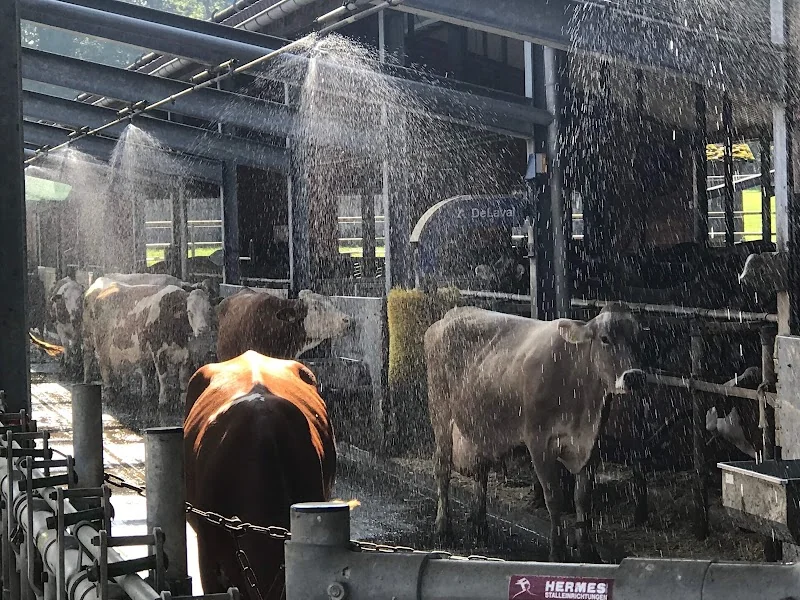
The dairy farming itself is also oriented towards modern animal welfare and barn concepts. The official presentation emphasizes the large space available in the barn, the clearly structured functional areas, and measures such as wind protection, ventilation, and seasonal adjustments. In winter, the calving area is protected by windbreak nets so that newborn calves are not exposed to drafts; in summer, temperature-controlled large-area fans and a sprinkler system on hot days provide cooling. For lactating cows, covered and uncovered areas, deep boxes with sand, and a neck rail at the feed table are described. This shows that the operation actively adapts the conditions in the barn to the needs of the animals. Additionally, the role of LED barn lights is highlighted because light duration and time of day can influence activity, reproduction, and young animal rearing. Achselschwang thus serves as an example of modern dairy farming that brings together animal comfort, productivity, and research. ([baysg.bayern.de](https://www.baysg.bayern.de/zentren/achselschwang/245496/index.php))
For inquiries related to cattle feeding, dairy farming, and barn technology, it is also important that the location does not operate in isolation. The operation includes several units that are managed together and cover different focuses. While Achselschwang itself consolidates dairy farming, Hübschenried is responsible for young cattle rearing, and Westerschondorf has been associated with cattle fattening trials. This division of labor makes the overall location particularly strong in terms of expertise because various life stages and usage steps of cattle can be examined under real operating conditions. For farmers, trainees, and professional visitors, this is an advantage: they gain not only a view of individual barn areas but also of a coherent system of cattle husbandry. Especially in connection with feeding, performance, animal health, and herd management, Achselschwang thus offers a practically relevant learning and research environment that occupies a unique position in Bavaria. ([baysg.bayern.de](https://www.baysg.bayern.de/zentren/achselschwang/245515/index.php?utm_source=openai))
Calf Rearing in the New Cold Barn
A particularly current topic in Achselschwang is calf rearing. The new calf barn was put into operation in January 2025, replacing the previously used old barn for 17 years. It is described as a single-house, south-facing cold barn with a regulated outdoor climate. The architecture is designed for precise control of the husbandry conditions and is divided into several structurally separate compartments. Particularly important is the combination of functional barn technology and research: Two independently controllable climate zones allow for exact control of the experimental conditions, while curtain systems, temperature-dependent openings, and a north-south ventilation create a flexible barn climate. Additionally, there is a 12-centimeter thick solid wood ceiling with an integrated rooftop photovoltaic system. The construction shows how closely animal welfare, energy efficiency, and research interests are intertwined at the location. Achselschwang thus also becomes visible as an innovation site in calf rearing, not just as a classic teaching or farm operation. ([baysg.bayern.de](https://www.baysg.bayern.de/zentren/achselschwang/245487/index.php))
The first days of life of the calves are described in detail in the official material. Newborn calves are dried in a warming box immediately after birth at outdoor temperatures below 10 degrees Celsius and receive the first colostrum of at least three liters with a quality of at least 22 Brix. After complete drying, they are weighed, marked, and housed in individual boxes. From the second meal onwards, whole milk is fed acidified, and from the fifth day of life, feeding is done exclusively with acidified milk replacer ad libitum. Water and a farm-specific calf TMR are freely available from the first day of life. This description makes it clear that the operation works very precisely and scientifically in the young animal phase. For search intentions related to calf rearing, barn concepts, and feeding, Achselschwang thus offers not only theoretical information but a concretely documented practical model. ([baysg.bayern.de](https://www.baysg.bayern.de/zentren/achselschwang/245487/index.php))
The research aspect of the location is also closely linked to calf rearing. Data on animal health, animal behavior, and animal welfare are to be compared under different climatic conditions so that recommendations for the construction and design of calf barns can be derived from this. On the research side, the barn is described as a place with two areas for newborn calves up to three weeks of age and subsequent group pens; additionally, video cameras per compartment, temperature and humidity sensors, and a weather station near the barn are used. Among other things, ammonia, carbon dioxide, temperature, humidity, and air movement are recorded. The goal is clear: robust findings are to emerge regarding which climatic conditions benefit calves in various developmental phases the most. This combination of technical equipment, experimental facility, and animal observation is a central reason why Achselschwang holds regional significance in the professional world. ([baysg.bayern.de](https://www.baysg.bayern.de/zentren/achselschwang/245477/index.php))
Training and Further Education in Cattle Husbandry
Another core area of Achselschwang is agricultural education. The location is explicitly organized as a research and education center, and the focus of the work lies, according to the official presentation, in training and further education, especially in cattle husbandry. The spectrum ranges from basic courses in animal production to specialized training courses and offerings for career changers, village helpers, trainees in their second and third years, and other interested parties. The courses combine theoretical and practical units so that participants can not only absorb knowledge but also understand processes directly in the barn, with the animals, and with the technology. For people searching for education, courses, cattle husbandry, or milking in connection with Achselschwang, this practical approach is crucial. The operation serves as an interface between school, research, and real agricultural production, thus fulfilling a public educational task that goes far beyond a single farm. ([baysg.bayern.de](https://www.baysg.bayern.de/zentren/achselschwang/245494/index.php?utm_source=openai))
The content of the courses is broad and tailored to the requirements of modern dairy farms. Among other things, practical breeding work, fertility, quality milk production, cattle feeding, ration design and calculation, udder health, maintenance and care of the milking system, herd management, cattle evaluation, hoof care, and calf rearing are mentioned. In the course formats for the second and third years of training, innovations in milking technology, performance feeding, feeding techniques and errors, animal health, forms of husbandry, cow comfort, and animal welfare during transport play an important role. Particularly noteworthy is that two modern milking stations are used in the instruction, including a double 8 fishbone milking parlor with quick exit and automatic detachment as well as a double 3 autotandem milking parlor. This equipment shows that Achselschwang does not just talk about agriculture but makes the technical standards of modern dairy farming tangible in a real operation. ([baysg.bayern.de](https://www.baysg.bayern.de/zentren/achselschwang/245506/index.php?utm_source=openai))
The reach of the educational work is also remarkable. The location page reports that in 2022 around 1830 interested parties attended training sessions and courses at the research and education center. Additionally, the location is mentioned for internships for students of agriculture or veterinary medicine. This makes it clear that Achselschwang is relevant not only for established farmers but also for the professional young generation and for career changers from other fields. Those searching for education, practice, further training, or courses in Bavaria will find a place where barn work, research results, and didactic communication intertwine. Especially because the training in cattle husbandry is highly practical, Achselschwang functions like a living training center: theory is explained directly on animals, facilities, and operational processes. This makes the location particularly valuable for search queries related to training, internships, and agricultural further education. ([baysg.bayern.de](https://www.baysg.bayern.de/cms16/zentren/achselschwang/245481/index.php?utm_source=openai))
Conference Area, Seminar Rooms, and Accommodation
Those looking for seminar rooms, conference areas, or accommodation in Achselschwang will find an offering closely linked to the agricultural educational mission. The state farm has various teaching and seminar rooms, a kitchen, and accommodations. As long as capacities are available, these are also rented to external users, but only if there is a connection to agriculture or the environment of Achselschwang. It is clear that the conference area is not a random event location but a thematically appropriate infrastructure for training, meetings, specialist seminars, and agriculture-related gatherings. For companies, associations, educational groups, or professional visitors, this is interesting because they can work in an authentic environment that is directly linked to animal husbandry and agriculture. This creates a framework in which content does not remain abstract but is supported by the location itself. ([baysg.bayern.de](https://www.baysg.bayern.de/zentren/achselschwang/245505/index.php?utm_source=openai))
The spatial facilities are surprisingly extensive for an operation of this kind. Mentioned are a large lecture hall for 40 people, a small lecture hall for 20 people, a large seminar room for 30 people, the Brown Swiss barn for 200 people, three lounges and TV rooms, a library for 10 people, and a cozy room for socializing after work. In addition, there are 26 double rooms and 3 single rooms with private bathrooms available. The kitchen offers full board in a hearty style, and vegetarian options are available upon request. The technical side is also well equipped: laptops, projectors, overhead projectors, sound systems, and pinboards can be borrowed by prior arrangement; two seminar rooms also feature smart board technology. These facts make the conference area attractive for groups that value functional equipment and a quiet working atmosphere. ([baysg.bayern.de](https://www.baysg.bayern.de/zentren/achselschwang/245505/index.php?utm_source=openai))
Practically speaking, the conference area is particularly suitable for agriculture-related training, further education, and meetings. The combination of accommodations, catering, and seminar technology facilitates multi-day courses and compact specialist programs. For inquiries about accommodation, seminar rooms, or conference areas in Achselschwang, this data is central because it distinguishes the location from other farms or training centers. Particularly interesting is the scale: there are both small rooms for internal discussions and larger capacities for lectures or group work. At the same time, the environment remains distinctly agricultural. This mix of professionalism and practical relevance fits very well with a research and education center that understands its spaces not in isolation but as part of a functioning operation. Therefore, anyone looking for an authentic, professionally suitable place for agriculture, animal husbandry, or regional meetings will find a well-thought-out offering in Achselschwang with clear framework conditions. ([baysg.bayern.de](https://www.baysg.bayern.de/zentren/achselschwang/245505/index.php?utm_source=openai))
History of the State Farm Achselschwang from its Beginnings to Today
Achselschwang has a very long history that begins long before today's research and educational tasks. The official history page describes settlement since the time of the Celts and Romans; in the early Middle Ages, the land was farmed by monasteries. The first documented mention dates back to the year 760 when Tassilo III. allocated revenues from Achselschwang to the monastery of Wessobrunn. Other historical milestones include confirmations of ownership by popes in the 12th century, the transfer to the monastery of Dießen in 1388, and the construction of the economic and horse barn building between 1512 and 1535, which is now considered the oldest preserved building. This early history shows how deeply the location is embedded in the cultural landscape of the Ammersee region. Achselschwang has thus been an agriculturally shaped place for many centuries, with changing forms of ownership and use, not just since modern agriculture. ([baysg.bayern.de](https://www.baysg.bayern.de/zentren/achselschwang/271487/index.php))
In modern times, Achselschwang has been transformed and realigned several times. After the secularization in 1803, the estate came into state ownership, was later repurchased as a military foal farm, and gained repeated significance for state horse and agricultural administration in the 19th century. In 1864, the royal stallion breeding farm was moved from Schwaiganger to Achselschwang, in 1897 the purchase of the Stillerhof hospital estate was added, and in 1936 the Romenthal estate was acquired. This phase shows that the operation played an important role not only in agriculture but also in horse breeding for a long time. The history thus documents a transformation from feudalism through stud and state farm to a modern research and education facility. Those who want to understand today's orientation recognize the historical background from which the current specialization has emerged. ([baysg.bayern.de](https://www.baysg.bayern.de/zentren/achselschwang/271487/index.php))
After World War II, the expansion into an inter-company training and further education facility was accelerated. In 1948, a breeding station was established, in 1953 the establishment of the experimental operation in the former stallion breeding farm began, and a livestock and milker school was founded. In 1977, the new dairy and cattle housing was completed, in 1988 a new building for the animal husbandry school followed. Later milestones included the integration into the State Institute for Agriculture in 2004, the occupancy of the new cow barn in 2004, the new calf barn in 2007, the founding and integration into the Bavarian State Farms in 2020, and finally the occupancy of the new calf barn for research and education in 2025. This chronology makes it clear that Achselschwang is not a static place but has continuously evolved. The current combination of research, education, and animal husbandry is the result of a long historical transformation. ([baysg.bayern.de](https://www.baysg.bayern.de/zentren/achselschwang/271487/index.php))
Directions, Contact, and Orientation for Achselschwang
For visitors, course participants, and professional guests, the directions are clearly described. The location is at Achselschwang 1, 86919 Utting am Ammersee. By car, the route leads via the A96 towards Lindau to exit 29 Greifenberg. From there, head towards Dießen am Ammersee or Schondorf, turn right onto Landsberger Straße after about 2.5 kilometers, stay left, and reach the state farm on the left after about 3.5 kilometers. Public transportation is also possible: from Munich Central Station, take the S4 to Geltendorf, transfer to regional traffic towards Weilheim, and travel to Utting am Ammersee; from there, it is about 4.5 kilometers by taxi. For professional orientation, this data is central because it makes the location easily findable. ([baysg.bayern.de](https://www.baysg.bayern.de/zentren/achselschwang/245511/index.php))
The official contact details are Tel. 089 / 6933442-200, Fax 089 / 6933442-260, and E-Mail achselschwang@baysg.bayern.de. This makes the location easily reachable for both general inquiries and organizational topics. Additionally, it is important that there are ancillary operations: Hübschenried is located near Dießen am Ammersee, Westerschondorf in Finning, and the operational sites are managed together. For interested parties, this means that Achselschwang should not be understood as an isolated farm but as part of a regional network of agricultural operations, research units, and educational sites. Therefore, anyone looking for directions, contact, or regional classification receives a clear overview of the practical accessibility and spatial structure of the overall location. ([baysg.bayern.de](https://www.baysg.bayern.de/zentren/achselschwang/245492/index.php))
Sources:
- Bavarian State Farms - Research and Education Center for Cattle Feeding Achselschwang
- Achselschwang - Directions to the Research and Education Center
- Achselschwang - Research
- Achselschwang - Calf Rearing at the State Farm
- Achselschwang - Conference Area in Achselschwang
- Achselschwang - History
- Achselschwang - Contact
Show moreShow less
State Farm Achselschwang | Cattle Feeding & Photos
Achselschwang is much more than an agricultural operation on the edge of Lake Ammersee. The location of the Bavarian State Farms in Utting am Ammersee combines research, education, and practical animal husbandry into an unusually multifaceted overall picture. Today, the focus is on cattle feeding, dairy farming, and training and further education for agriculture. At the same time, the operation, with its stable facilities, seminar rooms, accommodations, and ancillary operations, shapes a landscape that has been used agriculturally for centuries. Those looking for photos, background information, directions, or technical details will not find a classic event location here, but a practical educational and research site with a strong connection to animal husbandry. The Bavarian State Farms describe Achselschwang as a central research site for cattle feeding in Bavaria and as a place where insights flow directly back into agricultural practice. In addition to the main operation, the farms Hübschenried with Engenried and Westerschondorf with Stillerhof are also part of the overall complex. ([baysg.bayern.de](https://www.baysg.bayern.de/zentren/achselschwang/245511/index.php))
Cattle Feeding and Dairy Farming in Achselschwang
The professional identity of Achselschwang clearly lies in cattle feeding and dairy farming. Within the Bavarian State Research Institute for Agriculture, the location conducts feeding trials in the dairy sector and works closely with the LfL on practical questions related to dairy farming. This is significant for Bavarian agriculture because not only theoretical concepts are examined here, but concrete conditions from the everyday life of dairy farms. These include questions about feed intake, cow performance, and the interaction between husbandry, climate, and animal health. Particularly interesting is the use of fully automated weighing troughs, which can precisely record and evaluate the feed intake of individual animals. Thus, data is obtained that allows conclusions about behavior, feeding efficiency, and well-being. Achselschwang is therefore not just a teaching operation, but a location where scientific and practical work is done simultaneously. ([baysg.bayern.de](https://www.baysg.bayern.de/zentren/achselschwang/245477/index.php))
The dairy farming itself is also oriented towards modern animal welfare and barn concepts. The official presentation emphasizes the large space available in the barn, the clearly structured functional areas, and measures such as wind protection, ventilation, and seasonal adjustments. In winter, the calving area is protected by windbreak nets so that newborn calves are not exposed to drafts; in summer, temperature-controlled large-area fans and a sprinkler system on hot days provide cooling. For lactating cows, covered and uncovered areas, deep boxes with sand, and a neck rail at the feed table are described. This shows that the operation actively adapts the conditions in the barn to the needs of the animals. Additionally, the role of LED barn lights is highlighted because light duration and time of day can influence activity, reproduction, and young animal rearing. Achselschwang thus serves as an example of modern dairy farming that brings together animal comfort, productivity, and research. ([baysg.bayern.de](https://www.baysg.bayern.de/zentren/achselschwang/245496/index.php))
For inquiries related to cattle feeding, dairy farming, and barn technology, it is also important that the location does not operate in isolation. The operation includes several units that are managed together and cover different focuses. While Achselschwang itself consolidates dairy farming, Hübschenried is responsible for young cattle rearing, and Westerschondorf has been associated with cattle fattening trials. This division of labor makes the overall location particularly strong in terms of expertise because various life stages and usage steps of cattle can be examined under real operating conditions. For farmers, trainees, and professional visitors, this is an advantage: they gain not only a view of individual barn areas but also of a coherent system of cattle husbandry. Especially in connection with feeding, performance, animal health, and herd management, Achselschwang thus offers a practically relevant learning and research environment that occupies a unique position in Bavaria. ([baysg.bayern.de](https://www.baysg.bayern.de/zentren/achselschwang/245515/index.php?utm_source=openai))
Calf Rearing in the New Cold Barn
A particularly current topic in Achselschwang is calf rearing. The new calf barn was put into operation in January 2025, replacing the previously used old barn for 17 years. It is described as a single-house, south-facing cold barn with a regulated outdoor climate. The architecture is designed for precise control of the husbandry conditions and is divided into several structurally separate compartments. Particularly important is the combination of functional barn technology and research: Two independently controllable climate zones allow for exact control of the experimental conditions, while curtain systems, temperature-dependent openings, and a north-south ventilation create a flexible barn climate. Additionally, there is a 12-centimeter thick solid wood ceiling with an integrated rooftop photovoltaic system. The construction shows how closely animal welfare, energy efficiency, and research interests are intertwined at the location. Achselschwang thus also becomes visible as an innovation site in calf rearing, not just as a classic teaching or farm operation. ([baysg.bayern.de](https://www.baysg.bayern.de/zentren/achselschwang/245487/index.php))
The first days of life of the calves are described in detail in the official material. Newborn calves are dried in a warming box immediately after birth at outdoor temperatures below 10 degrees Celsius and receive the first colostrum of at least three liters with a quality of at least 22 Brix. After complete drying, they are weighed, marked, and housed in individual boxes. From the second meal onwards, whole milk is fed acidified, and from the fifth day of life, feeding is done exclusively with acidified milk replacer ad libitum. Water and a farm-specific calf TMR are freely available from the first day of life. This description makes it clear that the operation works very precisely and scientifically in the young animal phase. For search intentions related to calf rearing, barn concepts, and feeding, Achselschwang thus offers not only theoretical information but a concretely documented practical model. ([baysg.bayern.de](https://www.baysg.bayern.de/zentren/achselschwang/245487/index.php))
The research aspect of the location is also closely linked to calf rearing. Data on animal health, animal behavior, and animal welfare are to be compared under different climatic conditions so that recommendations for the construction and design of calf barns can be derived from this. On the research side, the barn is described as a place with two areas for newborn calves up to three weeks of age and subsequent group pens; additionally, video cameras per compartment, temperature and humidity sensors, and a weather station near the barn are used. Among other things, ammonia, carbon dioxide, temperature, humidity, and air movement are recorded. The goal is clear: robust findings are to emerge regarding which climatic conditions benefit calves in various developmental phases the most. This combination of technical equipment, experimental facility, and animal observation is a central reason why Achselschwang holds regional significance in the professional world. ([baysg.bayern.de](https://www.baysg.bayern.de/zentren/achselschwang/245477/index.php))
Training and Further Education in Cattle Husbandry
Another core area of Achselschwang is agricultural education. The location is explicitly organized as a research and education center, and the focus of the work lies, according to the official presentation, in training and further education, especially in cattle husbandry. The spectrum ranges from basic courses in animal production to specialized training courses and offerings for career changers, village helpers, trainees in their second and third years, and other interested parties. The courses combine theoretical and practical units so that participants can not only absorb knowledge but also understand processes directly in the barn, with the animals, and with the technology. For people searching for education, courses, cattle husbandry, or milking in connection with Achselschwang, this practical approach is crucial. The operation serves as an interface between school, research, and real agricultural production, thus fulfilling a public educational task that goes far beyond a single farm. ([baysg.bayern.de](https://www.baysg.bayern.de/zentren/achselschwang/245494/index.php?utm_source=openai))
The content of the courses is broad and tailored to the requirements of modern dairy farms. Among other things, practical breeding work, fertility, quality milk production, cattle feeding, ration design and calculation, udder health, maintenance and care of the milking system, herd management, cattle evaluation, hoof care, and calf rearing are mentioned. In the course formats for the second and third years of training, innovations in milking technology, performance feeding, feeding techniques and errors, animal health, forms of husbandry, cow comfort, and animal welfare during transport play an important role. Particularly noteworthy is that two modern milking stations are used in the instruction, including a double 8 fishbone milking parlor with quick exit and automatic detachment as well as a double 3 autotandem milking parlor. This equipment shows that Achselschwang does not just talk about agriculture but makes the technical standards of modern dairy farming tangible in a real operation. ([baysg.bayern.de](https://www.baysg.bayern.de/zentren/achselschwang/245506/index.php?utm_source=openai))
The reach of the educational work is also remarkable. The location page reports that in 2022 around 1830 interested parties attended training sessions and courses at the research and education center. Additionally, the location is mentioned for internships for students of agriculture or veterinary medicine. This makes it clear that Achselschwang is relevant not only for established farmers but also for the professional young generation and for career changers from other fields. Those searching for education, practice, further training, or courses in Bavaria will find a place where barn work, research results, and didactic communication intertwine. Especially because the training in cattle husbandry is highly practical, Achselschwang functions like a living training center: theory is explained directly on animals, facilities, and operational processes. This makes the location particularly valuable for search queries related to training, internships, and agricultural further education. ([baysg.bayern.de](https://www.baysg.bayern.de/cms16/zentren/achselschwang/245481/index.php?utm_source=openai))
Conference Area, Seminar Rooms, and Accommodation
Those looking for seminar rooms, conference areas, or accommodation in Achselschwang will find an offering closely linked to the agricultural educational mission. The state farm has various teaching and seminar rooms, a kitchen, and accommodations. As long as capacities are available, these are also rented to external users, but only if there is a connection to agriculture or the environment of Achselschwang. It is clear that the conference area is not a random event location but a thematically appropriate infrastructure for training, meetings, specialist seminars, and agriculture-related gatherings. For companies, associations, educational groups, or professional visitors, this is interesting because they can work in an authentic environment that is directly linked to animal husbandry and agriculture. This creates a framework in which content does not remain abstract but is supported by the location itself. ([baysg.bayern.de](https://www.baysg.bayern.de/zentren/achselschwang/245505/index.php?utm_source=openai))
The spatial facilities are surprisingly extensive for an operation of this kind. Mentioned are a large lecture hall for 40 people, a small lecture hall for 20 people, a large seminar room for 30 people, the Brown Swiss barn for 200 people, three lounges and TV rooms, a library for 10 people, and a cozy room for socializing after work. In addition, there are 26 double rooms and 3 single rooms with private bathrooms available. The kitchen offers full board in a hearty style, and vegetarian options are available upon request. The technical side is also well equipped: laptops, projectors, overhead projectors, sound systems, and pinboards can be borrowed by prior arrangement; two seminar rooms also feature smart board technology. These facts make the conference area attractive for groups that value functional equipment and a quiet working atmosphere. ([baysg.bayern.de](https://www.baysg.bayern.de/zentren/achselschwang/245505/index.php?utm_source=openai))
Practically speaking, the conference area is particularly suitable for agriculture-related training, further education, and meetings. The combination of accommodations, catering, and seminar technology facilitates multi-day courses and compact specialist programs. For inquiries about accommodation, seminar rooms, or conference areas in Achselschwang, this data is central because it distinguishes the location from other farms or training centers. Particularly interesting is the scale: there are both small rooms for internal discussions and larger capacities for lectures or group work. At the same time, the environment remains distinctly agricultural. This mix of professionalism and practical relevance fits very well with a research and education center that understands its spaces not in isolation but as part of a functioning operation. Therefore, anyone looking for an authentic, professionally suitable place for agriculture, animal husbandry, or regional meetings will find a well-thought-out offering in Achselschwang with clear framework conditions. ([baysg.bayern.de](https://www.baysg.bayern.de/zentren/achselschwang/245505/index.php?utm_source=openai))
History of the State Farm Achselschwang from its Beginnings to Today
Achselschwang has a very long history that begins long before today's research and educational tasks. The official history page describes settlement since the time of the Celts and Romans; in the early Middle Ages, the land was farmed by monasteries. The first documented mention dates back to the year 760 when Tassilo III. allocated revenues from Achselschwang to the monastery of Wessobrunn. Other historical milestones include confirmations of ownership by popes in the 12th century, the transfer to the monastery of Dießen in 1388, and the construction of the economic and horse barn building between 1512 and 1535, which is now considered the oldest preserved building. This early history shows how deeply the location is embedded in the cultural landscape of the Ammersee region. Achselschwang has thus been an agriculturally shaped place for many centuries, with changing forms of ownership and use, not just since modern agriculture. ([baysg.bayern.de](https://www.baysg.bayern.de/zentren/achselschwang/271487/index.php))
In modern times, Achselschwang has been transformed and realigned several times. After the secularization in 1803, the estate came into state ownership, was later repurchased as a military foal farm, and gained repeated significance for state horse and agricultural administration in the 19th century. In 1864, the royal stallion breeding farm was moved from Schwaiganger to Achselschwang, in 1897 the purchase of the Stillerhof hospital estate was added, and in 1936 the Romenthal estate was acquired. This phase shows that the operation played an important role not only in agriculture but also in horse breeding for a long time. The history thus documents a transformation from feudalism through stud and state farm to a modern research and education facility. Those who want to understand today's orientation recognize the historical background from which the current specialization has emerged. ([baysg.bayern.de](https://www.baysg.bayern.de/zentren/achselschwang/271487/index.php))
After World War II, the expansion into an inter-company training and further education facility was accelerated. In 1948, a breeding station was established, in 1953 the establishment of the experimental operation in the former stallion breeding farm began, and a livestock and milker school was founded. In 1977, the new dairy and cattle housing was completed, in 1988 a new building for the animal husbandry school followed. Later milestones included the integration into the State Institute for Agriculture in 2004, the occupancy of the new cow barn in 2004, the new calf barn in 2007, the founding and integration into the Bavarian State Farms in 2020, and finally the occupancy of the new calf barn for research and education in 2025. This chronology makes it clear that Achselschwang is not a static place but has continuously evolved. The current combination of research, education, and animal husbandry is the result of a long historical transformation. ([baysg.bayern.de](https://www.baysg.bayern.de/zentren/achselschwang/271487/index.php))
Directions, Contact, and Orientation for Achselschwang
For visitors, course participants, and professional guests, the directions are clearly described. The location is at Achselschwang 1, 86919 Utting am Ammersee. By car, the route leads via the A96 towards Lindau to exit 29 Greifenberg. From there, head towards Dießen am Ammersee or Schondorf, turn right onto Landsberger Straße after about 2.5 kilometers, stay left, and reach the state farm on the left after about 3.5 kilometers. Public transportation is also possible: from Munich Central Station, take the S4 to Geltendorf, transfer to regional traffic towards Weilheim, and travel to Utting am Ammersee; from there, it is about 4.5 kilometers by taxi. For professional orientation, this data is central because it makes the location easily findable. ([baysg.bayern.de](https://www.baysg.bayern.de/zentren/achselschwang/245511/index.php))
The official contact details are Tel. 089 / 6933442-200, Fax 089 / 6933442-260, and E-Mail achselschwang@baysg.bayern.de. This makes the location easily reachable for both general inquiries and organizational topics. Additionally, it is important that there are ancillary operations: Hübschenried is located near Dießen am Ammersee, Westerschondorf in Finning, and the operational sites are managed together. For interested parties, this means that Achselschwang should not be understood as an isolated farm but as part of a regional network of agricultural operations, research units, and educational sites. Therefore, anyone looking for directions, contact, or regional classification receives a clear overview of the practical accessibility and spatial structure of the overall location. ([baysg.bayern.de](https://www.baysg.bayern.de/zentren/achselschwang/245492/index.php))
Sources:
- Bavarian State Farms - Research and Education Center for Cattle Feeding Achselschwang
- Achselschwang - Directions to the Research and Education Center
- Achselschwang - Research
- Achselschwang - Calf Rearing at the State Farm
- Achselschwang - Conference Area in Achselschwang
- Achselschwang - History
- Achselschwang - Contact
State Farm Achselschwang | Cattle Feeding & Photos
Achselschwang is much more than an agricultural operation on the edge of Lake Ammersee. The location of the Bavarian State Farms in Utting am Ammersee combines research, education, and practical animal husbandry into an unusually multifaceted overall picture. Today, the focus is on cattle feeding, dairy farming, and training and further education for agriculture. At the same time, the operation, with its stable facilities, seminar rooms, accommodations, and ancillary operations, shapes a landscape that has been used agriculturally for centuries. Those looking for photos, background information, directions, or technical details will not find a classic event location here, but a practical educational and research site with a strong connection to animal husbandry. The Bavarian State Farms describe Achselschwang as a central research site for cattle feeding in Bavaria and as a place where insights flow directly back into agricultural practice. In addition to the main operation, the farms Hübschenried with Engenried and Westerschondorf with Stillerhof are also part of the overall complex. ([baysg.bayern.de](https://www.baysg.bayern.de/zentren/achselschwang/245511/index.php))
Cattle Feeding and Dairy Farming in Achselschwang
The professional identity of Achselschwang clearly lies in cattle feeding and dairy farming. Within the Bavarian State Research Institute for Agriculture, the location conducts feeding trials in the dairy sector and works closely with the LfL on practical questions related to dairy farming. This is significant for Bavarian agriculture because not only theoretical concepts are examined here, but concrete conditions from the everyday life of dairy farms. These include questions about feed intake, cow performance, and the interaction between husbandry, climate, and animal health. Particularly interesting is the use of fully automated weighing troughs, which can precisely record and evaluate the feed intake of individual animals. Thus, data is obtained that allows conclusions about behavior, feeding efficiency, and well-being. Achselschwang is therefore not just a teaching operation, but a location where scientific and practical work is done simultaneously. ([baysg.bayern.de](https://www.baysg.bayern.de/zentren/achselschwang/245477/index.php))
The dairy farming itself is also oriented towards modern animal welfare and barn concepts. The official presentation emphasizes the large space available in the barn, the clearly structured functional areas, and measures such as wind protection, ventilation, and seasonal adjustments. In winter, the calving area is protected by windbreak nets so that newborn calves are not exposed to drafts; in summer, temperature-controlled large-area fans and a sprinkler system on hot days provide cooling. For lactating cows, covered and uncovered areas, deep boxes with sand, and a neck rail at the feed table are described. This shows that the operation actively adapts the conditions in the barn to the needs of the animals. Additionally, the role of LED barn lights is highlighted because light duration and time of day can influence activity, reproduction, and young animal rearing. Achselschwang thus serves as an example of modern dairy farming that brings together animal comfort, productivity, and research. ([baysg.bayern.de](https://www.baysg.bayern.de/zentren/achselschwang/245496/index.php))
For inquiries related to cattle feeding, dairy farming, and barn technology, it is also important that the location does not operate in isolation. The operation includes several units that are managed together and cover different focuses. While Achselschwang itself consolidates dairy farming, Hübschenried is responsible for young cattle rearing, and Westerschondorf has been associated with cattle fattening trials. This division of labor makes the overall location particularly strong in terms of expertise because various life stages and usage steps of cattle can be examined under real operating conditions. For farmers, trainees, and professional visitors, this is an advantage: they gain not only a view of individual barn areas but also of a coherent system of cattle husbandry. Especially in connection with feeding, performance, animal health, and herd management, Achselschwang thus offers a practically relevant learning and research environment that occupies a unique position in Bavaria. ([baysg.bayern.de](https://www.baysg.bayern.de/zentren/achselschwang/245515/index.php?utm_source=openai))
Calf Rearing in the New Cold Barn
A particularly current topic in Achselschwang is calf rearing. The new calf barn was put into operation in January 2025, replacing the previously used old barn for 17 years. It is described as a single-house, south-facing cold barn with a regulated outdoor climate. The architecture is designed for precise control of the husbandry conditions and is divided into several structurally separate compartments. Particularly important is the combination of functional barn technology and research: Two independently controllable climate zones allow for exact control of the experimental conditions, while curtain systems, temperature-dependent openings, and a north-south ventilation create a flexible barn climate. Additionally, there is a 12-centimeter thick solid wood ceiling with an integrated rooftop photovoltaic system. The construction shows how closely animal welfare, energy efficiency, and research interests are intertwined at the location. Achselschwang thus also becomes visible as an innovation site in calf rearing, not just as a classic teaching or farm operation. ([baysg.bayern.de](https://www.baysg.bayern.de/zentren/achselschwang/245487/index.php))
The first days of life of the calves are described in detail in the official material. Newborn calves are dried in a warming box immediately after birth at outdoor temperatures below 10 degrees Celsius and receive the first colostrum of at least three liters with a quality of at least 22 Brix. After complete drying, they are weighed, marked, and housed in individual boxes. From the second meal onwards, whole milk is fed acidified, and from the fifth day of life, feeding is done exclusively with acidified milk replacer ad libitum. Water and a farm-specific calf TMR are freely available from the first day of life. This description makes it clear that the operation works very precisely and scientifically in the young animal phase. For search intentions related to calf rearing, barn concepts, and feeding, Achselschwang thus offers not only theoretical information but a concretely documented practical model. ([baysg.bayern.de](https://www.baysg.bayern.de/zentren/achselschwang/245487/index.php))
The research aspect of the location is also closely linked to calf rearing. Data on animal health, animal behavior, and animal welfare are to be compared under different climatic conditions so that recommendations for the construction and design of calf barns can be derived from this. On the research side, the barn is described as a place with two areas for newborn calves up to three weeks of age and subsequent group pens; additionally, video cameras per compartment, temperature and humidity sensors, and a weather station near the barn are used. Among other things, ammonia, carbon dioxide, temperature, humidity, and air movement are recorded. The goal is clear: robust findings are to emerge regarding which climatic conditions benefit calves in various developmental phases the most. This combination of technical equipment, experimental facility, and animal observation is a central reason why Achselschwang holds regional significance in the professional world. ([baysg.bayern.de](https://www.baysg.bayern.de/zentren/achselschwang/245477/index.php))
Training and Further Education in Cattle Husbandry
Another core area of Achselschwang is agricultural education. The location is explicitly organized as a research and education center, and the focus of the work lies, according to the official presentation, in training and further education, especially in cattle husbandry. The spectrum ranges from basic courses in animal production to specialized training courses and offerings for career changers, village helpers, trainees in their second and third years, and other interested parties. The courses combine theoretical and practical units so that participants can not only absorb knowledge but also understand processes directly in the barn, with the animals, and with the technology. For people searching for education, courses, cattle husbandry, or milking in connection with Achselschwang, this practical approach is crucial. The operation serves as an interface between school, research, and real agricultural production, thus fulfilling a public educational task that goes far beyond a single farm. ([baysg.bayern.de](https://www.baysg.bayern.de/zentren/achselschwang/245494/index.php?utm_source=openai))
The content of the courses is broad and tailored to the requirements of modern dairy farms. Among other things, practical breeding work, fertility, quality milk production, cattle feeding, ration design and calculation, udder health, maintenance and care of the milking system, herd management, cattle evaluation, hoof care, and calf rearing are mentioned. In the course formats for the second and third years of training, innovations in milking technology, performance feeding, feeding techniques and errors, animal health, forms of husbandry, cow comfort, and animal welfare during transport play an important role. Particularly noteworthy is that two modern milking stations are used in the instruction, including a double 8 fishbone milking parlor with quick exit and automatic detachment as well as a double 3 autotandem milking parlor. This equipment shows that Achselschwang does not just talk about agriculture but makes the technical standards of modern dairy farming tangible in a real operation. ([baysg.bayern.de](https://www.baysg.bayern.de/zentren/achselschwang/245506/index.php?utm_source=openai))
The reach of the educational work is also remarkable. The location page reports that in 2022 around 1830 interested parties attended training sessions and courses at the research and education center. Additionally, the location is mentioned for internships for students of agriculture or veterinary medicine. This makes it clear that Achselschwang is relevant not only for established farmers but also for the professional young generation and for career changers from other fields. Those searching for education, practice, further training, or courses in Bavaria will find a place where barn work, research results, and didactic communication intertwine. Especially because the training in cattle husbandry is highly practical, Achselschwang functions like a living training center: theory is explained directly on animals, facilities, and operational processes. This makes the location particularly valuable for search queries related to training, internships, and agricultural further education. ([baysg.bayern.de](https://www.baysg.bayern.de/cms16/zentren/achselschwang/245481/index.php?utm_source=openai))
Conference Area, Seminar Rooms, and Accommodation
Those looking for seminar rooms, conference areas, or accommodation in Achselschwang will find an offering closely linked to the agricultural educational mission. The state farm has various teaching and seminar rooms, a kitchen, and accommodations. As long as capacities are available, these are also rented to external users, but only if there is a connection to agriculture or the environment of Achselschwang. It is clear that the conference area is not a random event location but a thematically appropriate infrastructure for training, meetings, specialist seminars, and agriculture-related gatherings. For companies, associations, educational groups, or professional visitors, this is interesting because they can work in an authentic environment that is directly linked to animal husbandry and agriculture. This creates a framework in which content does not remain abstract but is supported by the location itself. ([baysg.bayern.de](https://www.baysg.bayern.de/zentren/achselschwang/245505/index.php?utm_source=openai))
The spatial facilities are surprisingly extensive for an operation of this kind. Mentioned are a large lecture hall for 40 people, a small lecture hall for 20 people, a large seminar room for 30 people, the Brown Swiss barn for 200 people, three lounges and TV rooms, a library for 10 people, and a cozy room for socializing after work. In addition, there are 26 double rooms and 3 single rooms with private bathrooms available. The kitchen offers full board in a hearty style, and vegetarian options are available upon request. The technical side is also well equipped: laptops, projectors, overhead projectors, sound systems, and pinboards can be borrowed by prior arrangement; two seminar rooms also feature smart board technology. These facts make the conference area attractive for groups that value functional equipment and a quiet working atmosphere. ([baysg.bayern.de](https://www.baysg.bayern.de/zentren/achselschwang/245505/index.php?utm_source=openai))
Practically speaking, the conference area is particularly suitable for agriculture-related training, further education, and meetings. The combination of accommodations, catering, and seminar technology facilitates multi-day courses and compact specialist programs. For inquiries about accommodation, seminar rooms, or conference areas in Achselschwang, this data is central because it distinguishes the location from other farms or training centers. Particularly interesting is the scale: there are both small rooms for internal discussions and larger capacities for lectures or group work. At the same time, the environment remains distinctly agricultural. This mix of professionalism and practical relevance fits very well with a research and education center that understands its spaces not in isolation but as part of a functioning operation. Therefore, anyone looking for an authentic, professionally suitable place for agriculture, animal husbandry, or regional meetings will find a well-thought-out offering in Achselschwang with clear framework conditions. ([baysg.bayern.de](https://www.baysg.bayern.de/zentren/achselschwang/245505/index.php?utm_source=openai))
History of the State Farm Achselschwang from its Beginnings to Today
Achselschwang has a very long history that begins long before today's research and educational tasks. The official history page describes settlement since the time of the Celts and Romans; in the early Middle Ages, the land was farmed by monasteries. The first documented mention dates back to the year 760 when Tassilo III. allocated revenues from Achselschwang to the monastery of Wessobrunn. Other historical milestones include confirmations of ownership by popes in the 12th century, the transfer to the monastery of Dießen in 1388, and the construction of the economic and horse barn building between 1512 and 1535, which is now considered the oldest preserved building. This early history shows how deeply the location is embedded in the cultural landscape of the Ammersee region. Achselschwang has thus been an agriculturally shaped place for many centuries, with changing forms of ownership and use, not just since modern agriculture. ([baysg.bayern.de](https://www.baysg.bayern.de/zentren/achselschwang/271487/index.php))
In modern times, Achselschwang has been transformed and realigned several times. After the secularization in 1803, the estate came into state ownership, was later repurchased as a military foal farm, and gained repeated significance for state horse and agricultural administration in the 19th century. In 1864, the royal stallion breeding farm was moved from Schwaiganger to Achselschwang, in 1897 the purchase of the Stillerhof hospital estate was added, and in 1936 the Romenthal estate was acquired. This phase shows that the operation played an important role not only in agriculture but also in horse breeding for a long time. The history thus documents a transformation from feudalism through stud and state farm to a modern research and education facility. Those who want to understand today's orientation recognize the historical background from which the current specialization has emerged. ([baysg.bayern.de](https://www.baysg.bayern.de/zentren/achselschwang/271487/index.php))
After World War II, the expansion into an inter-company training and further education facility was accelerated. In 1948, a breeding station was established, in 1953 the establishment of the experimental operation in the former stallion breeding farm began, and a livestock and milker school was founded. In 1977, the new dairy and cattle housing was completed, in 1988 a new building for the animal husbandry school followed. Later milestones included the integration into the State Institute for Agriculture in 2004, the occupancy of the new cow barn in 2004, the new calf barn in 2007, the founding and integration into the Bavarian State Farms in 2020, and finally the occupancy of the new calf barn for research and education in 2025. This chronology makes it clear that Achselschwang is not a static place but has continuously evolved. The current combination of research, education, and animal husbandry is the result of a long historical transformation. ([baysg.bayern.de](https://www.baysg.bayern.de/zentren/achselschwang/271487/index.php))
Directions, Contact, and Orientation for Achselschwang
For visitors, course participants, and professional guests, the directions are clearly described. The location is at Achselschwang 1, 86919 Utting am Ammersee. By car, the route leads via the A96 towards Lindau to exit 29 Greifenberg. From there, head towards Dießen am Ammersee or Schondorf, turn right onto Landsberger Straße after about 2.5 kilometers, stay left, and reach the state farm on the left after about 3.5 kilometers. Public transportation is also possible: from Munich Central Station, take the S4 to Geltendorf, transfer to regional traffic towards Weilheim, and travel to Utting am Ammersee; from there, it is about 4.5 kilometers by taxi. For professional orientation, this data is central because it makes the location easily findable. ([baysg.bayern.de](https://www.baysg.bayern.de/zentren/achselschwang/245511/index.php))
The official contact details are Tel. 089 / 6933442-200, Fax 089 / 6933442-260, and E-Mail achselschwang@baysg.bayern.de. This makes the location easily reachable for both general inquiries and organizational topics. Additionally, it is important that there are ancillary operations: Hübschenried is located near Dießen am Ammersee, Westerschondorf in Finning, and the operational sites are managed together. For interested parties, this means that Achselschwang should not be understood as an isolated farm but as part of a regional network of agricultural operations, research units, and educational sites. Therefore, anyone looking for directions, contact, or regional classification receives a clear overview of the practical accessibility and spatial structure of the overall location. ([baysg.bayern.de](https://www.baysg.bayern.de/zentren/achselschwang/245492/index.php))
Sources:
- Bavarian State Farms - Research and Education Center for Cattle Feeding Achselschwang
- Achselschwang - Directions to the Research and Education Center
- Achselschwang - Research
- Achselschwang - Calf Rearing at the State Farm
- Achselschwang - Conference Area in Achselschwang
- Achselschwang - History
- Achselschwang - Contact
Upcoming Events
No events found
Frequently Asked Questions
Reviews
s K.
2. January 2026
I am shocked by the positive portrayal of extremely high milk yields. A lifetime achievement of 100,000 liters means years of physical strain for the animal. From an ethical standpoint, I find it problematic to celebrate such numbers as success without considering the animals' perspective.
Alina Mayr
29. July 2025
Very nice dairy barn and interesting group setup. The calf barn is well done and overall it's a lovely place.
Gabi Schussmann
16. October 2022
A good friend of mine lives there. Today there was a small but very nice flea market. Beautiful surroundings that are always super relaxing. Recommended for anyone who just wants to unwind and at this time of year: "steal" some apples!
Marys Tier- und Pferdewelt
2. July 2017
The floor of this hall was really bad for our horses; they couldn't walk well and struggled a lot. However, I have to say that there are some stalls where you can buy something to eat and drink.
QUADGHOSTRIDER86
6. June 2021
I was there myself 9 years ago and learned a lot. The instructors are very friendly and more than competent. I would go back anytime. And the food was really great.