
Weilheim in Oberbayern
St2057, 82362 Weilheim in Oberbayern, Deutschland
Ammer Bridge | Weilheim & Access
The Ammer Bridge in Weilheim in Upper Bavaria is not a classic excursion destination with a stage, seating plan, or ticket sales, but a functional crossing over the Ammer that shapes the local landscape. This is precisely why it is of interest for many search queries: Those searching for Ammer Bridge Weilheim, Wessobrunner Straße, St2057, access, parking, bike path, or flood want to find not just a point on the map but to understand how this place is embedded in the city. The official city chronicle notes that the aging Weilheim Ammer Bridge was rebuilt; the annual report 2008 states that construction began in spring 2008 and the traffic release was on November 4, 2008. Today, the bridge is part of the normal city life, part of the traffic network, and also part of the paths that connect Weilheim from the western side of the city to the old town. ([weilheim.de](https://www.weilheim.de/mein-weilheim/auf-einen-blick/stadtgeschichte/chronik-juengere-geschichte?utm_source=openai))
Access to the Ammer Bridge in Weilheim
Those approaching the Ammer Bridge are navigating the urban street network of Weilheim. The city describes Weilheim as a place between Munich and the Bavarian Alps with good regional accessibility; thus, the bridge is not an isolated structure on the edge but part of a developed city center and suburban structure. Particularly important is Wessobrunner Straße, where the bridge is located or which it follows as St 2057. A traffic study by the State Building Authority Weilheim shows a load of 13,300 vehicles per day on Wessobrunner Straße at the height of the Ammer Bridge, clearly indicating the significance of this crossing for local traffic. This makes the Ammer Bridge not just a river crossing but a fixed component of daily commuter, delivery, and resident traffic. ([weilheim.de](https://www.weilheim.de/touristinfo/uebernachtung-mobilitaet/lage-und-verkehrsanbindung?utm_source=openai))
This traffic situation also explains why the bridge appears in many contexts not as a mere sightseeing topic but as a practical reference point. Those coming from the west, south, or the city center use the bridge as a clear reference point in the network of paths. The city refers in various documents to the strong role of Wessobrunner Straße, and it is precisely there that the connection to the Ammer becomes visible. For keyword analysis, this means: At Ammer Bridge Weilheim, events or gastronomic offerings are not the focus, but questions about routes, road courses, traffic volume, and urban orientation. This is particularly valuable for search intent, as users want to understand very concretely how to reach the location and why it is so important in everyday life. ([stbawm.bayern.de](https://www.stbawm.bayern.de/mam/strassenbau/projekte/B17S.ABBA0009.00/2018_01_29_verkehrsuntersuchung_entlastung_weilheim_mg.pdf))
From an urban planning perspective, the location is also relevant. Weilheim describes itself as a historically grown city with a central location and a vibrant downtown. This means that the Ammer Bridge is not outside of an urban context but connects precisely those areas characterized by housing, commerce, everyday traffic, and short distances. In practice, this means that one does not view the bridge as a destination in the sense of a place to stay but as a clear reference point on the way through Weilheim. This combination of location, traffic reference, and proximity to the city center makes the Ammer Bridge a location that stands out in search engines, even though in real life it primarily plays a functional role. ([weilheim.de](https://www.weilheim.de/wirtschaft/einkaufsstadt-weilheim?utm_source=openai))
Parking around the Ammer Bridge
When it comes to the keyword parking, it is important to distinguish between the bridge itself and the entire city center area of Weilheim. No dedicated visitor parking is designated for the Ammer Bridge in official sources. Therefore, those wishing to explore the area are better off orienting themselves to the general parking options of the city. The city of Weilheim mentions more than 2000 centrally located parking spaces and refers to parking garages such as the Altstadt-Center and Am Öferl. Additionally, there is the option of mobile parking with EasyPark. This infrastructure shows that visitors to the city center can plan their routes well in connection with a short walk. The Ammer Bridge is understood in this context more as part of the city logistics than as a standalone parking location. ([weilheim.de](https://www.weilheim.de/touristinfo/uebernachtung-mobilitaet/stadtplaene-und-karten/parkplaetze-und-parkhaeuser-google-maps?utm_source=openai))
For searchers, this is a practical hint: Those aiming for the bridge, the Ammer banks, or the old town of Weilheim should take the city center parking as a starting point. The city’s parking overview lists, among other things, parking garages and centrally located spaces that are reachable in just a few minutes on foot to the pedestrian zone. This is also relevant for the Ammer Bridge, as it is located in an urban zone where short walks or bike rides should be considered as a matter of course. The visit can thus be conveniently combined with a city stroll without treating the structure itself as a separate destination with its own parking area. ([weilheim.de](https://www.weilheim.de/touristinfo/uebernachtung-mobilitaet/stadtplaene-und-karten/parkplaetze-und-parkhaeuser-google-maps?utm_source=openai))
From an SEO perspective, this fits very well with the frequent search queries regarding parking, access, and city center reference. Users usually want to know if they can easily reach the bridge, how close parking options are, and whether the area can also be explored well without a car. The official information from the city clearly supports this: Parking in Weilheim is geared towards visiting the city center, not an isolated bridge location. This is precisely why the Ammer Bridge is a good example of an urban crossing where mobility, short-term parking, and pedestrian paths belong together. ([weilheim.de](https://www.weilheim.de/touristinfo/uebernachtung-mobilitaet/stadtplaene-und-karten/parkplaetze-und-parkhaeuser-google-maps?utm_source=openai))
Bicycle and pedestrian paths over the Ammer
The Ammer Bridge is particularly interesting for cyclists and pedestrians because it explicitly appears as part of the pathways in urban development. In an urban planning document, it states that the old town is accessible by bike and on foot via the Ammer Bridge and two pedestrian bridges. This shows that the bridge is not just a traffic area for motorized traffic but also an important building block for short distances between residential areas, riverbanks, and the city center. For people traveling by bike or on foot to the old town, this connection is crucial. Thus, Weilheim does not think of the bridge in isolation but as a link between districts and the center. ([weilheim.de](https://www.weilheim.de/attachments/article/15237/34%20%C3%84nderungsplanung%20Begr%C3%BCndung%2008-2025%20.pdf?utm_source=openai))
The city’s cycling concept provides a particularly useful detail. It describes a bridge over the Ammer as a pedestrian and cyclist bridge; the current width is stated to be about 2.00 meters. At the same time, the concept notes that the bridge is too narrow and should be expanded to at least 2.50 meters in the long term to allow for better separation of walking and cycling paths. It also states that a new bridge is currently not feasible and would only be considered during a necessary overall renewal. These statements make it clear that the crossing is important for non-motorized traffic and simultaneously requires planning attention. ([weilheim.de](https://www.weilheim.de/attachments/article/11753/Radverkehrskonzept-Anlage_2-Steckbriefe.pdf?utm_source=openai))
In practice, this means that the Ammer Bridge and the surrounding paths are part of everyday mobility in Weilheim. They connect not only banks with banks but also functions of the city with each other. Those living, working, or shopping in the city center often use such crossings without consciously noticing them. This is precisely what makes the bridge so interesting for SEO: It is a place that people search for when they need a safe, direct, and preferably short connection to the old town or across the Ammer. The combination of footpath, bike path, and city center connection is therefore one of the strongest themes surrounding this location. ([weilheim.de](https://www.weilheim.de/attachments/article/15237/34%20%C3%84nderungsplanung%20Begr%C3%BCndung%2008-2025%20.pdf?utm_source=openai))
Flooding, Safety, and Location at the Ammer
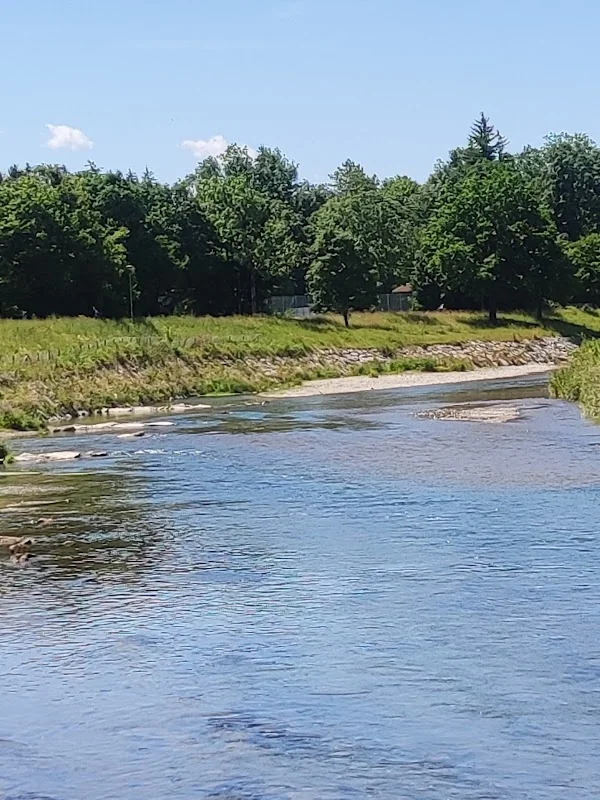
The Ammer is not only a picturesque river in Weilheim but also a body of water that must be taken very seriously in flood situations. The Bavarian Flood Reporting Service lists several flood markers for Weilheim that demonstrate the relevance of the bridge and the surrounding infrastructure. Already at 230 centimeters, the underpasses of the bike and footpath at the Ammer are flooded, and the barriers on Wessobrunner Straße are closed. At 510 centimeters, it is indicated for Weilheim that water reaches the underside of the bridge of St2057. These are very concrete data that show why the location is under the scrutiny of the city, water management, and traffic safety. ([hnd.bayern.de](https://www.hnd.bayern.de/pegel/naab_regen/weilheim-16613004/marken?utm_source=openai))
For readers, this means primarily: The bridge is not only located in a beautiful river landscape but in a hydrologically sensitive area. The city also points out in connection with the Ammer regulation that the upper Ammer is a wild river with typical dangers for boaters and bathers. Although this information mainly refers to the water section above Weilheim, it makes clear that the Ammer as a river should not be underestimated. In connection with the flood markers, a realistic picture of the location emerges: The Ammer Bridge is an important infrastructure structure whose location and use are always influenced by water levels and protective measures. ([weilheim.de](https://www.weilheim.de/mein-weilheim/auf-einen-blick/aktuelles-aus-weilheim/17138-regelungen-der-ammerverordnung-bei-kanufahrten-auf-der-ammer-beachten?utm_source=openai))
Especially for search queries like accident Ammer Bridge, flood Ammer Bridge, or safety at the Ammer, this classification is helpful. Serious information means here not to dramatize but to take the official threshold values and the city’s classification seriously. The bridge itself is a normal traffic and connection structure, but its location on a dynamic river requires attention. Therefore, those visiting the area should always keep an eye on the weather and water levels, especially when using paths along the banks or in lower-lying areas. This is a factual, practical, and very location-specific perspective on the Ammer Bridge. ([hnd.bayern.de](https://www.hnd.bayern.de/pegel/naab_regen/weilheim-16613004/marken?utm_source=openai))
History of the Weilheim Ammer Bridge
The history of the Ammer Bridge in Weilheim is closely linked to the traffic development of the city. The annual report 2008 of the city of Weilheim states that the reconstruction of the Ammer Bridge began in spring 2008 and was completed in the meantime. The State Building Authority Weilheim is named as the lead agency; the city was involved with connection work and street lighting. On November 4, 2008, the bridge was opened to traffic, and the next day the Lohgasse was opened, allowing traffic to flow as usual in time for Christmas. This information is particularly valuable for historical classification as it shows when the current bridge was put into operation and how closely municipal and state tasks collaborated. ([weilheim.de](https://www.weilheim.de/attachments/article/1763/Jahresbericht_2008.pdf))
The official city chronicle adds to this development with the brief but important note that the aging Weilheim Ammer Bridge was rebuilt. Combined with the annual report, a clear picture emerges: The bridge was not only repaired but renewed during a reconstruction to meet the demands of the traffic at that time. This also explains why it plays such a significant role in urban plans and traffic documents today. It is a reflection of a phase in which Weilheim modernized its infrastructure without losing the connection to the city center and the Ammer. ([weilheim.de](https://www.weilheim.de/mein-weilheim/auf-einen-blick/stadtgeschichte/chronik-juengere-geschichte?utm_source=openai))
This history is also important for local perception. Many people associate the Ammer Bridge with the transition between old and modern traffic space: on one side the developed city structure, on the other side a new, efficient crossing that facilitates everyday life. The fact that the bridge is firmly anchored in the traffic image of Weilheim is also evident in that it continues to appear in later city documents as a reference point for cycling, footpaths, traffic relief, and water level data. The bridge is thus not only a structure from 2008 but a permanent reference point in the urban memory and infrastructure planning. ([weilheim.de](https://www.weilheim.de/attachments/article/1763/Jahresbericht_2008.pdf))
Why the Ammer Bridge Remains Important for Weilheim
The significance of the Ammer Bridge is most evident in its function as a connection. It connects not only two banks but also traffic, everyday paths, and access to the old town. The city documents describe the old town as easily accessible on foot and by bike; for this, the Ammer Bridge is a central element. Additionally, Wessobrunner Straße has a high traffic load at this point, making it a significant part of the inner-city network. Therefore, the bridge is neither just a technical structure nor merely a background detail but a piece of urban mobility that is used daily and shapes the urban space. ([weilheim.de](https://www.weilheim.de/attachments/article/15237/34%20%C3%84nderungsplanung%20Begr%C3%BCndung%2008-2025%20.pdf?utm_source=openai))
Especially because Weilheim, as a district town and upper center, has a large catchment area, such crossings become particularly important. The city refers to its central location and good accessibility in the regional road network. From this perspective, the Ammer Bridge is a local bottleneck with very high everyday relevance: Those who drive, walk, or cycle here are usually not on a tourist route but on a very real path between living, working, shopping, and visiting the city center. This is exactly what makes the bridge so suitable for search engines, as the search intent is usually practical, concrete, and location-specific. ([weilheim.de](https://www.weilheim.de/touristinfo/uebernachtung-mobilitaet/lage-und-verkehrsanbindung?utm_source=openai))
In summary, the Ammer Bridge in Weilheim is a place where many themes come together: access, parking in the city, bike paths, footpaths, flooding, city history, and traffic. It is anchored in the city chronicle, measurable in the traffic network, described as a sensitive crossing in the cycling planning, and considered in flood protection through official markers. Therefore, those wanting to understand the bridge should not see it merely as a single roadway but as a hub between river, city, and mobility. This is where its lasting value for Weilheim in Upper Bavaria lies. ([weilheim.de](https://www.weilheim.de/mein-weilheim/auf-einen-blick/stadtgeschichte/chronik-juengere-geschichte?utm_source=openai))
Sources:
- City of Weilheim i.OB – Chronicle Recent History
- City of Weilheim i.OB – Annual Report 2008
- State Building Authority Weilheim – Traffic Study Relief Weilheim
- Bavarian Flood Reporting Service – Flood Markers Weilheim / Ammer
- City of Weilheim i.OB – Parking Spaces and Parking Garages
- City of Weilheim i.OB – Cycling Concept, Appendix 2 Fact Sheets
- City of Weilheim i.OB – Location and Traffic Connection
Show moreShow less
Ammer Bridge | Weilheim & Access
The Ammer Bridge in Weilheim in Upper Bavaria is not a classic excursion destination with a stage, seating plan, or ticket sales, but a functional crossing over the Ammer that shapes the local landscape. This is precisely why it is of interest for many search queries: Those searching for Ammer Bridge Weilheim, Wessobrunner Straße, St2057, access, parking, bike path, or flood want to find not just a point on the map but to understand how this place is embedded in the city. The official city chronicle notes that the aging Weilheim Ammer Bridge was rebuilt; the annual report 2008 states that construction began in spring 2008 and the traffic release was on November 4, 2008. Today, the bridge is part of the normal city life, part of the traffic network, and also part of the paths that connect Weilheim from the western side of the city to the old town. ([weilheim.de](https://www.weilheim.de/mein-weilheim/auf-einen-blick/stadtgeschichte/chronik-juengere-geschichte?utm_source=openai))
Access to the Ammer Bridge in Weilheim
Those approaching the Ammer Bridge are navigating the urban street network of Weilheim. The city describes Weilheim as a place between Munich and the Bavarian Alps with good regional accessibility; thus, the bridge is not an isolated structure on the edge but part of a developed city center and suburban structure. Particularly important is Wessobrunner Straße, where the bridge is located or which it follows as St 2057. A traffic study by the State Building Authority Weilheim shows a load of 13,300 vehicles per day on Wessobrunner Straße at the height of the Ammer Bridge, clearly indicating the significance of this crossing for local traffic. This makes the Ammer Bridge not just a river crossing but a fixed component of daily commuter, delivery, and resident traffic. ([weilheim.de](https://www.weilheim.de/touristinfo/uebernachtung-mobilitaet/lage-und-verkehrsanbindung?utm_source=openai))
This traffic situation also explains why the bridge appears in many contexts not as a mere sightseeing topic but as a practical reference point. Those coming from the west, south, or the city center use the bridge as a clear reference point in the network of paths. The city refers in various documents to the strong role of Wessobrunner Straße, and it is precisely there that the connection to the Ammer becomes visible. For keyword analysis, this means: At Ammer Bridge Weilheim, events or gastronomic offerings are not the focus, but questions about routes, road courses, traffic volume, and urban orientation. This is particularly valuable for search intent, as users want to understand very concretely how to reach the location and why it is so important in everyday life. ([stbawm.bayern.de](https://www.stbawm.bayern.de/mam/strassenbau/projekte/B17S.ABBA0009.00/2018_01_29_verkehrsuntersuchung_entlastung_weilheim_mg.pdf))
From an urban planning perspective, the location is also relevant. Weilheim describes itself as a historically grown city with a central location and a vibrant downtown. This means that the Ammer Bridge is not outside of an urban context but connects precisely those areas characterized by housing, commerce, everyday traffic, and short distances. In practice, this means that one does not view the bridge as a destination in the sense of a place to stay but as a clear reference point on the way through Weilheim. This combination of location, traffic reference, and proximity to the city center makes the Ammer Bridge a location that stands out in search engines, even though in real life it primarily plays a functional role. ([weilheim.de](https://www.weilheim.de/wirtschaft/einkaufsstadt-weilheim?utm_source=openai))
Parking around the Ammer Bridge
When it comes to the keyword parking, it is important to distinguish between the bridge itself and the entire city center area of Weilheim. No dedicated visitor parking is designated for the Ammer Bridge in official sources. Therefore, those wishing to explore the area are better off orienting themselves to the general parking options of the city. The city of Weilheim mentions more than 2000 centrally located parking spaces and refers to parking garages such as the Altstadt-Center and Am Öferl. Additionally, there is the option of mobile parking with EasyPark. This infrastructure shows that visitors to the city center can plan their routes well in connection with a short walk. The Ammer Bridge is understood in this context more as part of the city logistics than as a standalone parking location. ([weilheim.de](https://www.weilheim.de/touristinfo/uebernachtung-mobilitaet/stadtplaene-und-karten/parkplaetze-und-parkhaeuser-google-maps?utm_source=openai))
For searchers, this is a practical hint: Those aiming for the bridge, the Ammer banks, or the old town of Weilheim should take the city center parking as a starting point. The city’s parking overview lists, among other things, parking garages and centrally located spaces that are reachable in just a few minutes on foot to the pedestrian zone. This is also relevant for the Ammer Bridge, as it is located in an urban zone where short walks or bike rides should be considered as a matter of course. The visit can thus be conveniently combined with a city stroll without treating the structure itself as a separate destination with its own parking area. ([weilheim.de](https://www.weilheim.de/touristinfo/uebernachtung-mobilitaet/stadtplaene-und-karten/parkplaetze-und-parkhaeuser-google-maps?utm_source=openai))
From an SEO perspective, this fits very well with the frequent search queries regarding parking, access, and city center reference. Users usually want to know if they can easily reach the bridge, how close parking options are, and whether the area can also be explored well without a car. The official information from the city clearly supports this: Parking in Weilheim is geared towards visiting the city center, not an isolated bridge location. This is precisely why the Ammer Bridge is a good example of an urban crossing where mobility, short-term parking, and pedestrian paths belong together. ([weilheim.de](https://www.weilheim.de/touristinfo/uebernachtung-mobilitaet/stadtplaene-und-karten/parkplaetze-und-parkhaeuser-google-maps?utm_source=openai))
Bicycle and pedestrian paths over the Ammer
The Ammer Bridge is particularly interesting for cyclists and pedestrians because it explicitly appears as part of the pathways in urban development. In an urban planning document, it states that the old town is accessible by bike and on foot via the Ammer Bridge and two pedestrian bridges. This shows that the bridge is not just a traffic area for motorized traffic but also an important building block for short distances between residential areas, riverbanks, and the city center. For people traveling by bike or on foot to the old town, this connection is crucial. Thus, Weilheim does not think of the bridge in isolation but as a link between districts and the center. ([weilheim.de](https://www.weilheim.de/attachments/article/15237/34%20%C3%84nderungsplanung%20Begr%C3%BCndung%2008-2025%20.pdf?utm_source=openai))
The city’s cycling concept provides a particularly useful detail. It describes a bridge over the Ammer as a pedestrian and cyclist bridge; the current width is stated to be about 2.00 meters. At the same time, the concept notes that the bridge is too narrow and should be expanded to at least 2.50 meters in the long term to allow for better separation of walking and cycling paths. It also states that a new bridge is currently not feasible and would only be considered during a necessary overall renewal. These statements make it clear that the crossing is important for non-motorized traffic and simultaneously requires planning attention. ([weilheim.de](https://www.weilheim.de/attachments/article/11753/Radverkehrskonzept-Anlage_2-Steckbriefe.pdf?utm_source=openai))
In practice, this means that the Ammer Bridge and the surrounding paths are part of everyday mobility in Weilheim. They connect not only banks with banks but also functions of the city with each other. Those living, working, or shopping in the city center often use such crossings without consciously noticing them. This is precisely what makes the bridge so interesting for SEO: It is a place that people search for when they need a safe, direct, and preferably short connection to the old town or across the Ammer. The combination of footpath, bike path, and city center connection is therefore one of the strongest themes surrounding this location. ([weilheim.de](https://www.weilheim.de/attachments/article/15237/34%20%C3%84nderungsplanung%20Begr%C3%BCndung%2008-2025%20.pdf?utm_source=openai))
Flooding, Safety, and Location at the Ammer
The Ammer is not only a picturesque river in Weilheim but also a body of water that must be taken very seriously in flood situations. The Bavarian Flood Reporting Service lists several flood markers for Weilheim that demonstrate the relevance of the bridge and the surrounding infrastructure. Already at 230 centimeters, the underpasses of the bike and footpath at the Ammer are flooded, and the barriers on Wessobrunner Straße are closed. At 510 centimeters, it is indicated for Weilheim that water reaches the underside of the bridge of St2057. These are very concrete data that show why the location is under the scrutiny of the city, water management, and traffic safety. ([hnd.bayern.de](https://www.hnd.bayern.de/pegel/naab_regen/weilheim-16613004/marken?utm_source=openai))
For readers, this means primarily: The bridge is not only located in a beautiful river landscape but in a hydrologically sensitive area. The city also points out in connection with the Ammer regulation that the upper Ammer is a wild river with typical dangers for boaters and bathers. Although this information mainly refers to the water section above Weilheim, it makes clear that the Ammer as a river should not be underestimated. In connection with the flood markers, a realistic picture of the location emerges: The Ammer Bridge is an important infrastructure structure whose location and use are always influenced by water levels and protective measures. ([weilheim.de](https://www.weilheim.de/mein-weilheim/auf-einen-blick/aktuelles-aus-weilheim/17138-regelungen-der-ammerverordnung-bei-kanufahrten-auf-der-ammer-beachten?utm_source=openai))
Especially for search queries like accident Ammer Bridge, flood Ammer Bridge, or safety at the Ammer, this classification is helpful. Serious information means here not to dramatize but to take the official threshold values and the city’s classification seriously. The bridge itself is a normal traffic and connection structure, but its location on a dynamic river requires attention. Therefore, those visiting the area should always keep an eye on the weather and water levels, especially when using paths along the banks or in lower-lying areas. This is a factual, practical, and very location-specific perspective on the Ammer Bridge. ([hnd.bayern.de](https://www.hnd.bayern.de/pegel/naab_regen/weilheim-16613004/marken?utm_source=openai))
History of the Weilheim Ammer Bridge
The history of the Ammer Bridge in Weilheim is closely linked to the traffic development of the city. The annual report 2008 of the city of Weilheim states that the reconstruction of the Ammer Bridge began in spring 2008 and was completed in the meantime. The State Building Authority Weilheim is named as the lead agency; the city was involved with connection work and street lighting. On November 4, 2008, the bridge was opened to traffic, and the next day the Lohgasse was opened, allowing traffic to flow as usual in time for Christmas. This information is particularly valuable for historical classification as it shows when the current bridge was put into operation and how closely municipal and state tasks collaborated. ([weilheim.de](https://www.weilheim.de/attachments/article/1763/Jahresbericht_2008.pdf))
The official city chronicle adds to this development with the brief but important note that the aging Weilheim Ammer Bridge was rebuilt. Combined with the annual report, a clear picture emerges: The bridge was not only repaired but renewed during a reconstruction to meet the demands of the traffic at that time. This also explains why it plays such a significant role in urban plans and traffic documents today. It is a reflection of a phase in which Weilheim modernized its infrastructure without losing the connection to the city center and the Ammer. ([weilheim.de](https://www.weilheim.de/mein-weilheim/auf-einen-blick/stadtgeschichte/chronik-juengere-geschichte?utm_source=openai))
This history is also important for local perception. Many people associate the Ammer Bridge with the transition between old and modern traffic space: on one side the developed city structure, on the other side a new, efficient crossing that facilitates everyday life. The fact that the bridge is firmly anchored in the traffic image of Weilheim is also evident in that it continues to appear in later city documents as a reference point for cycling, footpaths, traffic relief, and water level data. The bridge is thus not only a structure from 2008 but a permanent reference point in the urban memory and infrastructure planning. ([weilheim.de](https://www.weilheim.de/attachments/article/1763/Jahresbericht_2008.pdf))
Why the Ammer Bridge Remains Important for Weilheim
The significance of the Ammer Bridge is most evident in its function as a connection. It connects not only two banks but also traffic, everyday paths, and access to the old town. The city documents describe the old town as easily accessible on foot and by bike; for this, the Ammer Bridge is a central element. Additionally, Wessobrunner Straße has a high traffic load at this point, making it a significant part of the inner-city network. Therefore, the bridge is neither just a technical structure nor merely a background detail but a piece of urban mobility that is used daily and shapes the urban space. ([weilheim.de](https://www.weilheim.de/attachments/article/15237/34%20%C3%84nderungsplanung%20Begr%C3%BCndung%2008-2025%20.pdf?utm_source=openai))
Especially because Weilheim, as a district town and upper center, has a large catchment area, such crossings become particularly important. The city refers to its central location and good accessibility in the regional road network. From this perspective, the Ammer Bridge is a local bottleneck with very high everyday relevance: Those who drive, walk, or cycle here are usually not on a tourist route but on a very real path between living, working, shopping, and visiting the city center. This is exactly what makes the bridge so suitable for search engines, as the search intent is usually practical, concrete, and location-specific. ([weilheim.de](https://www.weilheim.de/touristinfo/uebernachtung-mobilitaet/lage-und-verkehrsanbindung?utm_source=openai))
In summary, the Ammer Bridge in Weilheim is a place where many themes come together: access, parking in the city, bike paths, footpaths, flooding, city history, and traffic. It is anchored in the city chronicle, measurable in the traffic network, described as a sensitive crossing in the cycling planning, and considered in flood protection through official markers. Therefore, those wanting to understand the bridge should not see it merely as a single roadway but as a hub between river, city, and mobility. This is where its lasting value for Weilheim in Upper Bavaria lies. ([weilheim.de](https://www.weilheim.de/mein-weilheim/auf-einen-blick/stadtgeschichte/chronik-juengere-geschichte?utm_source=openai))
Sources:
- City of Weilheim i.OB – Chronicle Recent History
- City of Weilheim i.OB – Annual Report 2008
- State Building Authority Weilheim – Traffic Study Relief Weilheim
- Bavarian Flood Reporting Service – Flood Markers Weilheim / Ammer
- City of Weilheim i.OB – Parking Spaces and Parking Garages
- City of Weilheim i.OB – Cycling Concept, Appendix 2 Fact Sheets
- City of Weilheim i.OB – Location and Traffic Connection
Ammer Bridge | Weilheim & Access
The Ammer Bridge in Weilheim in Upper Bavaria is not a classic excursion destination with a stage, seating plan, or ticket sales, but a functional crossing over the Ammer that shapes the local landscape. This is precisely why it is of interest for many search queries: Those searching for Ammer Bridge Weilheim, Wessobrunner Straße, St2057, access, parking, bike path, or flood want to find not just a point on the map but to understand how this place is embedded in the city. The official city chronicle notes that the aging Weilheim Ammer Bridge was rebuilt; the annual report 2008 states that construction began in spring 2008 and the traffic release was on November 4, 2008. Today, the bridge is part of the normal city life, part of the traffic network, and also part of the paths that connect Weilheim from the western side of the city to the old town. ([weilheim.de](https://www.weilheim.de/mein-weilheim/auf-einen-blick/stadtgeschichte/chronik-juengere-geschichte?utm_source=openai))
Access to the Ammer Bridge in Weilheim
Those approaching the Ammer Bridge are navigating the urban street network of Weilheim. The city describes Weilheim as a place between Munich and the Bavarian Alps with good regional accessibility; thus, the bridge is not an isolated structure on the edge but part of a developed city center and suburban structure. Particularly important is Wessobrunner Straße, where the bridge is located or which it follows as St 2057. A traffic study by the State Building Authority Weilheim shows a load of 13,300 vehicles per day on Wessobrunner Straße at the height of the Ammer Bridge, clearly indicating the significance of this crossing for local traffic. This makes the Ammer Bridge not just a river crossing but a fixed component of daily commuter, delivery, and resident traffic. ([weilheim.de](https://www.weilheim.de/touristinfo/uebernachtung-mobilitaet/lage-und-verkehrsanbindung?utm_source=openai))
This traffic situation also explains why the bridge appears in many contexts not as a mere sightseeing topic but as a practical reference point. Those coming from the west, south, or the city center use the bridge as a clear reference point in the network of paths. The city refers in various documents to the strong role of Wessobrunner Straße, and it is precisely there that the connection to the Ammer becomes visible. For keyword analysis, this means: At Ammer Bridge Weilheim, events or gastronomic offerings are not the focus, but questions about routes, road courses, traffic volume, and urban orientation. This is particularly valuable for search intent, as users want to understand very concretely how to reach the location and why it is so important in everyday life. ([stbawm.bayern.de](https://www.stbawm.bayern.de/mam/strassenbau/projekte/B17S.ABBA0009.00/2018_01_29_verkehrsuntersuchung_entlastung_weilheim_mg.pdf))
From an urban planning perspective, the location is also relevant. Weilheim describes itself as a historically grown city with a central location and a vibrant downtown. This means that the Ammer Bridge is not outside of an urban context but connects precisely those areas characterized by housing, commerce, everyday traffic, and short distances. In practice, this means that one does not view the bridge as a destination in the sense of a place to stay but as a clear reference point on the way through Weilheim. This combination of location, traffic reference, and proximity to the city center makes the Ammer Bridge a location that stands out in search engines, even though in real life it primarily plays a functional role. ([weilheim.de](https://www.weilheim.de/wirtschaft/einkaufsstadt-weilheim?utm_source=openai))
Parking around the Ammer Bridge
When it comes to the keyword parking, it is important to distinguish between the bridge itself and the entire city center area of Weilheim. No dedicated visitor parking is designated for the Ammer Bridge in official sources. Therefore, those wishing to explore the area are better off orienting themselves to the general parking options of the city. The city of Weilheim mentions more than 2000 centrally located parking spaces and refers to parking garages such as the Altstadt-Center and Am Öferl. Additionally, there is the option of mobile parking with EasyPark. This infrastructure shows that visitors to the city center can plan their routes well in connection with a short walk. The Ammer Bridge is understood in this context more as part of the city logistics than as a standalone parking location. ([weilheim.de](https://www.weilheim.de/touristinfo/uebernachtung-mobilitaet/stadtplaene-und-karten/parkplaetze-und-parkhaeuser-google-maps?utm_source=openai))
For searchers, this is a practical hint: Those aiming for the bridge, the Ammer banks, or the old town of Weilheim should take the city center parking as a starting point. The city’s parking overview lists, among other things, parking garages and centrally located spaces that are reachable in just a few minutes on foot to the pedestrian zone. This is also relevant for the Ammer Bridge, as it is located in an urban zone where short walks or bike rides should be considered as a matter of course. The visit can thus be conveniently combined with a city stroll without treating the structure itself as a separate destination with its own parking area. ([weilheim.de](https://www.weilheim.de/touristinfo/uebernachtung-mobilitaet/stadtplaene-und-karten/parkplaetze-und-parkhaeuser-google-maps?utm_source=openai))
From an SEO perspective, this fits very well with the frequent search queries regarding parking, access, and city center reference. Users usually want to know if they can easily reach the bridge, how close parking options are, and whether the area can also be explored well without a car. The official information from the city clearly supports this: Parking in Weilheim is geared towards visiting the city center, not an isolated bridge location. This is precisely why the Ammer Bridge is a good example of an urban crossing where mobility, short-term parking, and pedestrian paths belong together. ([weilheim.de](https://www.weilheim.de/touristinfo/uebernachtung-mobilitaet/stadtplaene-und-karten/parkplaetze-und-parkhaeuser-google-maps?utm_source=openai))
Bicycle and pedestrian paths over the Ammer
The Ammer Bridge is particularly interesting for cyclists and pedestrians because it explicitly appears as part of the pathways in urban development. In an urban planning document, it states that the old town is accessible by bike and on foot via the Ammer Bridge and two pedestrian bridges. This shows that the bridge is not just a traffic area for motorized traffic but also an important building block for short distances between residential areas, riverbanks, and the city center. For people traveling by bike or on foot to the old town, this connection is crucial. Thus, Weilheim does not think of the bridge in isolation but as a link between districts and the center. ([weilheim.de](https://www.weilheim.de/attachments/article/15237/34%20%C3%84nderungsplanung%20Begr%C3%BCndung%2008-2025%20.pdf?utm_source=openai))
The city’s cycling concept provides a particularly useful detail. It describes a bridge over the Ammer as a pedestrian and cyclist bridge; the current width is stated to be about 2.00 meters. At the same time, the concept notes that the bridge is too narrow and should be expanded to at least 2.50 meters in the long term to allow for better separation of walking and cycling paths. It also states that a new bridge is currently not feasible and would only be considered during a necessary overall renewal. These statements make it clear that the crossing is important for non-motorized traffic and simultaneously requires planning attention. ([weilheim.de](https://www.weilheim.de/attachments/article/11753/Radverkehrskonzept-Anlage_2-Steckbriefe.pdf?utm_source=openai))
In practice, this means that the Ammer Bridge and the surrounding paths are part of everyday mobility in Weilheim. They connect not only banks with banks but also functions of the city with each other. Those living, working, or shopping in the city center often use such crossings without consciously noticing them. This is precisely what makes the bridge so interesting for SEO: It is a place that people search for when they need a safe, direct, and preferably short connection to the old town or across the Ammer. The combination of footpath, bike path, and city center connection is therefore one of the strongest themes surrounding this location. ([weilheim.de](https://www.weilheim.de/attachments/article/15237/34%20%C3%84nderungsplanung%20Begr%C3%BCndung%2008-2025%20.pdf?utm_source=openai))
Flooding, Safety, and Location at the Ammer
The Ammer is not only a picturesque river in Weilheim but also a body of water that must be taken very seriously in flood situations. The Bavarian Flood Reporting Service lists several flood markers for Weilheim that demonstrate the relevance of the bridge and the surrounding infrastructure. Already at 230 centimeters, the underpasses of the bike and footpath at the Ammer are flooded, and the barriers on Wessobrunner Straße are closed. At 510 centimeters, it is indicated for Weilheim that water reaches the underside of the bridge of St2057. These are very concrete data that show why the location is under the scrutiny of the city, water management, and traffic safety. ([hnd.bayern.de](https://www.hnd.bayern.de/pegel/naab_regen/weilheim-16613004/marken?utm_source=openai))
For readers, this means primarily: The bridge is not only located in a beautiful river landscape but in a hydrologically sensitive area. The city also points out in connection with the Ammer regulation that the upper Ammer is a wild river with typical dangers for boaters and bathers. Although this information mainly refers to the water section above Weilheim, it makes clear that the Ammer as a river should not be underestimated. In connection with the flood markers, a realistic picture of the location emerges: The Ammer Bridge is an important infrastructure structure whose location and use are always influenced by water levels and protective measures. ([weilheim.de](https://www.weilheim.de/mein-weilheim/auf-einen-blick/aktuelles-aus-weilheim/17138-regelungen-der-ammerverordnung-bei-kanufahrten-auf-der-ammer-beachten?utm_source=openai))
Especially for search queries like accident Ammer Bridge, flood Ammer Bridge, or safety at the Ammer, this classification is helpful. Serious information means here not to dramatize but to take the official threshold values and the city’s classification seriously. The bridge itself is a normal traffic and connection structure, but its location on a dynamic river requires attention. Therefore, those visiting the area should always keep an eye on the weather and water levels, especially when using paths along the banks or in lower-lying areas. This is a factual, practical, and very location-specific perspective on the Ammer Bridge. ([hnd.bayern.de](https://www.hnd.bayern.de/pegel/naab_regen/weilheim-16613004/marken?utm_source=openai))
History of the Weilheim Ammer Bridge
The history of the Ammer Bridge in Weilheim is closely linked to the traffic development of the city. The annual report 2008 of the city of Weilheim states that the reconstruction of the Ammer Bridge began in spring 2008 and was completed in the meantime. The State Building Authority Weilheim is named as the lead agency; the city was involved with connection work and street lighting. On November 4, 2008, the bridge was opened to traffic, and the next day the Lohgasse was opened, allowing traffic to flow as usual in time for Christmas. This information is particularly valuable for historical classification as it shows when the current bridge was put into operation and how closely municipal and state tasks collaborated. ([weilheim.de](https://www.weilheim.de/attachments/article/1763/Jahresbericht_2008.pdf))
The official city chronicle adds to this development with the brief but important note that the aging Weilheim Ammer Bridge was rebuilt. Combined with the annual report, a clear picture emerges: The bridge was not only repaired but renewed during a reconstruction to meet the demands of the traffic at that time. This also explains why it plays such a significant role in urban plans and traffic documents today. It is a reflection of a phase in which Weilheim modernized its infrastructure without losing the connection to the city center and the Ammer. ([weilheim.de](https://www.weilheim.de/mein-weilheim/auf-einen-blick/stadtgeschichte/chronik-juengere-geschichte?utm_source=openai))
This history is also important for local perception. Many people associate the Ammer Bridge with the transition between old and modern traffic space: on one side the developed city structure, on the other side a new, efficient crossing that facilitates everyday life. The fact that the bridge is firmly anchored in the traffic image of Weilheim is also evident in that it continues to appear in later city documents as a reference point for cycling, footpaths, traffic relief, and water level data. The bridge is thus not only a structure from 2008 but a permanent reference point in the urban memory and infrastructure planning. ([weilheim.de](https://www.weilheim.de/attachments/article/1763/Jahresbericht_2008.pdf))
Why the Ammer Bridge Remains Important for Weilheim
The significance of the Ammer Bridge is most evident in its function as a connection. It connects not only two banks but also traffic, everyday paths, and access to the old town. The city documents describe the old town as easily accessible on foot and by bike; for this, the Ammer Bridge is a central element. Additionally, Wessobrunner Straße has a high traffic load at this point, making it a significant part of the inner-city network. Therefore, the bridge is neither just a technical structure nor merely a background detail but a piece of urban mobility that is used daily and shapes the urban space. ([weilheim.de](https://www.weilheim.de/attachments/article/15237/34%20%C3%84nderungsplanung%20Begr%C3%BCndung%2008-2025%20.pdf?utm_source=openai))
Especially because Weilheim, as a district town and upper center, has a large catchment area, such crossings become particularly important. The city refers to its central location and good accessibility in the regional road network. From this perspective, the Ammer Bridge is a local bottleneck with very high everyday relevance: Those who drive, walk, or cycle here are usually not on a tourist route but on a very real path between living, working, shopping, and visiting the city center. This is exactly what makes the bridge so suitable for search engines, as the search intent is usually practical, concrete, and location-specific. ([weilheim.de](https://www.weilheim.de/touristinfo/uebernachtung-mobilitaet/lage-und-verkehrsanbindung?utm_source=openai))
In summary, the Ammer Bridge in Weilheim is a place where many themes come together: access, parking in the city, bike paths, footpaths, flooding, city history, and traffic. It is anchored in the city chronicle, measurable in the traffic network, described as a sensitive crossing in the cycling planning, and considered in flood protection through official markers. Therefore, those wanting to understand the bridge should not see it merely as a single roadway but as a hub between river, city, and mobility. This is where its lasting value for Weilheim in Upper Bavaria lies. ([weilheim.de](https://www.weilheim.de/mein-weilheim/auf-einen-blick/stadtgeschichte/chronik-juengere-geschichte?utm_source=openai))
Sources:
- City of Weilheim i.OB – Chronicle Recent History
- City of Weilheim i.OB – Annual Report 2008
- State Building Authority Weilheim – Traffic Study Relief Weilheim
- Bavarian Flood Reporting Service – Flood Markers Weilheim / Ammer
- City of Weilheim i.OB – Parking Spaces and Parking Garages
- City of Weilheim i.OB – Cycling Concept, Appendix 2 Fact Sheets
- City of Weilheim i.OB – Location and Traffic Connection
Frequently Asked Questions
Reviews
No reviews found