Student Life at Lake Ammersee: Partying & Celebrating on a Budget
Student Life at Lake Ammersee 2026/2027: Partying on a Budget, Going Out & Planning Events
Are you studying in the region or commuting to Lake Ammersee and want to celebrate affordably in the coming semesters (Summer 2026 to Spring 2027)? This guide is focused on future evenings and upcoming plans: from spontaneous beer garden meetups to larger semester parties – with budget levers, capacity checks, and organizational tips.
For whom: Students, student councils, university groups, shared flats, project teams, and circles of friends around Herrsching, Stegen/Inning, Utting, Dießen, and the surrounding area.
Why Lake Ammersee is Worth Partying at in 2026/2027 (Even on a Small Budget)
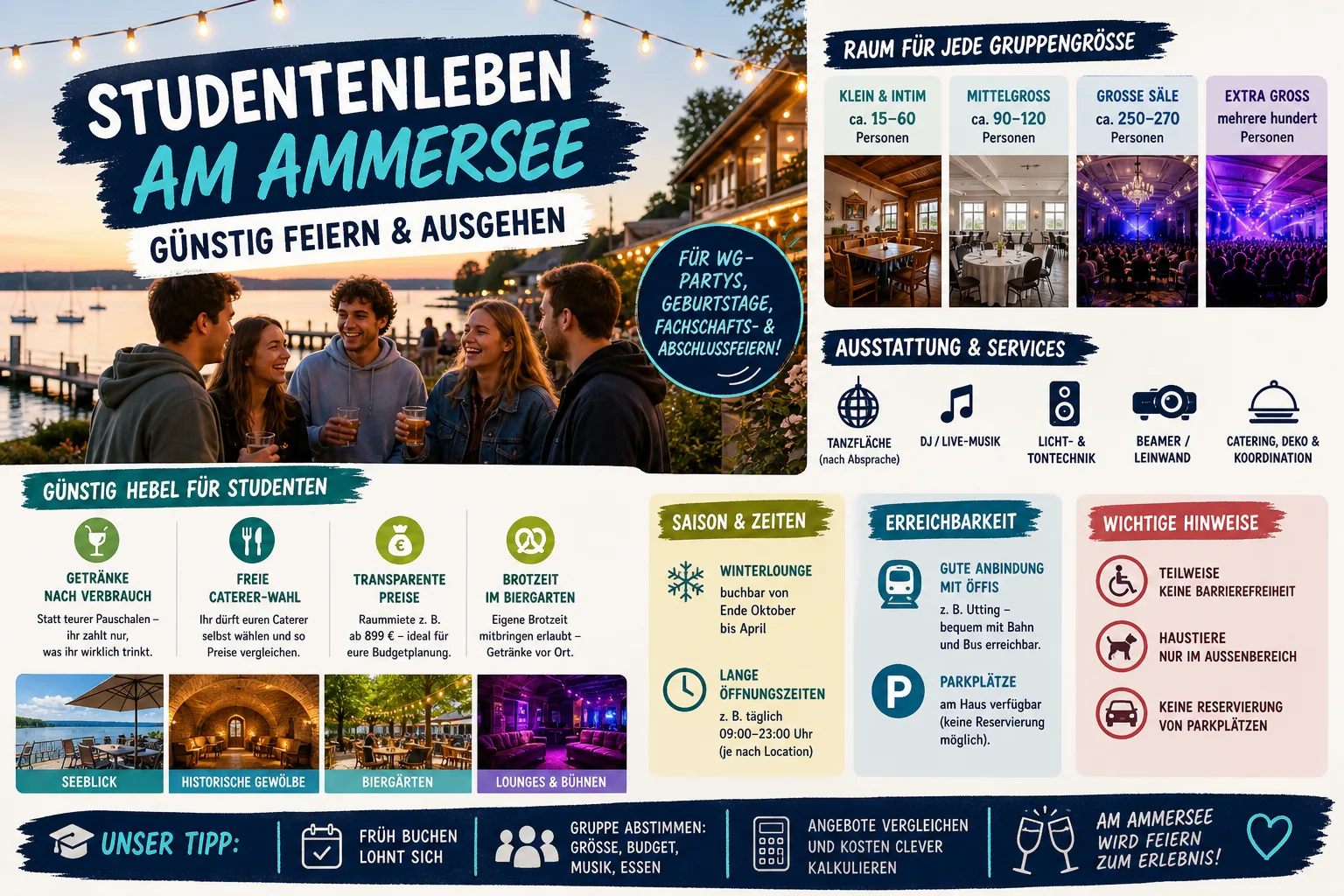
The combination of lakeside, good public transport connections on the Munich–Ammersee axis, and many inns with separate side rooms makes the region attractive for student formats. For the next period (upcoming semesters), two cost-saving approaches are particularly relevant:
- Room instead of large event: A separable side room or a small lounge can be cheaper and easier to plan for birthdays, semester starts, or team wrap-ups than large venues.
- Beer garden principle: In classic Bavarian beer gardens, it is customary for guests to bring their own snacks while drinks are purchased on site – ideal for an affordable get-together after lectures or a study day.
Event Ideas for Upcoming Semesters (Summer 2026 to Spring 2027)
Summer & Late Summer 2026: Start Outdoors, End Indoors
- Beer Garden Meetup (Low Budget): Each person brings a small item (e.g., bread, spread, salad); drinks are bought on site. Afterwards, a group walk to the lakeshore – no extra admission.
- Sunset "Semester Start Light": Early start (e.g., from late afternoon) so commuters can get home easily. Optional: Afterwards, a short "after-drink" in a nearby bar – only for those who want to.
- Open-Air Quiz (small group): Two teams, small prizes (e.g., snacks). Costs remain minimal, fun factor high.
Planning tip: For outdoor evenings in the coming months, always plan a bad weather alternative (e.g., early reserved side room) – so the weather risk doesn’t become a budget risk.
Autumn 2026: Side Rooms, Clubhouses & "Bring-a-Plate" Parties
- Shared Flat Birthday in a Side Room: Instead of your own apartment (noise, space, neighbors), a separated room in an inn is suitable – often with clear minimum spend instead of expensive flat rates.
- "Bring-a-Plate" Evening: Each person brings a dish (vegan/vegetarian possible); drinks are billed by consumption. Good for international student groups.
- Karaoke or Game Night (with tech check): Clarify in advance whether beamer/screen or audio is possible – otherwise it gets more expensive due to external equipment.
Winter 2026/2027: Warm, Plannable, Commuter-Friendly
- Year-End for University Group: Early start, binding end time so the last train/bus can be reached.
- Small Winter Get-together Instead of Big Party: Smaller groups lower costs (room, decor, food) and reduce organizational effort.
- Charity Format with Clear Purpose: If you collect donations: communicate transparently what for (e.g., defined organization/project), and document income/expenses internally.
Spring 2027: Graduation Parties & "Pre-Exam" Time-Outs
- Project Completion/Team Evening: Short program (e.g., 30-minute presentation), then a relaxed part. This often makes it easier to justify and structure a room.
- "Pre-Exam" Evening Without Escalation: Focus on food, conversations, possibly non-alcoholic specials – affordable and you can study the next day.
Realistically Assessing Capacities: How to Avoid Cost Traps
For upcoming events: Group size determines room type, minimum spend, and effort. Use this practical classification:
- 15–40 people: Side room/lounge – often the cheapest option with a "living room feel".
- 60–120 people: Larger guest rooms – suitable for student council evenings, semester starts, mixed groups.
- 150–270 people: Hall/cultural room – only recommended if there is an organizing team, entry and return travel plan.
Rule of thumb for reservations: Plan with a moderate reserve (about 10–20% above the expected number). At the same time: If commitments are uncertain, better to start small and expand with good feedback, rather than paying for a too-large room that stays "empty" at high cost.
Budget Levers for 2026/2027: How to Keep the Evening Affordable
1) Drinks by Consumption Instead of Fixed Flat Rate
For student groups, "by consumption" can be the fairer option – especially if not everyone stays the same length or if some drink non-alcoholic. When making inquiries, ask specifically about:
- Billing per drink vs. flat rate per person
- Minimum spend (and whether it is realistically achievable)
- Whether water/soft drinks are available as a cheap base
2) Keep Food Flexible: Snacks, Bring-Your-Own Concept or Simple Buffet
Food is often what gets expensive, not the room. For the coming semesters, these work particularly well:
- Beer garden with brought snacks (drinks on site)
- Potluck buffet (clearly label allergens, e.g., by list)
- Simple buffet with clear portioning instead of menu
Important: If you bring food, clarify in advance whether this is allowed at the chosen location (beer garden tradition does not automatically apply everywhere, especially not indoors).
3) Cost Control Through Clear Agreements
- Document in writing: What is included (room, equipment, service), what costs extra (setup, cleaning, security)?
- Fixed time slots: Define start/end – avoids unplanned extra hours.
- Plan cash flow: If you charge entry/contribution: clear cash box, clear responsibility, transparent accounting.
Technology, Atmosphere & Process: Making the Event Work
For many future student formats, "solid standard equipment" is enough. Before spending money, check these basics:
- Sound: Is there a system or do you have to bring your own?
- Volume rules: What limits apply (indoors/outdoors), and until when?
- Layout: Where is a dance floor possible, where does it stay quiet (conversation corner)?
- Program: A short official part (welcome, quiz, karaoke) increases structure and reduces "idle costs".
Arrival, Safety & Responsibility (for Upcoming Evenings)
Especially at the lake, the return journey is a central part of planning. For upcoming events, it is recommended:
- Public transport plan: Check the last connections in advance and include them in the invitation (with buffer).
- Carpooling: If cars are necessary: clear coordination so no one gets "stuck".
- Safer-event basics: Contact person in the organizing team, respectful interaction, clear options for getting home.
- Accessibility check: Clarify in advance whether access, toilets, and paths are suitable for all participants.
Conclusion: Partying Affordably at Lake Ammersee in the Next Semesters – Without Losing the Vibe
For Summer 2026 to Spring 2027: With the right group size, a flexible food strategy (beer garden/snacks or bring-your-own concept), and transparent billing, it’s possible to celebrate affordably at Lake Ammersee even as a student. The key is to plan early, consider return travel and rules, and structure the evening so it works for everyone – whether it’s a shared flat, student council, or project team.