Social Projects at Lake Ammersee: Initiatives That Make a Difference
Social Projects & Initiatives That Will Shape the Ammersee in the Future: Dates, Participation Formats, and Guidance for 2026/2027
Around Lake Ammersee, new opportunities are constantly emerging where neighborhood assistance, mobility, family offerings, nature, and community welfare projects come together. This article looks exclusively ahead: at upcoming actions, calls for applications, information evenings, and participation formats as typically announced by municipalities, associations, social organizations, and educational venues in the region.
The goal is practical guidance: Where are new projects announced, which formats are suitable for locals and guests, and how can engagement be planned so that it realistically fits into everyday life.
How to Find Upcoming Dates: The Most Reliable Announcement Places
If you want to specifically participate in future projects at Lake Ammersee, the most important step is: to know the right channels for announcements. In practice, new actions and participation formats are often published through a few recurring sources.
1) Municipalities & Municipal Platforms
- Municipal websites (sections such as “Social Affairs,” “Citizen Engagement,” “Official Announcements,” “Events”)
- Municipal newsletters (print/PDF) with calls for volunteers, driving services, citizen participation
- Social guides or “Help & Advice” overviews (often with contact points and office hours for new offerings)
2) Associations, Welfare Organizations, and Local Providers
- Newsletters and notices about introductory evenings, trainings, and participation dates
- Social media channels with short-term calls (e.g., for escort services, collection campaigns, helper lists)
3) Funding Programs & Calls for Participation
New meeting places (e.g., activity areas, inclusive leisure offerings, village community rooms) are often prepared in the region through funding logic: first the idea, then the application, then participation, then implementation. If you want to get involved early, look out for notices about citizen workshops, planning rounds, or public presentations.
Neighborhood Assistance 2026/2027: Getting Started via Info Evenings & Short Assignments
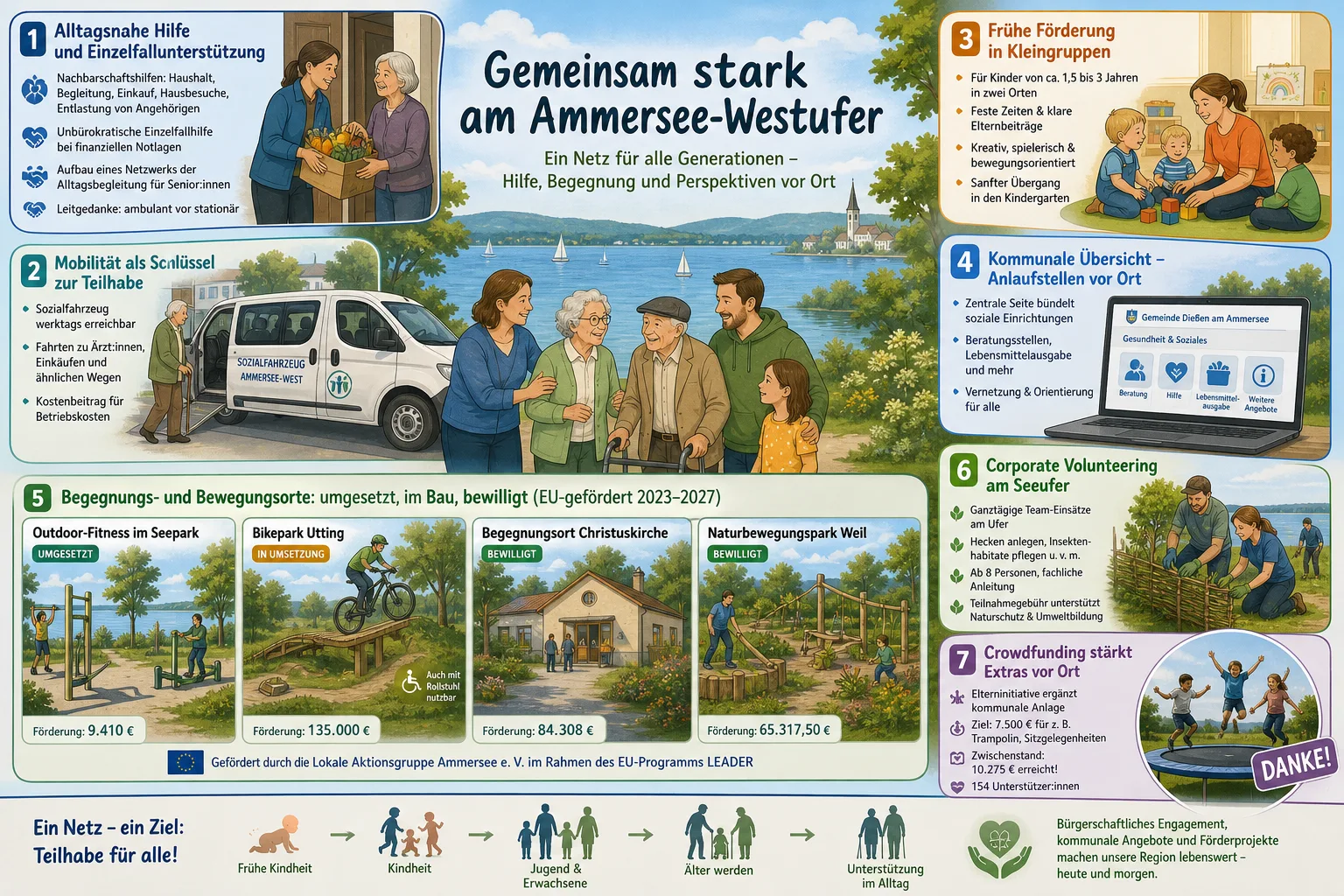
Future neighborhood and everyday assistance projects at Lake Ammersee can often be supported without long lead times. Many initiatives regularly plan info evenings or introductory dates so that new helpers can join with low barriers.
Participation Formats You Can Expect in the Coming Months
- Visiting services (e.g., fixed visiting windows, walks, conversation offers)
- Accompaniment to appointments (official errands, doctor visits, therapy or rehab trips with accompaniment)
- Shopping and errand assistance (planned tours, shopping communities, pick-up and delivery services)
- Relief for family caregivers (hourly support by arrangement)
Especially relevant for the future: Many providers are increasingly focusing on clear role profiles (time commitment, requirements, insurance coverage) and short basic trainings to ensure that volunteering remains reliable and safe.
Mobile & Involved: Future Driving Service Trainings and Ride-Sharing Models
Mobility remains a key issue for participation at Lake Ammersee. For 2026/2027, similar formats are particularly likely in many regions: driving service teams (voluntary or mixed), ride-sharing exchanges for individual occasions, and coordinated accompaniment to appointments.
Typical Upcoming Components (and What They Mean)
- Driver trainings: Introduction to procedures, data protection, dealing with people with limited mobility.
- Coordination office hours: Times when rides are planned, needs are recorded, and deployment schedules are created.
- Cost contributions: Often transparently regulated so that operating costs remain understandable and social hardships can be cushioned.
If you want to get involved in the future, it is worth looking at the calls for applications from providers: They are often looking not only for drivers, but also for people for telephone shifts, route planning, or accompanying roles without driving responsibility.
Early Support: Registration Starts, Parent Evenings, and Open Trial Dates
For families, the coming months are often characterized by registration deadlines and planning windows: Toddler groups, playgroup-like formats, and small-scale care offerings often publish new places bundled at certain times.
Which Upcoming Dates Are Particularly Relevant?
- Parent evenings with concept presentation (group size, care times, settling-in, cost structure)
- Trial or introductory days before registrations become binding
- Information windows for settling-in so that families can realistically plan the start
In terms of content, many future offerings will continue to focus on everyday support, movement, creative routines, and nature experiences. At the same time, the importance of planning security for parents is growing (reliable times, clear communication, fixed contacts).
New Meeting and Activity Places: Openings, Participation Workshops, Test Days
In the coming quarters, three types of events are particularly decisive for projects around play, activity, and meeting spaces: participation (ideas are collected), testing (prototypes/trial setups), and commissioning (openings, action days, briefings).
How to Recognize That Something New Is “Getting Moving”
- Invitation to citizen workshops (e.g., “What is missing in the community?”, “Which equipment is inclusively usable?”)
- Announcement of test days (activity equipment, course elements, play modules)
- Notices of opening programs (sports and family activities, club presentations, open trainings)
For future projects, it is worth taking a close look at inclusion: Good concepts make usability visible (pathways, access, signage, rest areas) and involve those affected at an early stage.
Nature Conservation with Team Spirit: Upcoming Corporate Volunteering Days & Open Action Days
Team days in nature and educational projects are also expected to play an important role in 2026/2027, as they combine two goals: concrete maintenance work (e.g., on habitats) and environmental education with tangible benefits for the region.
Which Types of Actions Are Particularly Likely in the Future?
- Maintenance assignments (paths, biotope structures, shrub clearance under guidance)
- Structural measures for biodiversity (e.g., hedge and border structures, nesting aids, insect habitats)
- Educational modules for teams and family groups (introduction to habitats, water and shore protection)
If you would like to participate in the future, look out for information on guidance, safety rules, insurance coverage, and suitable clothing. Reputable providers communicate this clearly in advance and rely on professional support.
Crowdfunding & Citizen Participation: How to Spot New Campaigns Early
Citizen-funded additions (e.g., extra seating, play and activity modules, low-barrier elements) are expected to become even more important in the future, as they can specifically improve projects “beyond the minimum.”
How to Find Upcoming Campaigns Before They Get Big
- Subscribe to municipal newsletters and follow local associations/initiatives.
- Look out for public donation calls in the context of square or park projects (often linked to participation workshops).
- Check whether a campaign is transparent: purpose, budget logic, schedule, responsible persons, updates.
For 2026/2027, a good standard is: Campaigns that build trust show early on what is being funded specifically, who is responsible, and how implementation will be documented (e.g., with progress reports).
Checklist: How to Plan Meaningful Engagement at Lake Ammersee
- Choose a time frame: one-off (action day), seasonal (multiple dates), or regular (e.g., weekly).
- Clarify the role: accompaniment, organization, driving service, manual help, public relations.
- Ask about framework conditions: contact person, insurance, data protection, briefing.
- Check accessibility: Is the offer also suitable for beginners? Are there low-barrier participation options?
- Document your capacity: fixed days, preferred times, maximum assignments per month.
- Stay informed: regularly check newsletters, municipal calendars, association announcements.
Sources & Background
The following sources provide reliable background on volunteering, citizen participation, rural development funding, and quality aspects (e.g., transparency, organization, framework conditions). They serve as guidance for classifying future projects and announcements.
- European Commission: Rural development (CAP) — Overview of rural development and program logic (accessed 2026-09-23)
- German Networking Agency for Rural Areas (DVS) — Information on LEADER and regional development (accessed 2026-09-23)
- BMFSFJ: Engagement and Society — Basics and framework conditions for civic engagement (accessed 2026-09-23)
- Data Protection Conference (DSK) — Guidance on data protection requirements in German-speaking countries (accessed 2026-09-23)