Cultural Education and Discourse at Lake Ammersee
Cultural Education & Societal Discourse at Lake Ammersee: Outlook on Upcoming Formats and Events
This article looks ahead: Which cultural education formats and occasions for discourse will be particularly in demand at Lake Ammersee in the future, how can they be planned – and how can people in the region get involved in the coming months and years?
Why the Next Years at Lake Ammersee Will Be Decisive
In the coming years, questions that already shape everyday life elsewhere will also become more pressing around Lake Ammersee: How can cultural participation succeed outside major cities? How can initiatives remain stable beyond individual seasons? And how can events simultaneously be places of encounter, engagement, and shared learning?
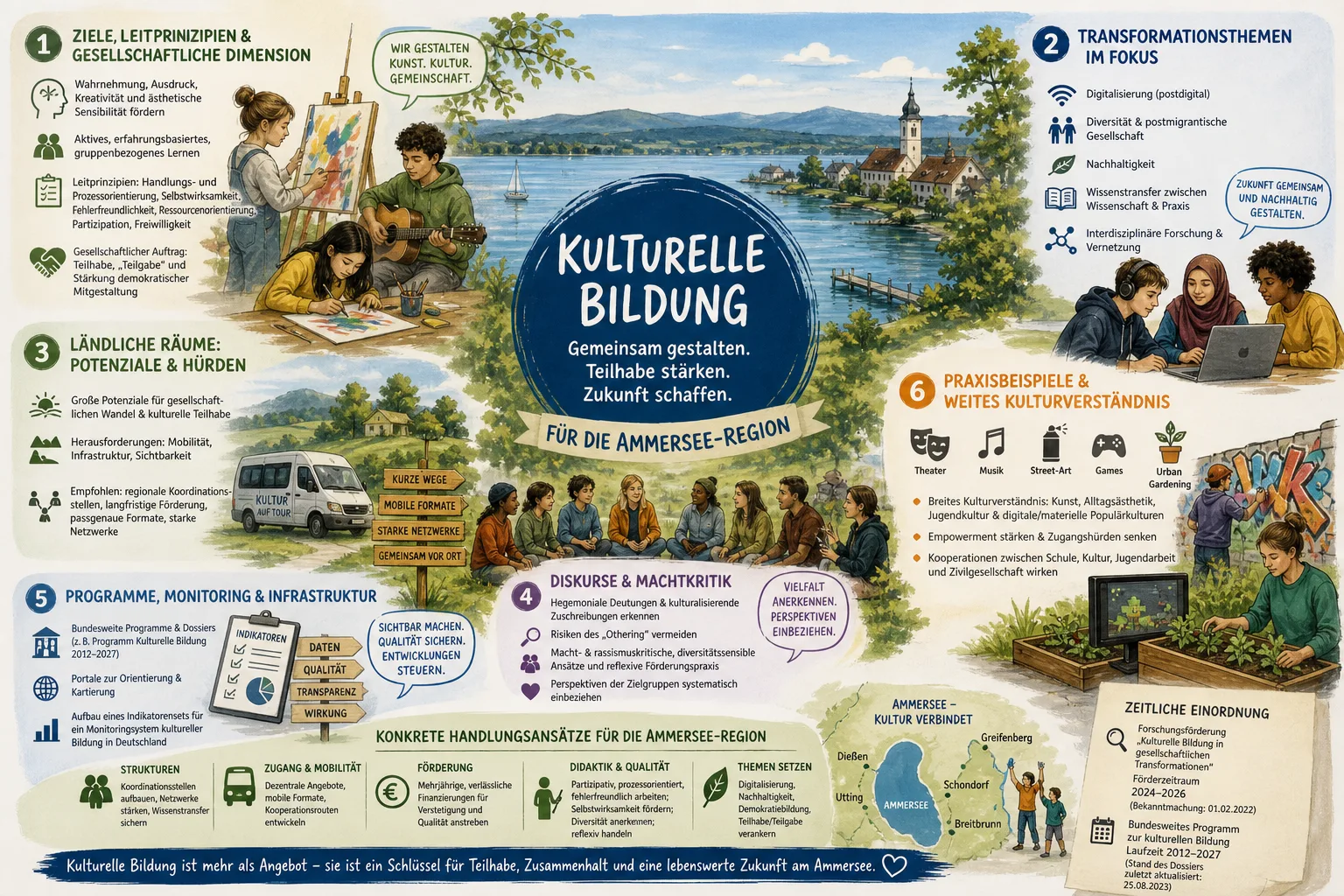
Lake Ammersee can serve as a resonance space for this in the future: Cultural formats that people not only “consume” but co-create will likely gain in importance – as will moderated discussion formats that make sustainability, digitalization, diversity, and democracy tangible on a local level rather than negotiating them in the abstract.
Upcoming Season: Which Event Formats Are Particularly Sustainable
For the next event phase in the region, formats that offer low-threshold entry, enable cooperation, and build relationships over several dates are promising. Particularly sustainable are likely to be:
- Serial workshops (e.g., 4–8 sessions): continuous, binding, with visible learning progress.
- Hybrid cultural evenings: In-person events with an additional digital participation option, so that people with mobility or time barriers can also join.
- Discourse formats following performances: short, clearly moderated discussions that strengthen conflict skills and enable perspective shifts.
- Pop-up studios and mobile formats: Cultural offerings that “travel” to people (decentralized meeting points) instead of only using central locations.
- Intergenerational projects: Teams of young people, adults, and seniors who produce together (audio, stage, image, text).
For all formats, the following applies: In the coming months, not only the end product will count, but the quality of the process – for example, through good support, clear participant rights, transparent communication, and reliable contactability.
Goals of Cultural Education in Future Events
Cultural education offerings in the coming years will be effective if they achieve more than just a “cultural program.” The following goal axes are suitable for planning future events at Lake Ammersee:
- Self-efficacy: Participants should be able to make decisions and influence outcomes (choice of topics, roles, presentation form).
- Participation: Co-determination is structurally enabled (e.g., joint rules, co-moderation, open stage segments).
- Error-friendliness: Rehearsals, drafts, and detours are made visible as part of the learning process, not hidden.
- Resource orientation: Interests and strengths are central; access is offered in diverse ways (linguistically, temporally, financially, spatially).
- Democratic practice: Listening, reasoned dissent, dealing with conflicts, and diversity of perspectives are practiced within the event itself.
If these goals are anchored from the outset in upcoming series, the chances increase that projects at Lake Ammersee will not remain episodic but will have a lasting impact.
Future Topics for Upcoming Events: Digitalization, Sustainability, Diversity
1) Digitalization as Cultural Practice (Thinking Post-Digitally)
For future cultural events, it will be crucial not to pit digital and analog experiences against each other. In the coming years, formats that understand digital tools as part of everyday life will prevail: such as collaborative audio formats, interactive exhibitions, or media workshops where technical competence is linked with questions of publicness and responsibility.
2) Sustainability as Sensory Experience and Discourse
Future event series can link ecological questions with artistic methods without slipping into pure instruction. Promising are projects that combine observation, creation, and conversation (e.g., artistic mappings, audio walks, material and upcycling labs) and leave room for ambivalence.
3) Diversity and Belonging as Design Principles
For future cultural offerings at Lake Ammersee, diversity will be credible when it is visible in teams, program design, and communication. This works particularly well when organizers consistently plan with different social milieus, age groups, and life realities – and when barriers (time, place, cost, language, access codes) are considered early on.
Societal Discourse in Upcoming Series: Open, Moderated, Power-Sensitive
In the coming years, it will not be enough to talk “about” societal topics. Discourse formats will be sustainable if they set clear framework conditions: respectful interaction, understandable moderation, protection from devaluation – and at the same time real controversy.
For future events at Lake Ammersee, a discourse culture is recommended that combines three elements:
- Power sensitivity: Who gets to speak, who is interrupted, whose perspectives are considered “normal”? These questions belong in the planning.
- Transparency: The goals of the conversation, rules, and roles (moderation, inputs, audience) are clearly communicated in advance.
- Error-friendliness: Willingness to learn is expected – from participants as well as organizers; criticism is treated as part of the process.
This way, upcoming discussion series will not become “echo chambers,” but places where people remain connected even when they disagree.
Planning Upcoming Events: What Should Be Prepared Now
To ensure that future cultural and educational formats can reliably take place at Lake Ammersee, the next planning cycles should secure some basics:
- Establish cooperation early: Schools, clubs, youth work, libraries, the independent scene, and municipalities should jointly schedule future series and share resources.
- Consider mobility: Decentralized event locations, coordinated times, and well-explained travel options increase participation.
- Remove barriers: Clear information (also in simple language), family-friendly times, transparent costs, and alternative ways to participate.
- Ensure quality: Training, supervision, and peer counseling for future project work strengthen sustainability.
- Make impact visible: For upcoming series, goals, target groups, learning and discourse objectives should be defined in advance and reflected upon after implementation.
If these factors are consistently considered in the next program planning, the chances increase for long-term, recurring formats that strengthen social cohesion at Lake Ammersee.
How People at Lake Ammersee Can Participate in and Help Shape Future Cultural Offerings
In the coming months, cultural participation will be particularly successful when people are not only “invited” but given room to shape things. Those who want to get involved in the future can specifically look for formats that:
- offer multiple entry points (trial sessions, open rehearsals, participation stations),
- visibly enable co-creation (co-curation, audience contributions, open stages),
- have clear communication channels (contact, procedure, rules, accessibility).
For the region, it is especially important: Even small-scale, recurring offerings can be more effective in the future than individual major events, because they build relationships and trust.