Flea Markets Ammersee: Dates, Locations & Flea Market Tips
Flea Markets at Lake Ammersee (from June 2026): Formats, Locations, Planning & Rules
Status: June 3, 2026 (Europe/Berlin)
Around Lake Ammersee, flea market days turn entire towns into open bazaars: from classic markets on a fixed site to decentralized garden and garage flea markets, where sales stands are spread across private properties. This overview helps you sensibly plan upcoming flea market dates in the region, understand typical procedures, and prepare well—whether as a visitor or as a seller.
Which flea market formats you can expect at Lake Ammersee in the future
In the Ammersee region, two formats are especially relevant, which differ significantly in process and organization:
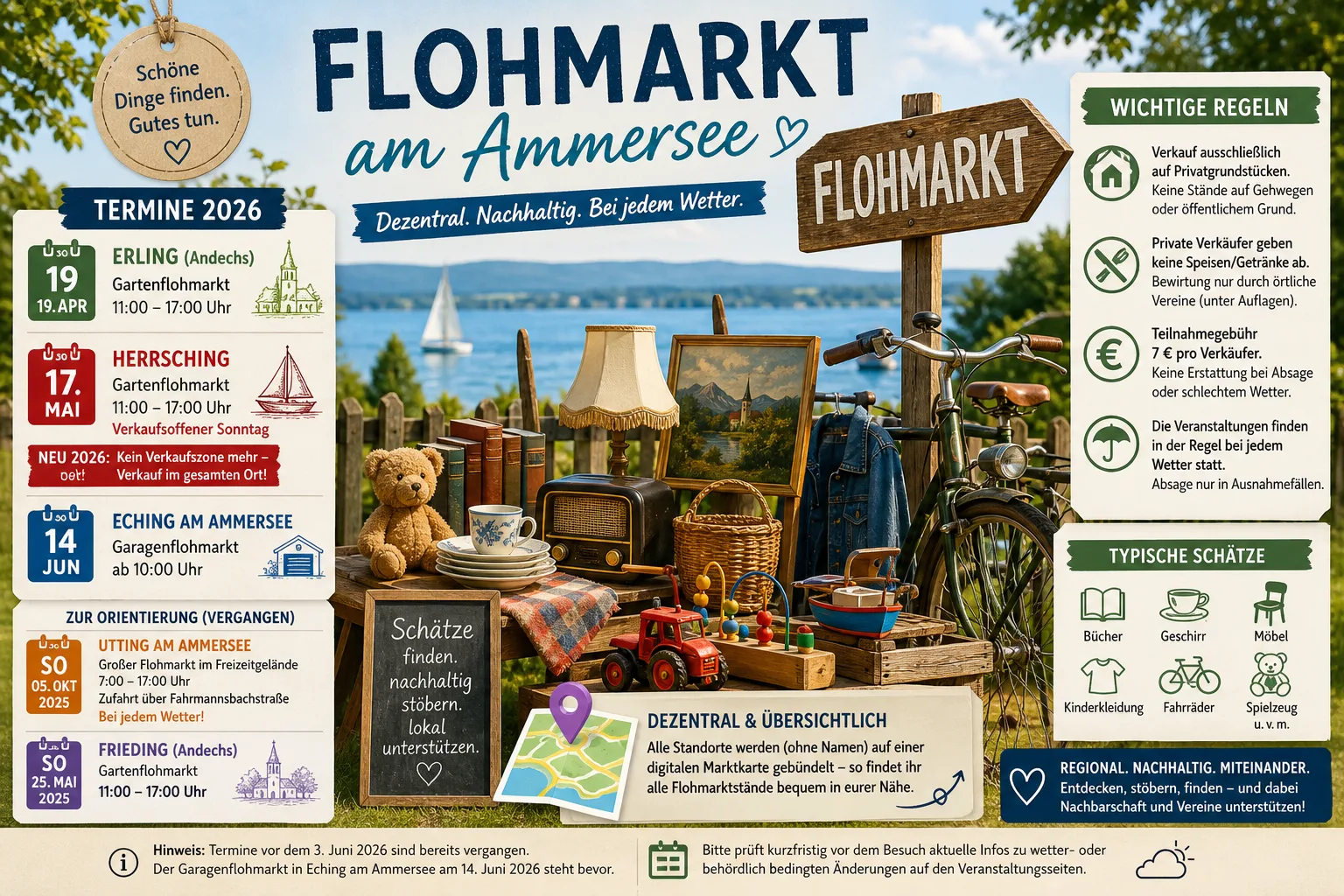
- Decentralized garden and garage flea markets: The town becomes a flea market zone. Stands are set up in gardens, driveways, garages, or courtyards. Visitors usually use a digital map or a stand plan and walk (or cycle) from address to address.
- Classic flea markets on a site: All stands are located on a central area (e.g., recreation ground, parking lot, or event meadow). Setup and routes are more regulated, and there is often gastronomy or infrastructure nearby.
Both variants are easy to plan—but preparation differs: while central markets are often associated with earlier start times and arrival/parking, decentralized markets depend on route, time window, and consideration in residential areas.
Dates & Locations from June 2026: How to find reliable announcements
For upcoming flea market events in the Ammersee region: Dates may change—depending on the municipality, organizer, weather conditions, or permits. Therefore, always rely on the official announcements shortly before each event for concrete dates and start times.
Recommended checklist before you set off
- Check official event page or notice: Date, time, location/zone, rules (private property, parking, setup times).
- Open digital market map/stand plan: For decentralized markets, this is the most important “entrance” to the event.
- Clarify arrival: Public transport/Ammersee railway, bicycle, or parking options at the edge of the zone (keep residential streets clear).
- Observe weather & notices on the event day: Especially in case of wind/rain (secure goods, umbrellas, tarpaulins).
Places where you will frequently find flea market days in the future
Around Lake Ammersee, these places are particularly known for recurring flea market formats. Whether and when a specific event takes place depends on the respective organizers and official publications:
- Herrsching am Ammersee: Decentralized garden flea market formats (town-wide, with map/stand plan).
- Erling (Andechs): Local flea market days with stands in courtyards and driveways (often organized as a “village flea market”).
- Eching am Ammersee: Garage flea market formats, where many households participate in parallel.
- Utting am Ammersee: Classic markets on a central site are particularly popular as an excursion destination in the region.
Typical time windows (guideline): Decentralized markets often start in the late morning and end in the afternoon; central site flea markets often begin earlier. However, the respective event announcement is always binding.
Rules & Organization: What is important at upcoming flea market days
Private property instead of sidewalk: Safety and consideration
For decentralized flea markets, one basic principle is especially widespread for upcoming events: Sales take place on private property (garden, driveway, garage, courtyard). This keeps sidewalks, roadways, and driveways clear—a key point for traffic safety, accessibility, and emergency routes. Follow the requirements of the respective municipality/organization, as these may vary by location.
Participation fee, market map, and visibility
Many organizers work with a participation fee that covers typical organizational costs (communication, map/stand plan, printing/posters, coordination, possibly permits). For decentralized markets, the digital market map is central: It shows where stands are located so visitors can plan their route. When registering, make sure that address and stand information are correct (e.g., “in the courtyard,” “garage on the left”), if the organization allows such details.
Food & drinks: Why private serving is often restricted
Whether private sellers are allowed to serve food or drinks depends on the event rules and legal framework. Private catering is often prohibited or heavily restricted because specific hygiene requirements apply to food and responsibility/liability must be clearly defined. In many places, clubs or professional providers take over catering (e.g., coffee/cake) as part of the event.
Weather & execution
For future flea market dates: Some events are planned “in (almost) any weather,” but severe weather, safety requirements, or official decisions can cause short-term changes. On the day of the event, check the official channels of the organizers (website, notice, social media) before you travel.
Typical flea market treasures you can expect around Lake Ammersee
Especially at garden and garage flea markets, the selection is often strongly shaped by the everyday life of households. Typical finds you will often see at upcoming dates in the region:
- Books & media: Novels, children's books, illustrated books, CDs, DVDs, occasionally vinyl.
- Household & crockery: Glasses, cups, cutlery, kitchen helpers, decorations—ideal for single pieces or starter sets.
- Furniture & living: Small furniture, lamps, mirrors, picture frames (plan for transport).
- Children & family: Clothing, toys, balance bikes, board games—often seasonally appropriate.
- Sports & outdoor: Bicycle accessories, helmets, inline skates, hiking equipment (carefully check condition).
One advantage of decentralized formats: You often buy directly from the people who used the items. This makes it easier to ask about condition, origin, and accessories.
Practical tips for upcoming flea market days (visitors & sellers)
Tips for visitors
- Plan your route in advance: For decentralized markets, a planned round saves time and distance.
- Choose the right way to get there: If possible, use public transport or bicycle—residential streets and driveways should remain clear.
- Bring cash in small bills: Card payment is often not available.
- Pack a bag/carrying aid: Cloth bag, backpack, or small trolley for books and crockery.
- Bargain fairly: Ask politely, suggest bundle prices, but don't put private households “under pressure.”
Tips for sellers
- Read the event rules thoroughly: Private property, times, signage, parking rules, waste/leftover goods.
- Present clearly: Set up tables stably, sort small items in boxes, make price tags clearly visible.
- Think about safety: Keep paths clear, avoid tripping hazards, secure/tie down goods in case of wind.
- Prepare for payment: Change, simple price list, possibly receipt book (if desired).
- Finish sustainably: Pack up leftovers in time and pass them on sensibly (donate/give away/secondhand).
Sources & further information
- Regulation (EC) No. 852/2004 on food hygiene — EU legal basis for food hygiene requirements (retrieved on 2026-06-03)
- Food Hygiene Regulation (LMHV) — German legal framework for food hygiene (retrieved on 2026-06-03)
- Trade Regulation Act (GewO) — General regulations on trade law; relevance may vary depending on event and sales situation (retrieved on 2026-06-03)
Note: Specific rules (e.g., areas, times, fees, parking concept, catering) are set separately for each flea market. The respective event conditions and municipal requirements are always decisive.