Experience modern architecture at Lake Ammersee with wooden facades
Modern architecture at Lake Ammersee: Which building ideas could shape the coming years
How could the view of Lake Ammersee change if, in the coming years, more wooden facades, gentle densification, and climate-conscious planned neighborhoods are implemented near the lake? This outlook summarizes design and planning trends that are expected to gain importance by the end of the 2020s.
Classification: Why Lake Ammersee is likely facing a new construction phase
Around Lake Ammersee, modern architecture is likely to continue developing in the coming years, especially where three factors come together: high usage pressure (housing, second homes, tourism), limited space, and increasing demands for climate and resource protection. This may lead to new projects in the future needing to be legitimized more strongly through choice of materials, ensemble quality, mobility concepts, and integration into local images.
This article therefore does not describe individual, already realized objects, but rather a forward-looking trend and criteria catalog: Which architectural solutions could prevail at Lake Ammersee if municipalities, planners, and builders take the next steps toward densification and sustainability?
Trend 1: Wooden facades as a "boathouse motif" – more modern, durable, verifiable
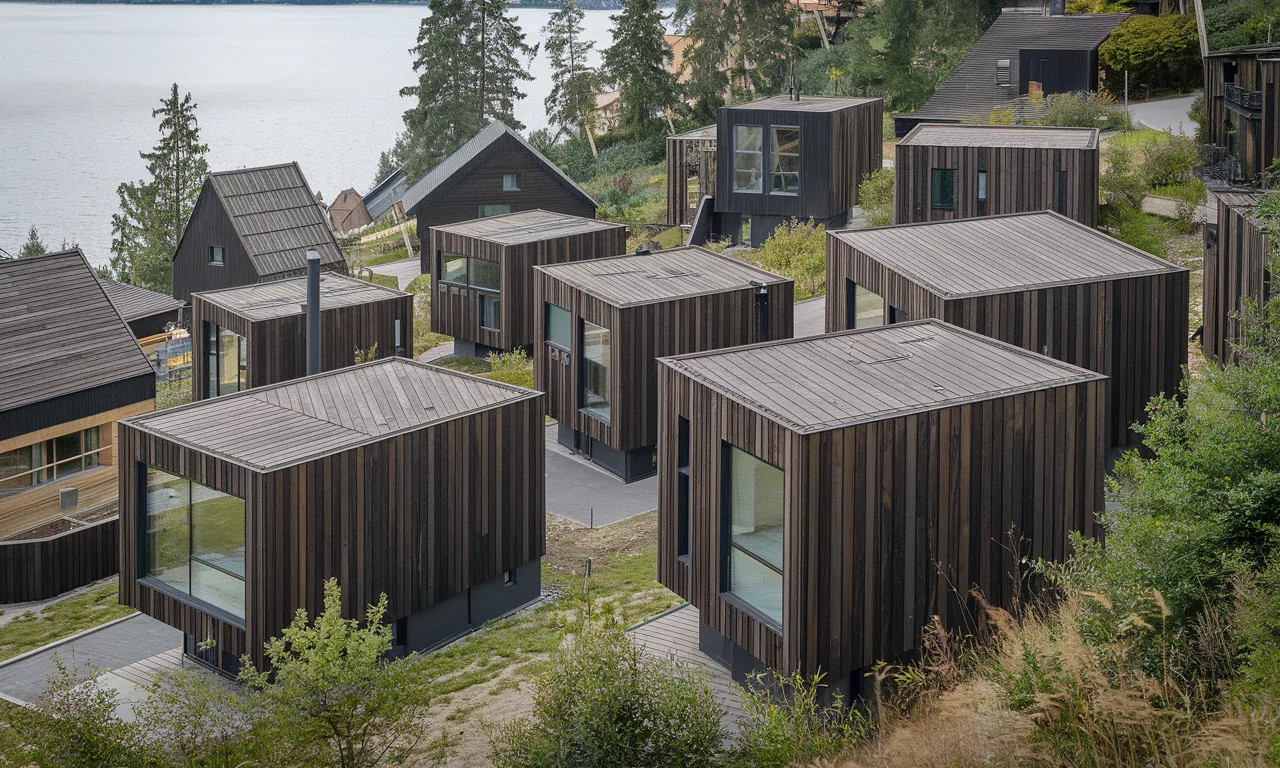
Vertical wooden structures and finely structured facades could continue to be among the most defining images of modern architecture at the lake in the coming years. The reason is not just aesthetics: Wood can (with professional planning) provide good conditions for CO₂-reduced construction, prefabrication, and later dismantling.
What is likely to become more important in the future
- Durability & maintenance: Constructive wood protection, rear ventilation, splash water zones, and the replaceability of individual elements will likely become more important than mere "wooden look".
- Material honesty: Visible wood (instead of mere appearance) could be considered a quality feature if origin, treatment, and fire/sound protection are transparently documented.
- Light & shadow: Vertical slats and open joints can visually structure future buildings without being loud—a benefit for sensitive lake and village edges.
Trend 2: Cube or gabled roof – probably the dialogue will become more important than the either-or
In many Bavarian lakeside towns, modern architecture will likely continue to move in a field of tension: clear, cubic volumes (often with large openings) on the one hand and contemporary interpretations of gabled roofs on the other. In the future, the decisive factor is likely to be less the "style question" than the integration into topography, neighborhood, and local image.
What could intensify into the late 2020s
- Restrained roof shapes: More gently sloping gabled roofs, precise eaves details, and reduced overhangs could be used to reference regional typologies without becoming historicizing.
- Gradations instead of dominance: Staggering, setbacks, and differentiated facade surfaces could be used more frequently to balance lake views, lighting, and privacy in dense contexts.
- Windows as landscape instruments: Large-format glazing will likely need to be considered more in conjunction with summer heat protection, shading, and bird protection.
Trend 3: Neighborhoods near the lake – densification will only be accepted with ensemble and open space quality
If additional housing units are planned near the shore in the coming years, acceptance will likely depend heavily on whether a project works as an ensemble: that is, whether buildings, paths, green spaces, rainwater management, recreational areas, and mobility are designed as a coherent system.
Elements that are likely to become standard in modern neighborhood planning
- Typology mix: Several housing forms (e.g., compact apartments, family-friendly units, barrier-free layouts) could help support social diversity and suitability for different life phases.
- Quiet mobility: Good pedestrian and bicycle connections, bicycle storage rooms, sharing offers, and charging options can reduce parking pressure—provided they are practically usable and safely planned.
- Open space as a climate and recreational factor: Shade trees, permeable surfaces, retention areas, and well-proportioned courtyards could be decisive so that densification is not perceived as a loss.
Trend 4: Topography & lake view – in the future more controlled by rules, sightlines, and microclimate
The landscape quality at Lake Ammersee arises not only from individual buildings but from distances, view corridors, and the alternation of buildings and vegetation. In future projects, it will therefore be more about securing sightlines while at the same time minimizing overheating, heavy rainfall, and soil sealing.
Planning principles with high probability
- Staggered buildings: Sloped sites will likely be solved more often with terraced volumes so that buildings appear less massive and outdoor spaces remain usable.
- Rainwater on site: Swales, infiltration trenches, green roofs, and retention can become standard building blocks in the future to buffer heavy rainfall events.
- Summer heat protection: Shading, thermal mass, night ventilation, and reduced glass areas on unfavorable facades could be prioritized more strongly.
Trend 5: Sustainable constructions – timber and hybrid construction with verifiable performance
"Sustainable" will probably function less as a buzzword in the coming years and more as a verifiable property: Life cycle assessment, material passports, dismantlability, and energy indicators are likely to play a greater role in new projects—also due to regulatory developments and increasing sensitivity to operating costs.
What could prevail in practice
- Hybrid construction: Combinations of wood (e.g., ceilings/walls) and mineral components (e.g., base/stairwell zones) could be used to balance statics, sound insulation, and robustness.
- Prefabrication: Shorter construction times and better controllable execution quality could make prefabrication more attractive—especially in sensitive locations with limited construction site logistics.
- Technology with moderation: Heat pumps, PV, storage, efficient ventilation, and monitoring will likely be integrated more often—but ideally in such a way that maintenance, costs, and user-friendliness are considered.
Trend 6: Holiday and secondary uses – in the future more regulated and architecturally integrated
Temporary uses (holiday apartments, small apartment buildings, retreat and studio houses) could continue to play a role in the future—at the same time, the pressure is likely to increase to manage such uses so that they do not overload town centers, rental markets, and infrastructures. Architecturally, this could result in a stronger tendency to plan compact, well-insulated, and suitable for year-round use typologies that clearly fit into the surroundings in terms of scale and materiality.
For guests, this could mean: less "show architecture", more everyday suitability—with good accessibility without a car, robust materials, and outdoor spaces that enable a landscape experience without overusing shore areas.
Decision aid: How to recognize "good" modern architecture at Lake Ammersee in the future
- Compatibility with the local image: Scale, roofscape, materiality, and open space references work together—without disguise or theatricality.
- Climate resilience: Concepts for heat, heavy rainfall, and shading are clearly integrated, not retrofitted.
- Verifiable sustainability: Indicators, material origin, and operational energy are documented and plausible.
- Quiet mobility: Everyday life without a car is possible (safe paths, bicycle infrastructure, proximity to public transport, sharing/charging).
- Ensemble instead of solitary: Buildings are arranged in meaningful outdoor spaces; privacy and publicness are clearly resolved spatially.